
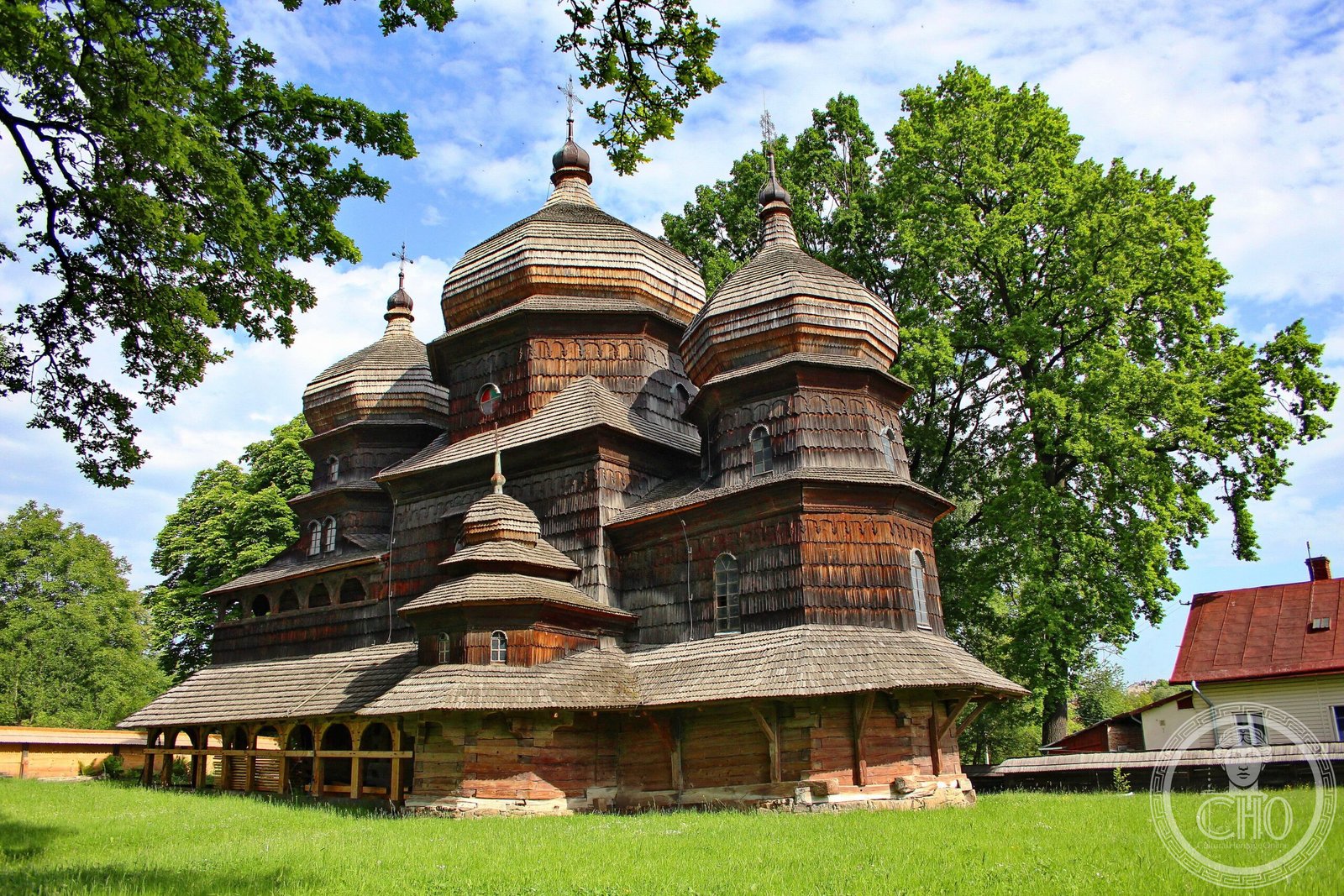
One of Galicia’s finest timber churches, this 15th-century wooden structure represents the pinnacle of Ukrainian sacral architecture, meticulously preserved and shaped by master architect Hryhoriy Tesla.
At a glance
St. George’s Church stands as one of the oldest and best preserved timber churches in the Galician region. Built in the 15th century and refined through multiple rebuildings, the church exemplifies the distinctive wooden architecture of late medieval Ukraine. Its three-part composition—nave, double apse, and narthex—creates a harmonious spatial arrangement characteristic of the period.
History
Constructed during the 15th century, the church underwent significant transformation across subsequent generations. Between 1678 and 1711, a major renovation campaign fundamentally enhanced its character. The interior received elaborate frescoes, octagonal structures were built up, and a new belfry was constructed.
The church’s final architectural form came through the vision of talented Ukrainian architect Hryhoriy Tesla of Drohobych, whose interventions helped establish it as a monument of regional significance.
What you see
The church’s design reflects a sophisticated understanding of timber construction. Three distinct parts comprise the structure: a square central block containing the nave, flanked by sections housing the double apse and narthex. This tripartite arrangement was refined during the late 17th and early 18th-century renovations.
Octagonal wooden forms rise prominently, while the belfry crowns the composition. Interior frescoes from the 1678–1711 renovation campaign survive, offering glimpses of the spiritual decoration that once filled the sacred space.
Cultural significance
The church represents one of the finest surviving examples of ancient Ukrainian sacral architecture and Galician wooden building traditions. Its preservation allows scholars and visitors to understand medieval timber construction techniques and religious spatial concepts.
St. George’s Church is one of 16 churches designated as a UNESCO World Heritage Site under the collective name Wooden Tserkvas of the Carpathian Region in Poland and Ukraine—recognition of its irreplaceable cultural value.
Key facts
- Country: Ukraine
- City: Drohobych
- Period: 15th–16th century, with major renovations 1678–1711
- Coordinates: 49.3478° N, 23.4994° E
- UNESCO: Part of Wooden Tserkvas of the Carpathian Region (World Heritage Site)
- Museum affiliation: Wooden architecture department, Museum of Drohobych Region
Practical information & getting there
The church is integrated into the Museum of Drohobych Region’s wooden architecture department. Drohobych is located in western Ukraine in the Lviv Oblast. For current visiting hours, accessibility details, and guided tour availability, contact the museum directly or consult its official website.
Sources & resources
Find it on the map
See this place and what’s around it →📷 Become a Cultural Heritage Online photographer
Share your photos of places: they stay published under your name as the author. The more they're seen, the more you get noticed — and soon a contest will reward the most appreciated photos.
Log in or sign up free to add a photoIs this page about you?
This page is read by travellers and heritage enthusiasts who find it on Google. Tell us how you are connected to this place and we will take it from there.