

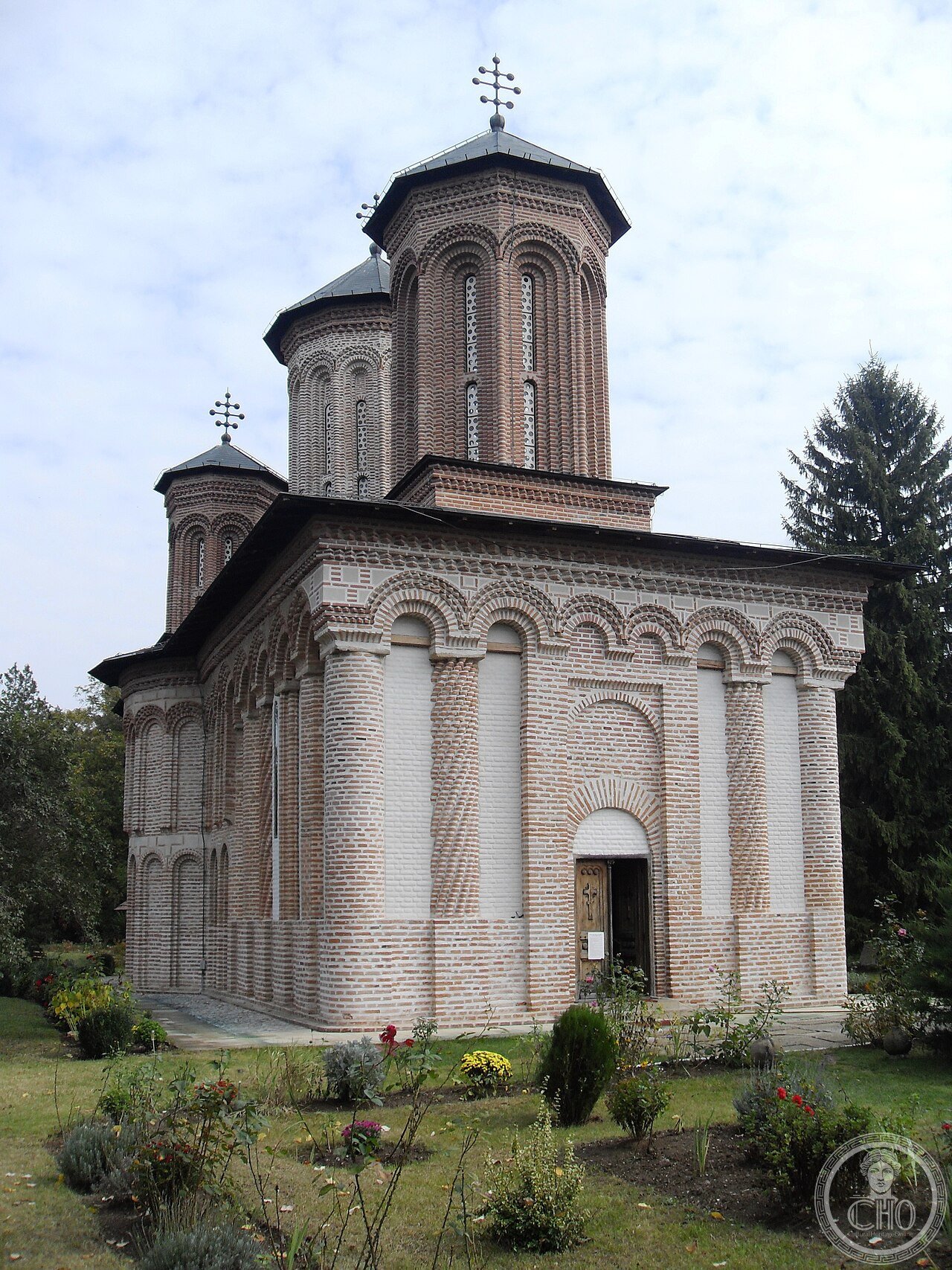
Snagov Monastery stands on an island in the lake of the same name, north of Bucharest, and is first documented in 1408. It was among the last foundations of Prince Mircea the Elder, on a site once held by a wooden monastic community of the 11th century, destroyed by fire. Around 1456, by order of Vlad III the Impaler (Dracula), the island was fortified with walls, a bridge to the mainland and a prison. Popular tradition holds that Vlad lies buried here, beheaded in battle, his head sent to the Ottoman sultan as a trophy. But when archaeologists opened the grave marked before the altar, in 1933, they found no body at all, only animal bones. A headless body dressed in purple, a colour reserved for rulers, was found instead on the south side of the church, together with a ring and a buckle traceable to the father of Vlad: a hint that the body had been moved there, perhaps during the rebuilding of the church forty years after his death. Historians such as Constantin Rezachevici have cast doubt on the whole tradition, arguing that the very idea that Vlad founded the monastery, and therefore lay buried in it, is a 17th-century invention with no historical ground.
About Snagov Monastery
Snagov Monastery, a medieval monastery located on an island in the northern reaches of Lake Snagov in Ilfov County, southern Romania, is probably one of the later foundations of Prince Mircea the Elder, first documented in 1408. The site’s history stretches back further still, to an earlier wooden monastic community dating to the 11th century that was destroyed by fire; the monastery was subsequently rebuilt several times under successive rulers, including Vlad Țepeș (Vlad the Impaler), Mircea Ciobanul, and Neagoe Basarab. Around the year 1456, on the orders of Vlad III, a prison was constructed on the island alongside defensive walls and a bridge connecting it to the mainland, giving the monastery a genuine documented association with the notorious ruler independent of any burial claim. After an earlier stone church was destroyed by an earthquake, the present church was erected by Neagoe Basarab in 1521 and underwent major renovations under Mircea Ciobanul in the mid-16th century; its walls were painted in 1563 by the artist Dobromir the Young during the reign of Petru Șchiopul. The monastery’s most famous — and most contested — claim is that Vlad the Impaler is buried within its grounds. According to popular legend, after Vlad’s death, rival aristocratic families denied him a proper Christian burial, and the monks of Snagov are said to have secretly recovered and buried his body without ceremony. When archaeologists excavated the grave traditionally marked as his, positioned before the altar, in 1933, they found no human remains at all — only animal bones. However, a headless skeleton dressed in purple cloth, a colour reserved for royalty, was discovered separately near the church’s south side, accompanied by a ring and belt buckle that could be traced to Vlad’s father, suggesting his body may have been relocated there, possibly during the church’s reconstruction roughly forty years after his death. The tradition has, however, been directly challenged by scholars: a 2002 study by historian Constantin Rezachevici of the Nicolae Iorga Institute of History argued that the entire claim rests on a fabricated 17th-century tradition asserting that Vlad himself founded the monastery — a claim Rezachevici demonstrates to be historically false, undermining the very basis for assuming his burial there.
Key facts
- 11th century: earlier wooden monastic community on the site, destroyed by fire.
- 1408: monastery first documented, likely founded by Mircea the Elder.
- c. 1456: Vlad III fortifies the island with a prison, walls, and bridge.
- 1521: present church built by Neagoe Basarab after an earthquake.
- 1563: church walls painted by Dobromir the Young.
- 1933: excavation of Vlad’s traditional grave finds no human remains.
- 2002: historian Constantin Rezachevici challenges the entire burial tradition as fabricated.
History
Vlad III’s documented use of Snagov’s island as a fortified prison in the mid-15th century gives the monastery a genuine historical connection to the ruler independent of the far more contested burial legend, reflecting the strategic value medieval Wallachian rulers placed on the island’s naturally defensible, water-surrounded position. The monastery’s subsequent role as a pan-Orthodox printing and cultural centre under Matei Basarab in the 17th century, including the establishment of a printing press in 1643, situates Snagov within the broader flourishing of Wallachian religious and intellectual life well beyond its association with Vlad.
The unresolved tension between the popular Dracula-tomb legend and the scholarly case against Vlad’s actual burial at Snagov exemplifies a recurring pattern at sites connected to famous historical figures, where a compelling but poorly evidenced tradition persists in popular culture and tourism long after historians have raised serious doubts about its factual basis — a genuine open question rather than a settled fact.
What you see
The present church, built by Neagoe Basarab in 1521 in Byzantine style with Romanian decorative elements and exposed brick exterior detailing, stands on the island amid the remains of the monastery’s fortified walls and the site of Vlad III’s 15th-century prison. Inside, 1563 wall paintings by Dobromir the Young accompany the traditionally marked but archaeologically empty grave associated with Vlad the Impaler, near the altar.
Practical information
- Opening hours: generally open daily with seasonal variation; check current hours before visiting.
- Address: Strada Mânăstirea Vlad Țepeș, Snagov, Ilfov County, Romania.
Getting there
Snagov Monastery sits on an island in Lake Snagov, roughly 40 kilometres north of Bucharest, reachable by car and a short boat crossing to the island. GPS: 44.7297° N, 26.1757° E.
Nearby
- Snagov Palace — former royal residence on the lake, nearby.
- Lake Snagov — the surrounding lake and recreational area.
- Bucharest — Romania’s capital, roughly 40 km to the south.
Sources
- Wikipedia — “Snagov Monastery” (en.wikipedia.org).
- Rolandia — “Snagov Monastery – the Burial Place of Vlad the Impaler” (rolandia.eu).
- The Jerusalem Post — “Has the real grave of Dracula been found” (jpost.com).
Find it on the map
See this place and what’s around it →📷 Become a Cultural Heritage Online photographer
Share your photos of places: they stay published under your name as the author. The more they're seen, the more you get noticed — and soon a contest will reward the most appreciated photos.
Log in or sign up free to add a photo