
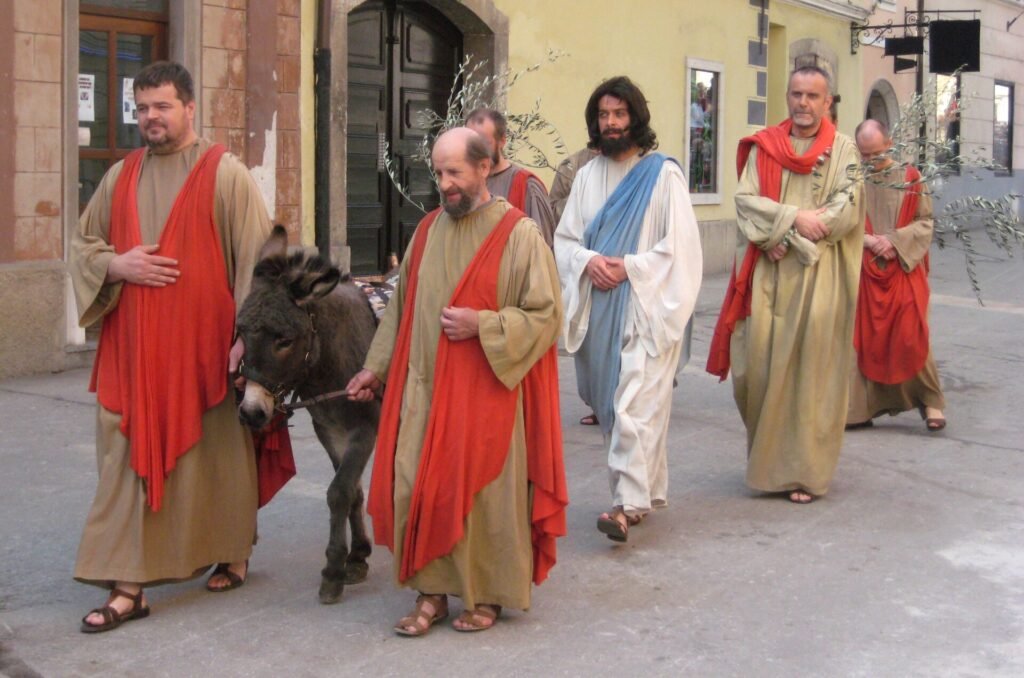
A baroque dramatic retelling of Christ’s Passion in 869 verses, performed by hundreds of amateur actors in open-air tableaux across Škofja Loka every quarter-century.
At a glance
The Škofja Loka Passion Play is Slovenia’s oldest dramatic work and the world’s oldest preserved director’s manual. Written in 1715 by Capuchin friar Father Romuald, it unfolds across thirteen tableaux in 869 lines of old Škofja Loka dialect, narrating scenes from the life of Jesus. Today, revivals draw around 640 volunteer performers and feature among Europe’s largest open-air theatrical productions.
Origins & history
Father Romuald (Lovrenc Marusič, 1676–1748) composed the play at Škofja Loka’s Capuchin monastery, drawing on earlier penitential procession traditions and refining the text through 1727. The work belongs to the baroque era and represents a unique survival—its original director’s book remains the oldest known in the world. From 1715 until 1751, the Passion was staged annually on Good Friday. After nearly three centuries of silence, it returned to performance in 1936 as an exhibition piece, then was fully revived in 1999, with subsequent productions in 2000, 2009, and 2015.
The practice
The play divides into thirteen biblical tableaux, expanded to twenty scenes in modern stagings. Performers—both male and female amateurs—move through the town’s streets in procession, enacting encounters with Christ from arrest to resurrection. Eighty horsemen ride among the cast, lending grandeur and movement to open-air performances that transform Škofja Loka’s public spaces into a living stage. The text is sung and spoken in the archaic local dialect, creating an immersive linguistic and visual experience that draws thousands of spectators.
Cultural significance
This work embodies Slovene identity and baroque devotional practice. Its survival as the oldest Slovene dramatic text and oldest preserved medieval and early-modern director’s manual makes it a cornerstone of European theatre history. The play demonstrates how rural communities sustain sacred performance across centuries, and its modern revivals affirm the power of volunteer-led cultural memory in the digital age. In 2008 it was registered as intangible cultural heritage in Slovenia.
Key facts
- Written by Father Romuald (Lovrenc Marusič) in 1715, refined until 1727
- 869 verses in old Škofja Loka dialect, arranged in 13 tableaux
- Oldest preserved director’s book in the world
- Performed annually on Good Friday until 1751; revived in 1999, 2000, 2009, 2015, with next performance scheduled for 2026
- Modern productions feature approximately 640 amateur actors and 80 horsemen
- Manuscript held by Škofja Loka monastery
- UNESCO Intangible Cultural Heritage reference: 01203
Where to experience it
Škofja Loka, a town in the Ljubljana region northwest of the capital, remains the heartland and sole venue for this play. Performances occur at intervals of several years and fill the town’s streets and squares with baroque spectacle. Check local tourism and UNESCO ICH resources for dates and registration details before planning a visit.
Sources & resources
Find it on the map
See this place and what’s around it →📷 Become a Cultural Heritage Online photographer
Share your photos of places: they stay published under your name as the author. The more they're seen, the more you get noticed — and soon a contest will reward the most appreciated photos.
Log in or sign up free to add a photo