A centuries-old equestrian tournament where horsemen gallop at full speed to pierce a hanging metal ring with their lances, commemorating a 1715 victory against Ottoman siege.
In UNESCO’s words
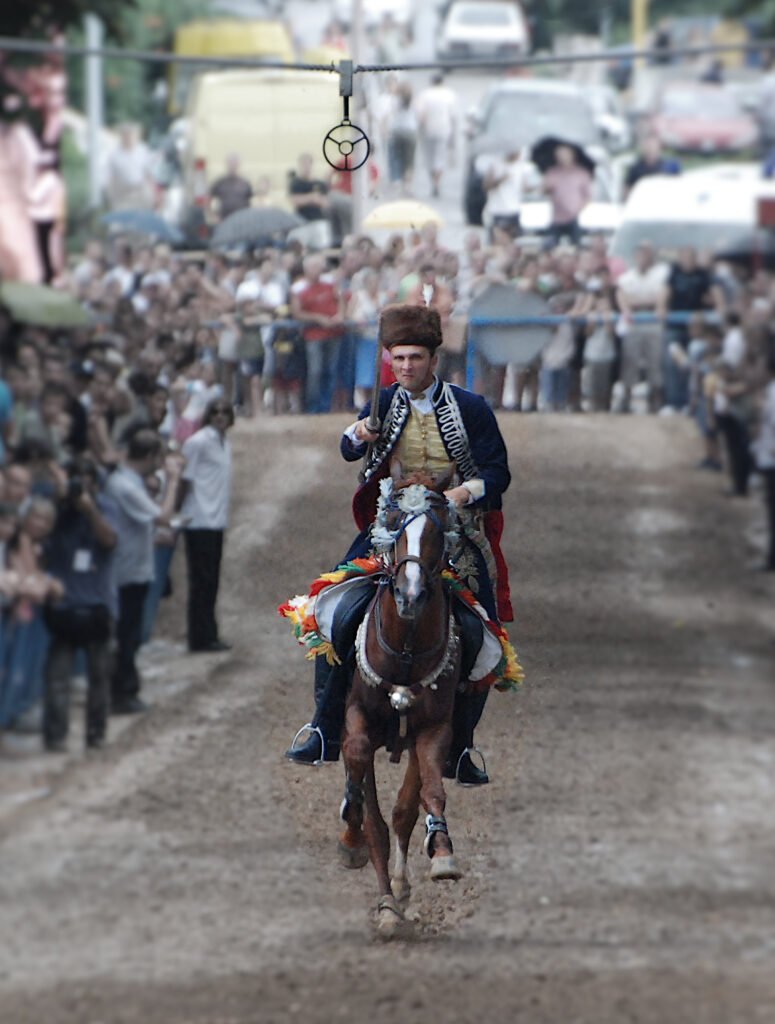
The Sinjska Alka is a chivalric tournament that takes place annually, as it has since the 18th century, in the town of Sinj, in the Cetinska krajina region. During the contest, knights ride horses at full gallop along a main street, aiming lances at an iron ring hanging on a rope. The name of the tournament derives from this ''alka'' or ring, a word whose Turkish origin reflects the historical co-existence and cultural exchange between two different civilizations. The tournament rules, codified in a 1833 statute, promote ethics and fair play, and stress the importance of participation in community life. Participants must be members of local families of Sinj and the Cetinska krajina region. The whole community helps to make, conserve, restore and reconstruct weapons, clothes and accessories to support the continuation of the tradition. The tournament is also entwined with local religious practices, social gatherings, family visits and festivities at home and in the open air. The Sinjska Alka is the only remaining example of the medieval knightly competitions that were regularly held in the Croatian coastal towns until the nineteenth century. It has become a marker of local history and a medium for transferring collective memory from one generation to another.
Official description, UNESCO Intangible Cultural Heritage List — Sinjska Alka, a knights’ tournament in Sinj
At a glance
The Sinjska Alka is an annual chivalric tournament held in Sinj where riders gallop along a main street and aim lances at an iron ring suspended on a rope. The name derives from this ring—'alka'—a word of Turkish origin that reflects centuries of cultural exchange between different civilizations. The event combines military skill with community participation and local religious observance.
Origins & history
The tournament has taken place annually since the 18th century, making it the only surviving example of medieval knightly competitions that were once regularly held in Croatian coastal towns until the nineteenth century. Tournament rules were codified in an 1833 statute emphasizing ethics, fair play, and the importance of community participation. Over time, the Alka has become a marker of local history and a means of transmitting collective memory across generations.
The practice
Participants must be members of local families from Sinj and the Cetinska krajina region. Riders gallop along the main street, aiming lances at the hanging iron ring. The whole community contributes to making, conserving, restoring and reconstructing the weapons, clothes and accessories needed to sustain the tradition. The tournament is intertwined with local religious practices, social gatherings, family visits and festivities both at home and in the open air.
Cultural significance
The Sinjska Alka holds deep meaning for the community as it preserves codes of honour and martial tradition while anchoring them to collective identity. The tournament connects local religious practice with social life and serves as a living link between past and present, allowing the community to sustain and pass forward its shared history and values to new generations.
Key facts
- Country: Croatia
- Inscribed: 2010
- UNESCO list: Representative List of the Intangible Cultural Heritage of Humanity
- UNESCO reference: 00357
- UNESCO vocabulary: Equestrian games; Festivals; Sports competitions
- Map: Sinj — the locality named in UNESCO’s official description of this element
Where to experience it
The Sinjska Alka takes place annually in Sinj, a town in the Cetinska krajina region, where it has been held since the 18th century. The tournament centres on the feast of the Assumption of Mary, drawing the whole community together for religious processions, equestrian competition, and festivities. Visitors attending during this period witness knights riding at full gallop along the main street, aiming lances at an iron ring—a tradition that remains the only surviving example of medieval knightly competitions once held throughout Croatian coastal towns.
Sources & resources
- UNESCO — official element page: Sinjska Alka, a knights’ tournament in Sinj
- UNESCO — open data record: Intangible Heritage List, reference 00357
- UNESCO — official video: UNESCO film on this element — embedded on this page
- UNESCO — official photograph: Photograph of this element — Berislav Alebic — 2009 Ministry of Culture
- Reference — Wikipedia (secondary): Sinjska alka — consulted as a secondary reference, not as confirmation
- Cultural Heritage Online: Our archive and city guides

Find it on the map
See this place and what’s around it →📷 Become a Cultural Heritage Online photographer
Share your photos of places: they stay published under your name as the author. The more they're seen, the more you get noticed — and soon a contest will reward the most appreciated photos.
Log in or sign up free to add a photo