
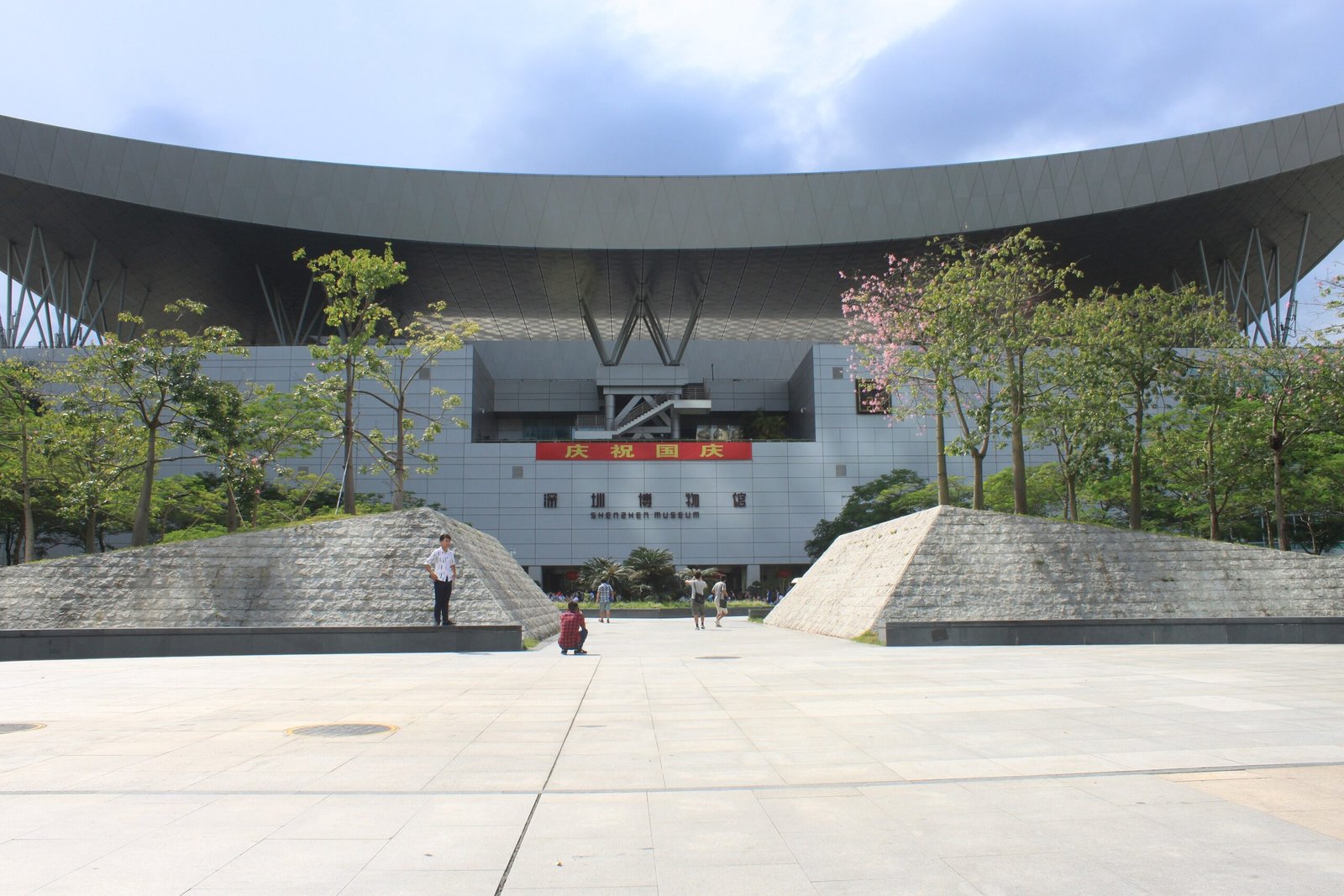
A four-site municipal institution documenting the city’s transformation from fishing village to global megacity, housing over 20,000 historical and cultural relics.
At a glance
Shenzhen Museum is a public institution funded by the municipal government, comprising four distinct venues across the city. The complex spans 37,000 square meters total, with 18,000 square meters of building space. The network encompasses ancient art, history and folk culture, contemporary reform narratives, and revolutionary heritage.
History
The original museum, now the Museum of Ancient Art, was established in 1981 but did not formally open until 1988. This initial site on Tongxin Road laid the foundation for what would become a multi-venue institution documenting Shenzhen’s extraordinary urban development. The expansion into four sites reflects the city’s rapid growth and its desire to preserve layered narratives—from ancient Guangdong culture through the revolutionary era to contemporary transformation.
What you see
The museum system showcases diverse collections across purpose-built venues. The Museum of Ancient Art houses artifacts primarily from the Shenzhen region. The History and Folk Culture branch, located in Civic Center, explores traditional lifeways. The Reform and Opening-up Exhibition Hall features compelling personal artifacts from Deng Xiaoping’s 1992 southern tour, including the spade he used to plant a tree in Shenzhen, hotel room furnishings, and his white Toyota van. The Dongjiang River Guerrilla Command Headquarters Memorial Museum preserves revolutionary history in Luohu District.
Cultural significance
Shenzhen Museum documents one of history’s most dramatic urban transformations. The collections chronicle the city’s evolution from a modest settlement into a global financial and manufacturing center following China’s 1978 reform and opening-up policies. The presence of Deng Xiaoping’s personal effects—tools and transportation—humanizes the pivotal decisions that reshaped modern China and demonstrate the museum’s commitment to material historical testimony.
Key facts
- Country: China
- City: Shenzhen, Guangdong
- Total area: 37,000 square meters
- Building area: 18,000 square meters
- Collection size: Over 20,000 historical and cultural relics
- Original founding: 1981; formal opening: 1988
- Four sites: Museum of Ancient Art, History and Folk Culture, Reform and Opening-up Exhibition Hall, and Dongjiang River Guerrilla Command Headquarters Memorial Museum
- Coordinates: 22.5465°N, 114.0568°E
Practical information & getting there
The museum operates as a four-venue network across Shenzhen. Primary locations include the Museum of Ancient Art on Tongxin Road and the History and Folk Culture branch in Civic Center (Jintian Road). The Reform and Opening-up Exhibition Hall is integrated with the Museum of Contemporary Art and Urban Planning. For visiting hours, admission fees, and transportation details, consult the official Shenzhen Museum website or local tourism information.
Sources & resources
Find it on the map
See this place and what’s around it →📷 Become a Cultural Heritage Online photographer
Share your photos of places: they stay published under your name as the author. The more they're seen, the more you get noticed — and soon a contest will reward the most appreciated photos.
Log in or sign up free to add a photoIs this page about you?
This page is read by travellers and heritage enthusiasts who find it on Google. Tell us how you are connected to this place and we will take it from there.