

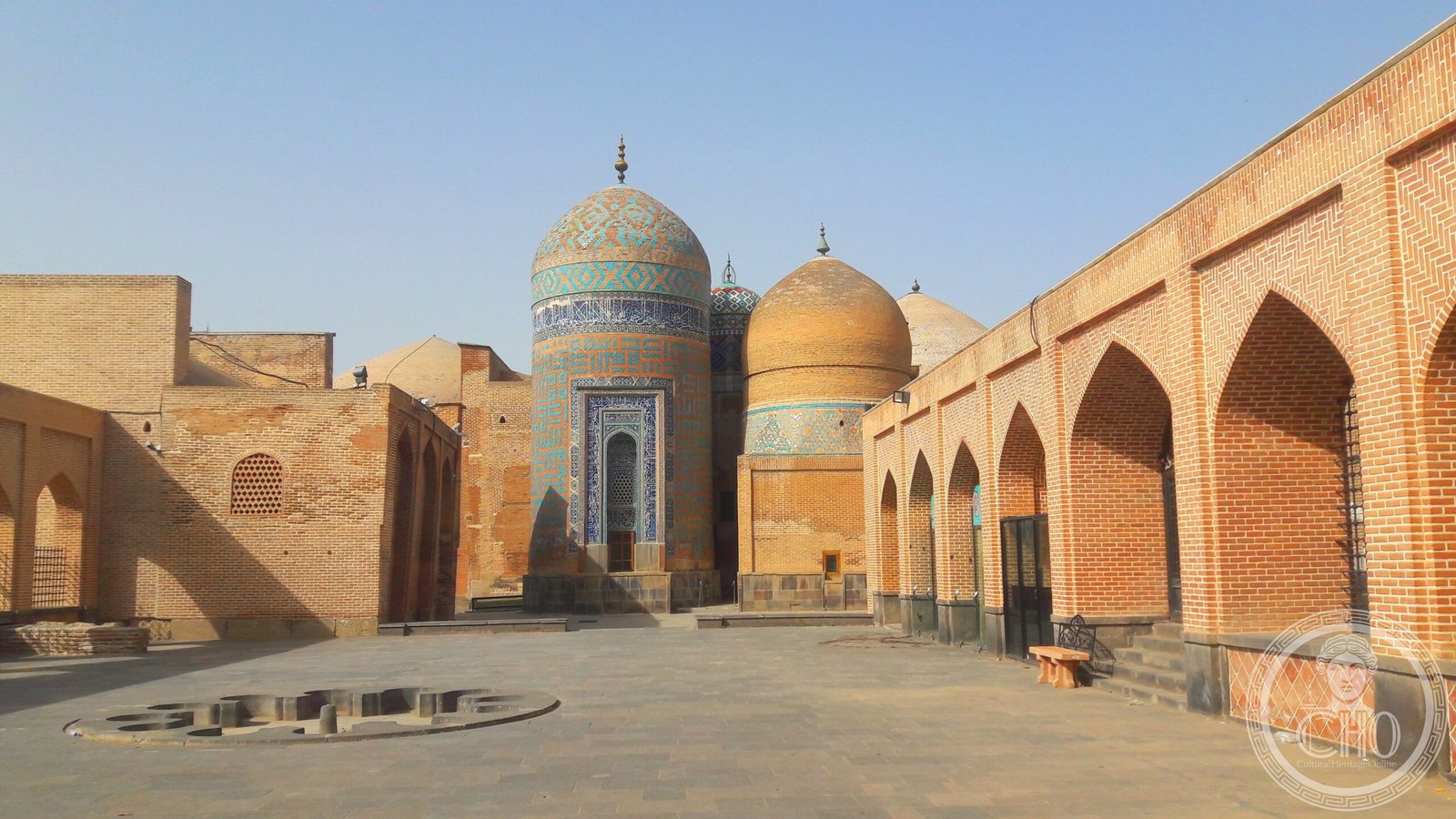
A sacred Sufi sanctuary and mausoleum complex honoring one of Islamic mysticism’s most influential figures, this ensemble represents centuries of spiritual devotion and architectural refinement in northwestern Iran.
In UNESCO’s words
Built between the beginning of the 16th century and the end of the 18th century, this place of spiritual retreat in the Sufi tradition uses Iranian traditional architectural forms to maximize use of available space to accommodate a variety of functions (including a library, a mosque, a school, mausolea, a cistern, a hospital, kitchens, a bakery, and some offices). It incorporates a route to reach the shrine of the Sheikh divided into seven segments, which mirror the seven stages of Sufi mysticism, separated by eight gates, which represent the eight attitudes of Sufism. The ensemble includes well-preserved and richly ornamented facades and interiors, with a remarkable collection of antique artefacts. It constitutes a rare ensemble of elements of medieval Islamic architecture.
At a glance
The Sheikh Safi al-Din Khānegāh and Shrine Ensemble is a religious funerary complex in Ardabil that serves as the tomb of Sheikh Safi-ad-Din Ardabili, a revered Sufi master. The site combines a khānegāh (a Sufi hospice or monastery) with a shrine, creating a unified sacred space that has drawn pilgrims and scholars for centuries.
History
Sheikh Safi-ad-Din Ardabili was a foundational figure in Islamic mysticism whose spiritual legacy shaped the development of Sufism across the Islamic world. The complex that bears his name grew as a center of devotion and learning. In 1932, the mausoleum entered Iran’s National Heritage List on 6 January. International recognition followed when UNESCO added the entire ensemble to the World Heritage List in 2010, affirming its cultural and religious significance.
What you see
The ensemble combines functional and sacred architecture typical of Islamic sanctuary spaces. A khānegāh served as a residence and meeting place for Sufi seekers, while the shrine focuses devotion on the tomb of its namesake saint. The complex reflects the architectural traditions of its period and region.
Cultural significance
This site stands as a monument to Sufi spirituality and Sheikh Safi-ad-Din’s profound influence on Islamic thought and practice. The complex embodies the integration of daily monastic life with sacred commemoration—a hallmark of the khānegāh tradition. Its UNESCO designation recognizes both its architectural merit and its role in the spiritual history of Iran and the Islamic world.
Key facts
- Location: Ardabil, Ardabil Province, Iran
- Coordinates: 38.2486, 48.2914
- UNESCO World Heritage List: inscribed 2010
- Iran National Heritage List: inscribed 6 January 1932
- Administered by: Cultural Heritage, Handicrafts and Tourism Organization of Iran
Practical information & getting there
The complex is located in Ardabil city. For current visiting hours, admission fees, and detailed directions, consult the Cultural Heritage, Handicrafts and Tourism Organization of Iran or local tourism resources in Ardabil.
Sources & resources
- Sheikh Safi al-din Khānegāh and Shrine Ensemble in Ardabil — whc.unesco.org — Sheikh Safi al-din Khānegāh and Shrine Ensemble in Ardabil
- World Heritage List — reference 1345 — UNESCO open data, dataset whc001
- Sheikh Safi al-din Khānegāh and Shrine Ensemble in Ardabil (Iran (Islamic Republic of)) — UNESCO official photograph — Iran Images/Mohammad Tajik — UNESCO
- Sheikh Safi al-Din Kh%C4%81neg%C4%81h and Shrine Ensemble — Wikipedia — consulted as a secondary reference, not as confirmation
- culturalheritageonline.com — our archive and city guides
Find it on the map
See this place and what’s around it →📷 Become a Cultural Heritage Online photographer
Share your photos of places: they stay published under your name as the author. The more they're seen, the more you get noticed — and soon a contest will reward the most appreciated photos.
Log in or sign up free to add a photoIs this page about you?
This page is read by travellers and heritage enthusiasts who find it on Google. Tell us how you are connected to this place and we will take it from there.