
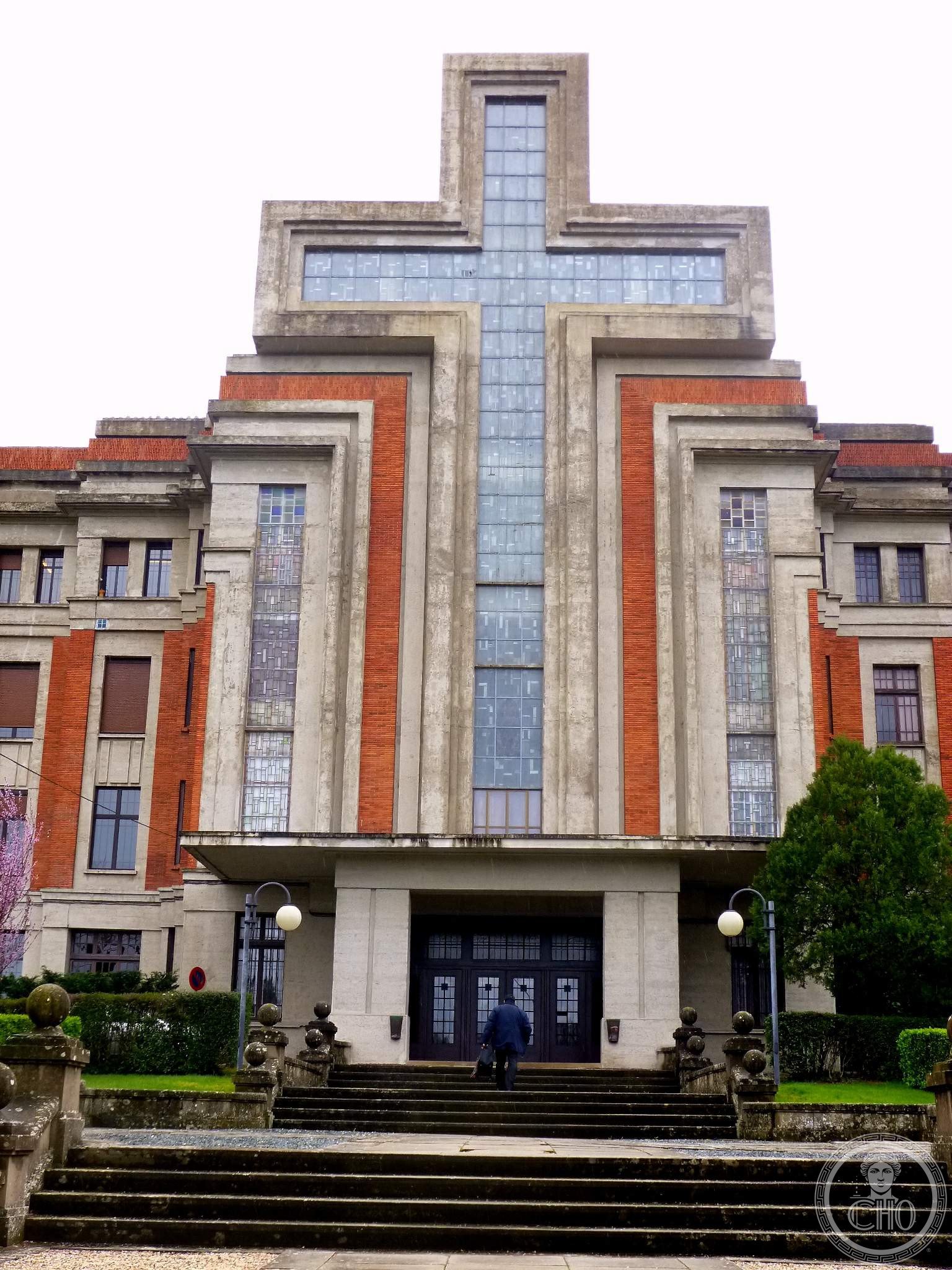
A bold expressionist seminary crowned by a colossal cross, where white concrete and red brick converge in geometric abstraction.
At a glance
The Seminary of Pamplona (Seminario Conciliar de San Miguel) is a Catholic seminary designed by architect Víctor Eusa Razquin. Its most striking feature is the monumental cross that forms the main façade—a geometric statement of faith expressed in modernist language.
History
Opened in 1931, the seminary emerged during a period of architectural experimentation in Spain. Eusa’s design drew inspiration from fellow expressionist architect Casto Fernández-Shaw, whose unrealized cathedral-skyscraper project “Cruz soñada” (Dreamt Cross) may have influenced the building’s audacious cross motif.
What you see
The building exemplifies Eusa’s most expressionist period, marked by striking contrasts between white concrete and red brick. This combination has been termed déco-expressionism or geometric expressionism. The dominant architectural gesture—a colossal cross dominating the façade—blurs the line between religious symbolism and futurist design, making form inseparable from faith.
Cultural significance
The seminary represents a distinctive moment in Spanish modernism, where Catholic institutional architecture embraced avant-garde aesthetics. The building demonstrates how expressionism and geometric abstraction could serve spiritual purposes, challenging conventional ecclesiastical design.
Key facts
- Country: Spain
- City: Pamplona
- Architect: Víctor Eusa Razquin
- Completed: 1931
- Coordinates: 42.8135, -1.6292
Practical information & getting there
The seminary is located in Pamplona, in Spain’s Navarre region. For visiting hours and access information, contact the institution directly, as seminary properties often maintain restricted visiting schedules.
Sources & resources
Find it on the map
See this place and what’s around it →📷 Become a Cultural Heritage Online photographer
Share your photos of places: they stay published under your name as the author. The more they're seen, the more you get noticed — and soon a contest will reward the most appreciated photos.
Log in or sign up free to add a photoIs this page about you?
This page is read by travellers and heritage enthusiasts who find it on Google. Tell us how you are connected to this place and we will take it from there.