

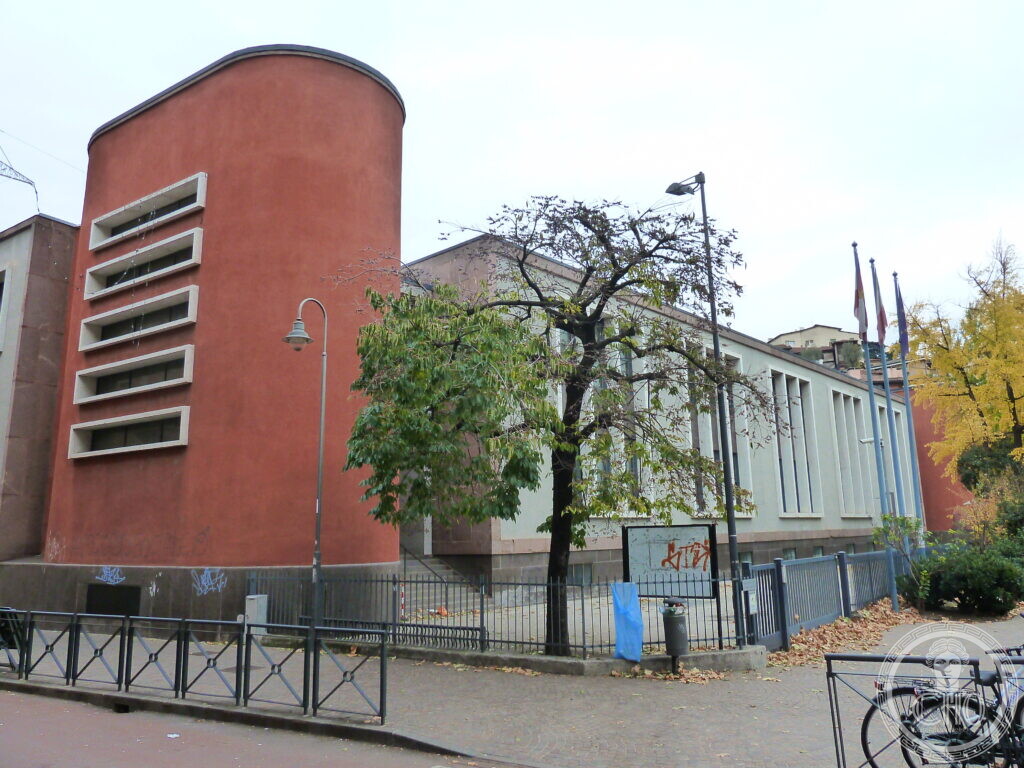
Adalberto Libera’s primary school at the edge of the medieval city: a red-plastered corner volume, a long pale front of three-light windows, and two murals by Gino Pancheri that are still in the stairwell.
At a glance
The Scuola elementare Raffaello Sanzio, usually called the Scuola primaria Raffaello Sanzio, stands at number 13 of the piazza named after the same painter, in the San Martino district of Trento. It occupies the ground of an Austrian military barracks, on the line of the old city walls, between the Castello del Buonconsiglio and the Torre Verde. Adalberto Libera designed the complex between 1932 and 1934, and the school opened in 1935. It is still a working primary school, so what this page describes is what can be seen from the street.
Key facts
- Where: Piazza Raffaello Sanzio 13, Trento, San Martino district
- What: a primary school complex, still in use
- Architect: Adalberto Libera (1903-1963), commissioned in 1931
- When: built 1932-1934, opened 1935, restored 1996-2000
- Inside: two tempera murals by Gino Pancheri (1905-1943) in the south-west stairwell
- GPS: 46.0724, 11.1258 · Open in Google Maps
History
The commission went to Libera in 1931, after a competition whose jury called his scheme well placed and well drawn. Work started the following year on a site that already had a history: the Austrian barracks stood where the medieval walls had run, at the point where the built city gave way to the river plain. Classrooms, a gymnasium, staircase towers and a trapezoidal inner courtyard were built between 1932 and 1934, and the school was named after Raphael and opened in 1935.
The building survived the century in its original role. Between 1996 and 2000 a restoration directed by Giovanni Marzari brought back materials and colours while keeping the school where it was, and kept the children in the same rooms. That continuity is the least visible thing on this page and the most unusual: plenty of Italian school buildings of the 1930s were converted, abandoned or turned into offices.
What you see
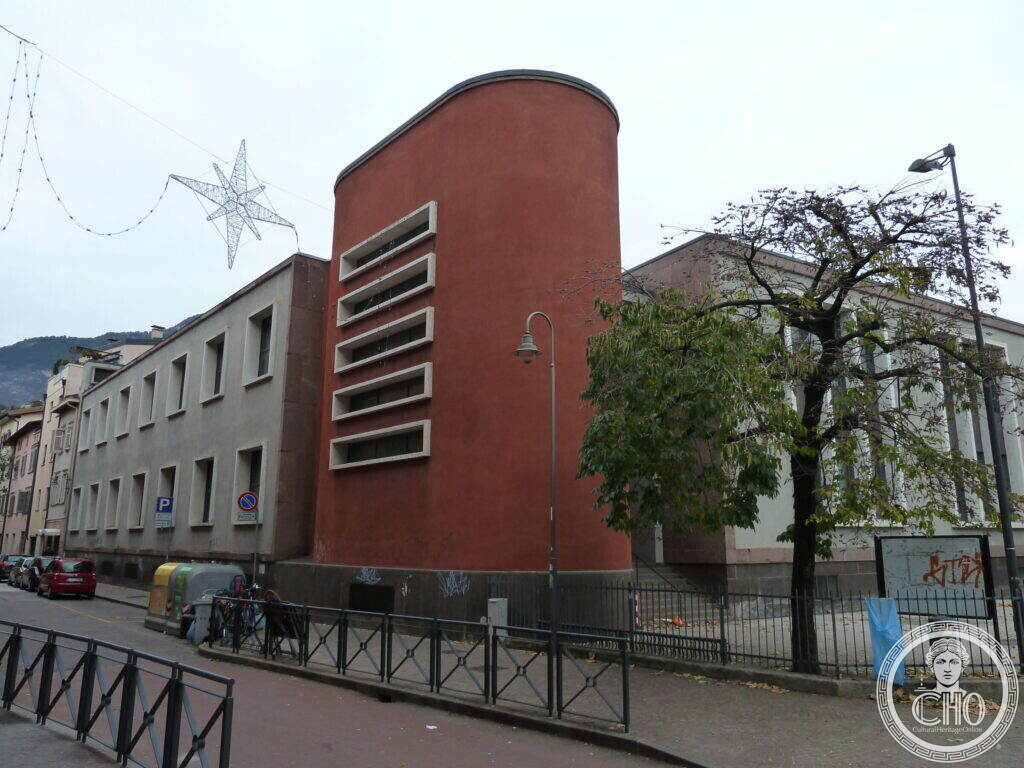
From the piazza, the school presents two distinct faces. A rounded corner volume is plastered a deep red, and five horizontal openings are stacked in it, each set in a thick pale stone frame. The glass sits far back in the reveal, so the five slots read as cuts through the plaster rather than as windows, and the light changes in them through the day. The long pale front beside it carries tall windows divided into three vertical lights, which the sources describe as the five tripartite windows that characterise the front.
At street level the building is fenced with a low iron railing, and the photographs show the ordinary furniture of the pavement: a bicycle rack, a street lamp, a traffic light, the flagpoles in front of the long wing. In one frame the trees still hold leaves, in the other a ginkgo has turned yellow and the fallen leaves line the kerb. Behind, the roofs and the wooded hill of the Castello del Buonconsiglio close the view.
The murals in the stairwell
Inside, in the south-west stairwell, Gino Pancheri painted two large tempera murals with scenes of school life. Sergio Perdomi photographed them shortly after they were made, and one of his plates is dated 1934; the murals are the reason the school is discussed by historians of Trentino art as well as by historians of architecture. They are not visible from the street, and the photographs on this page do not show them.
A school, not a monument
The building is not a museum. It is a primary school in use, and the complex is not open to visitors as a rule; what a visitor can do is walk the piazza and read the two façades, which are the part the sources describe in most detail. FAI records the school among its places, with a Spring Days campaign in 2019, which is the occasion on which parts of the interior are normally shown.
Nearby
- Torre Verde, a few dozen metres away, the medieval tower that closes the view from the piazza.
- Castello del Buonconsiglio, on the other side of the school, with its painted cycle of the months.
- Fontana dei Dò castradi, in Piazza delle Erbe, in the medieval centre.
Do you know more about this place?
If you have a photograph of the murals, a document on the competition of 1931 or a memory of the school, write to Sofia at sofia@culturalheritageonline.com or through the contact page. What arrives with a source goes into this page, with your name as the contributor.
Gallery
Sources
- Wikipedia (it), Scuola elementare Raffaello Sanzio: dates of construction, commission, murals, restoration, position between the castle and the tower
- Trentino Cultura, Una scuola moderna ai confini della città medievale (12 April 2017): the competition and its jury, the volumes of the complex, the five tripartite windows, the murals and the restoration directed by Marzari
- FAI, Scuola primaria Raffaello Sanzio: address and the 2019 Spring Days entry
- Alberto Folgheraiter, Le Sanzio: una scuola per la città, Trento, Curcu & Genovese, 2014
- Francesca Benini and others (eds.), Le scuole elementari "F. Crispi" e "R. Sanzio" di Trento, Archivi del Trentino 19, Soprintendenza per i beni culturali, 2017
- Stefano Vigolo, photographs sent to the editorial staff in 2026, taken in 2010 (EXIF: Panasonic DMC-TZ8, 13 November 2010)
Find it on the map
See this place and what’s around it →📷 Become a Cultural Heritage Online photographer
Share your photos of places: they stay published under your name as the author. The more they're seen, the more you get noticed — and soon a contest will reward the most appreciated photos.
Log in or sign up free to add a photoIs this page about you?
This page is read by travellers and heritage enthusiasts who find it on Google. Tell us how you are connected to this place and we will take it from there.