
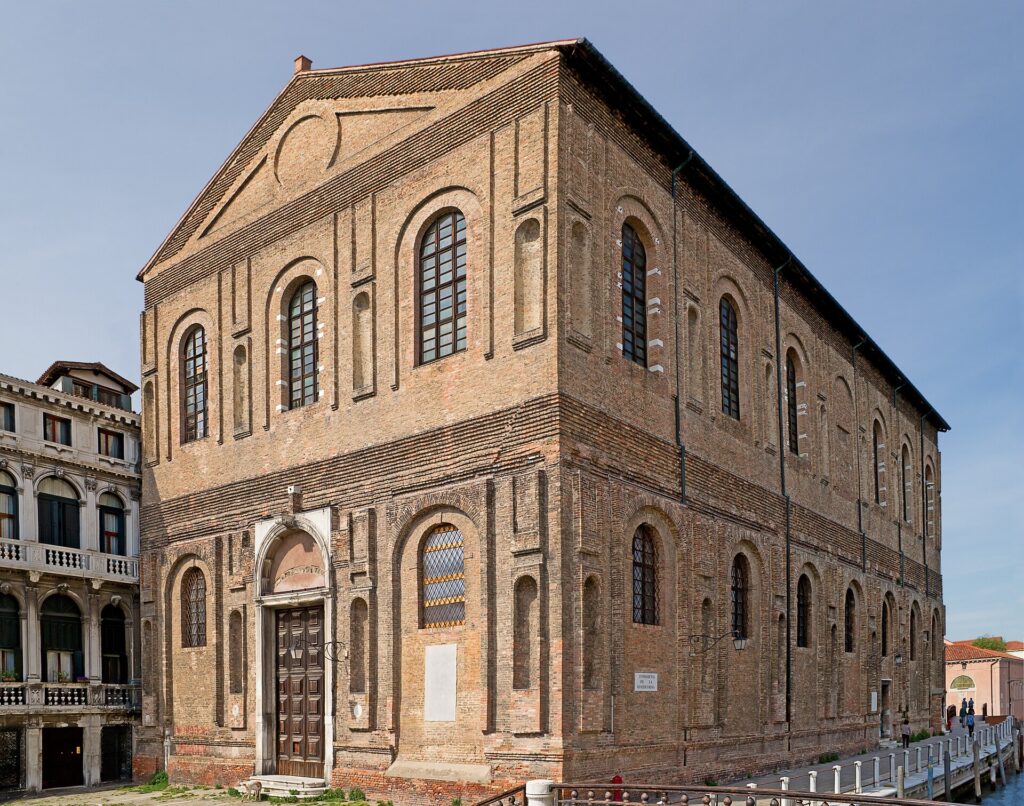
The largest room in Venice after the Doge’s Palace had a wooden grandstand for a thousand people and a line painted across its floor. For most of the twentieth century this was where the city played basketball.
At a glance
The confraternity of Santa Maria della Misericordia, founded in 1308, outgrew its old hall and in 1498 obtained permission from the Council of Ten to build a new one. Jacopo Sansovino designed it; work on the present building began in 1507 and dragged on until 1589. The confraternity was suppressed in 1806. In 1914 the upper floor was taken over by the Reyer sports club, which built a basketball court and timber stands for a thousand spectators. The gymnasium closed for good in 1991.
What you see
A vast brick block with no marble on it. The ground floor is the only part of Sansovino’s design that was carried out as drawn; the facing that was to have covered the rest never arrived, and the building has stood in bare brick ever since. Upstairs is the hall: the largest room in the historic centre after the Doge’s Palace, its walls frescoed with an architecture of niches holding the twelve major prophets, attributed to the workshop of Paolo Veronese and without parallel in the Venice of its day for scale and complexity.
Why it matters
Venice is usually described as a city that cannot change what it has. This building is the counter-example, twice over. A confraternity hall became a sports arena, and the frescoes looked down on seventy-seven years of basketball; then the arena became a hall again, after a restoration financed under a project-finance agreement and completed for the 2016 Biennale. Neither use was a betrayal of the building. Both kept it standing and in service, which is more than an empty monument manages.
Practical information
- The hall is a venue for exhibitions and events and opens according to the programme; there is no permanent visit
- The exterior, and the scale of it from the Sacca de la Misericordia, can be seen at any hour
Getting there
Waterbus to Madonna dell’Orto or Ca’ d’Oro, then about eight minutes on foot along the Fondamenta de la Misericordia.
Sources
- La Biennale di Venezia, venue file: Scuola Grande della Misericordia, labiennale.org
- Scuola Grande della Misericordia, official site, The spaces — on Sansovino’s ground floor and the frescoes attributed to the school of Paolo Veronese
Editorial text © Cultural Heritage Online, 2026. Video filmed and narrated on site by Andrea Manzo.
Find it on the map
See this place and what’s around it →
📷 Become a Cultural Heritage Online photographer
Share your photos of places: they stay published under your name as the author. The more they're seen, the more you get noticed — and soon a contest will reward the most appreciated photos.
Log in or sign up free to add a photoIs this page about you?
This page is read by travellers and heritage enthusiasts who find it on Google. Tell us how you are connected to this place and we will take it from there.