
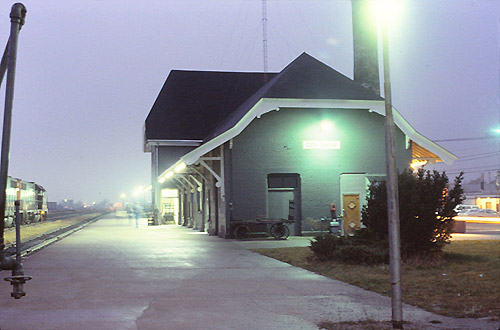
A Gothic Revival railway terminus designed by engineer Joseph Hobson, Sarnia Station marks the western end of Via Rail’s route through southwestern Ontario.
At a glance
Sarnia Station serves as the western terminus for Via Rail passenger trains departing from Toronto. The unstaffed station is wheelchair accessible and provides essential traveller amenities including a waiting area, washrooms, vending machines, and a pay phone.
History
The station was constructed in 1891 by the Grand Trunk Railway, following a design by engineer Joseph Hobson. The building exemplifies the Gothic Revival style favoured for institutional and transportation architecture of the era. Ownership eventually passed to Via Rail through CN Rail, reflecting the consolidation of Canada’s rail network over the twentieth century.
What you see
The station displays characteristic Gothic Revival features, a design language applied to railway buildings across North America during the 1890s. Its architectural presence reflects the importance of rail infrastructure to late-Victorian Canadian communities. The structure has been adapted for modern accessibility without loss of its historic character.
Cultural significance
Sarnia Station represents an important chapter in Canadian transportation history. As a functioning railway terminus designed during the height of the Grand Trunk Railway’s expansion, it documents the pivotal role of rail in connecting Ontario’s southwestern regions to urban centres.
Key facts
- Country: Canada
- City: Sarnia, Ontario
- Built: 1891
- Architect/engineer: Joseph Hobson
- Original builder: Grand Trunk Railway
- Coordinates: 42.9572, -82.3889
- Current operator: Via Rail
Practical information & getting there
The station is located in Sarnia, Ontario, at the terminus of Via Rail’s southwestern Ontario route. It is wheelchair accessible. As an unstaffed facility, you should plan ahead for information and services. Consult Via Rail’s website for current train schedules and booking information.
Sources & resources
Find it on the map
See this place and what’s around it →📷 Become a Cultural Heritage Online photographer
Share your photos of places: they stay published under your name as the author. The more they're seen, the more you get noticed — and soon a contest will reward the most appreciated photos.
Log in or sign up free to add a photoIs this page about you?
This page is read by travellers and heritage enthusiasts who find it on Google. Tell us how you are connected to this place and we will take it from there.