
A merchant’s private stage grew into one of Russia’s oldest working theaters, surviving fires, revolution, and rebuilding to keep its curtain rising for over a century and a half.
At a glance
The Saratov Drama Theater traces its public life to 1859, when the German-descended merchant Franz Schechtel opened his private home theater to city audiences. Wikidata records an earlier inception date of 1802, a reminder that institutional origins can predate public opening by decades. Today it carries the name of actor Ivan Slonov, who performed here for thirty years.
History
Before 1859, Saratov had no theater of its own. Touring companies from Moscow and St. Petersburg passed through occasionally, performing privately for the wealthy. Schechtel’s decision to open his home stage changed that. The building burned down more than once in its early decades and was rebuilt each time. Actors, not architecture, carried its reputation in this period. Piotr Medvedev, Maria Savina, Vasily Kachalov and other leading names of the Russian stage all appeared here. In 1915, a company of professional actors relocated from Kyiv, bringing Ivan Slonov, already famous across the empire. He stayed until his death in 1945. The 1917 Revolution renamed the house Karl Marx Drama Theater, a label it carried through most of the Soviet era. A new building went up in 1968. The Soviet Union’s collapse in 1991 brought another renaming, this time to honor Slonov himself.
What you see
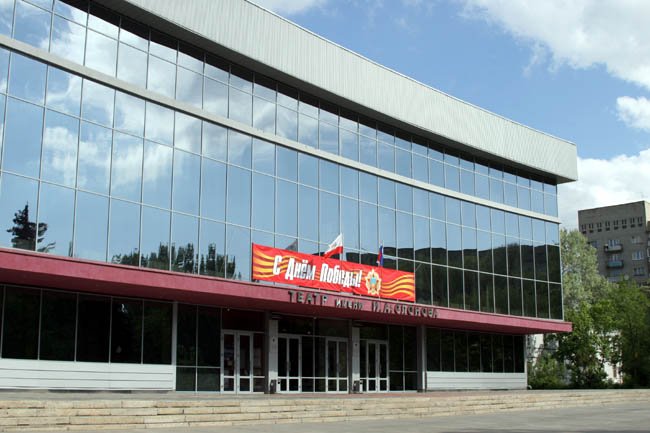
The current structure dates to 1968, a Soviet-era replacement for the repeatedly rebuilt 19th-century home theater. Little architectural detail survives in the historical record beyond this rebuilding date. What remains constant is function: a working stage, still active, still staging classical and contemporary repertoire under one roof shaped by two centuries of fire, war and political change.
Cultural significance
Few Russian provincial theaters can claim a guest list like this one. Aleksandr Lensky, Vladimir Davydov, Pelageya Strepetova, Nicolay Sobolschikov-Samarin, and Kachalov all passed through Saratov’s stage in the 19th century, at a time when the city had no resident troupe of its own. The theater’s survival through fires, a revolution, a Soviet renaming, and a full postwar rebuild speaks to its embeddedness in the city’s cultural identity. Its present name honors Ivan Slonov, whose three-decade tenure linked the imperial and early Soviet stage traditions in one career.
Key facts
- Location: Saratov, Russia
- Public opening: 1859, by Franz Schechtel
- Wikidata inception year: 1802
- Current building erected: 1968
- Named after actor Ivan Slonov (performed 1915–1945)
- Renamed Karl Marx Drama Theater after 1917; renamed again in 1991
Practical information & getting there
The theater sits within the city of Saratov, on Russia’s Volga River. You can check current productions and schedules through the official website before planning a visit. As with most working repertory theaters, performance times and programming change seasonally.
Sources & resources
Find it on the map
See this place and what’s around it →📷 Become a Cultural Heritage Online photographer
Share your photos of places: they stay published under your name as the author. The more they're seen, the more you get noticed — and soon a contest will reward the most appreciated photos.
Log in or sign up free to add a photoIs this page about you?
This page is read by travellers and heritage enthusiasts who find it on Google. Tell us how you are connected to this place and we will take it from there.