
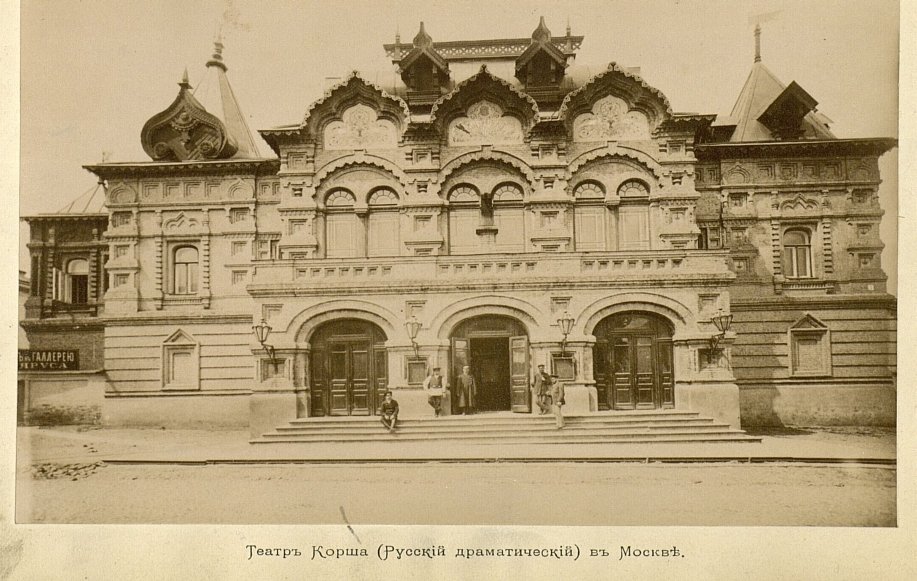
A private Moscow playhouse built on commercial nerve and gaslight-era ambition, where Chekhov made his stage debut and electricity outshone the Bolshoi.
At a glance
The Korsh Theatre opened in 1882 on Petrovsky Lane, founded by entrepreneur Fyodor Korsh with actors Modest Pisarev and Vasily Andreyev-Burlak. Built in the Russian Revival style, the house was designed by architect Mikhail Chichagov. It operated as a private theatre until 1917, then survived under shifting Soviet names until 1933. The building still stands. It now houses the Theatre of Nations.
History
The venture grew out of Anna Brenko’s bankrupt Pushkin Theatre. Korsh, backed financially by patron Alexander Bakhrushin, became sole owner in 1883. Early bills mixed Gogol’s Revizor, Ostrovsky’s The Forest and Lermontov’s Masquerade with cheaper comedies and vaudevilles, whose commercial success funded riskier work. Ibsen, Sudermann and Rostand followed. Anton Chekhov debuted as a playwright here in 1887, when Korsh commissioned Ivanov; The Bear and The Marriage came later. Tolstoy’s The Power of Darkness had its Moscow premiere at the Korsh in 1895. After 1898, competition from Stanislavski’s Moscow Art Theatre pushed Korsh to hire director Nikolai Sinelnikov, whose productions of Cyrano de Bergerac and Shakespeare’s The Tempest earned praise but never fully restored the theatre’s standing. Revolution brought repeated renaming and, in 1933, closure.
What you see
Chichagov’s building was engineered as much as decorated. It became the first fully electrified theatre in Moscow, at a time when even the Bolshoi and Maly still relied on gas. Contemporaries noted its technical stage effects and modern machinery, features that let it advertise itself as Russia’s most advanced house. Little of that original apparatus survives to view today. The Russian Revival exterior remains the clearest link to the 1880s theatre.
Cultural significance
Every Friday brought a premiere, often underrehearsed, always watched. Most such rushed productions vanished after a run; a few, like Charms of Love, held the stage for years. Korsh and his staff would shorthand new French plays in Parisian audiences, translate overnight, and stage them in Moscow before their home publication. That speed made the theatre a conduit for European drama into Russia. Its role as Chekhov’s launching point secures its place in Russian theatre history regardless of its later commercial reputation.
Key facts
- Founded: 1882, by Fyodor Korsh with Modest Pisarev and Vasily Andreyev-Burlak
- Architect: Mikhail Chichagov
- Style: Russian Revival architecture
- Official opening: 30 August 1885
- Chekhov’s Ivanov premiered here, 1887
- Closed under Soviet reorganisation, 1933
- Heritage-listed building
- Current occupant: Theatre of Nations
Practical information & getting there
The building stands on Petrovsky Lane in central Moscow, now home to the Theatre of Nations, which stages memorial events referencing the Korsh legacy. Check the current company’s own schedule for performances and public access, since the historic Korsh troupe no longer exists.
Sources & resources
Find it on the map
See this place and what’s around it →📷 Become a Cultural Heritage Online photographer
Share your photos of places: they stay published under your name as the author. The more they're seen, the more you get noticed — and soon a contest will reward the most appreciated photos.
Log in or sign up free to add a photoIs this page about you?
This page is read by travellers and heritage enthusiasts who find it on Google. Tell us how you are connected to this place and we will take it from there.