
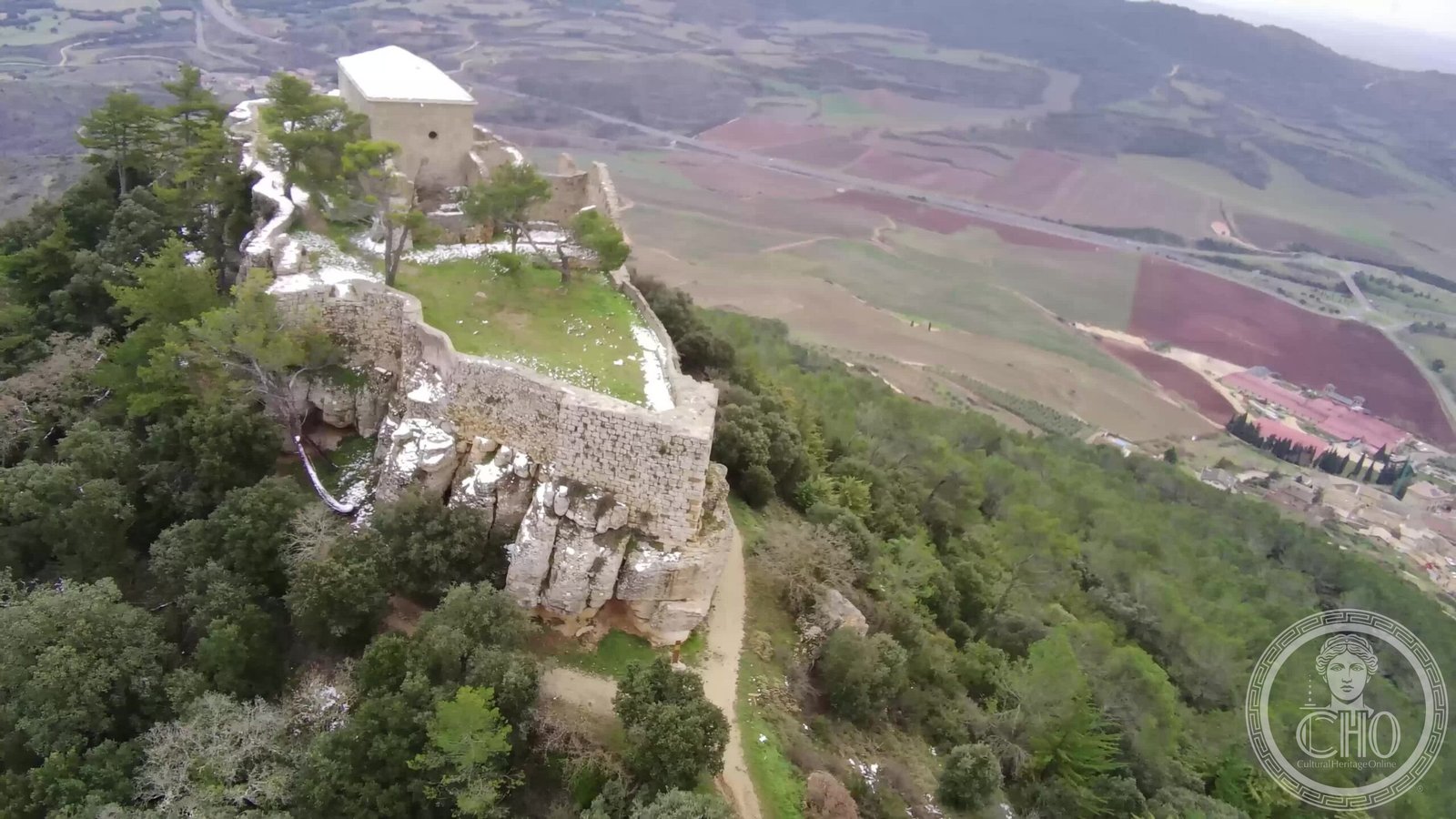
A ruined hilltop fortress in Navarre with roots in Roman times, transformed through centuries of conquest and conflict between Christian and Muslim powers.
At a glance
San Esteban de Deyo, also known as Castillo de Monjardín, crowns a 890-metre hill above Villamayor de Monjardín. The castle’s stone walls alone remain standing—a skeletal testament to its strategic importance. Today it holds protected status as a cultural monument of Navarre.
History
The fortress began as a Roman foundation but underwent repeated reconstruction across the centuries. It served as one of the last strongholds of the Banu Qasi, a local Muslim dynasty ruling the region, until King Sancho I of Navarre captured it in 914. Legend complicates this account: the Historia Caroli Magni et Rotholandi, a 12th-century chronicle embedded in the Codex Calixtinus, attributes the castle’s conquest to Charlemagne, claimed to have seized it from a Navarrese prince named Furré. In the 17th century, much of the remaining stonework was repurposed to construct the Ermita de San Esteban, a Baroque hermitage that still stands nearby.
What you see
The castle’s walls endure as the primary architectural remains. Their construction reflects multiple periods of building and reinforcement, though the layering of Roman, early medieval, and later work is difficult to distinguish with precision from the ruins themselves. The site commands panoramic views across the Navarrese landscape from its elevated position.
Cultural significance
San Esteban de Deyo embodies the frontier conflict of medieval Spain, marking the contested boundary between Christian and Islamic domains. Its transformation from Muslim stronghold to Christian fortress mirrors the broader Reconquista. The competing accounts of its conquest—historical record versus legendary tradition—highlight how medieval texts blurred fact and storytelling.
Key facts
- Location: Villamayor de Monjardín, Navarre, Spain
- Elevation: 890 metres
- Coordinates: 42.6339, −2.1064
- Protected status: Bien de Interés Cultural de Navarra (designated 25 June 1985)
- Original garrison: Banu Qasi dynasty
- Captured: 914 (by King Sancho I of Navarre, per historical records)
Practical information & getting there
The site is accessible to visitors willing to climb to the hilltop. The Ermita de San Esteban, built from repurposed castle stones, remains a functioning chapel. For current access conditions and visiting hours, check local tourism information for Villamayor de Monjardín.
Sources & resources
Find it on the map
See this place and what’s around it →📷 Become a Cultural Heritage Online photographer
Share your photos of places: they stay published under your name as the author. The more they're seen, the more you get noticed — and soon a contest will reward the most appreciated photos.
Log in or sign up free to add a photoIs this page about you?
This page is read by travellers and heritage enthusiasts who find it on Google. Tell us how you are connected to this place and we will take it from there.