
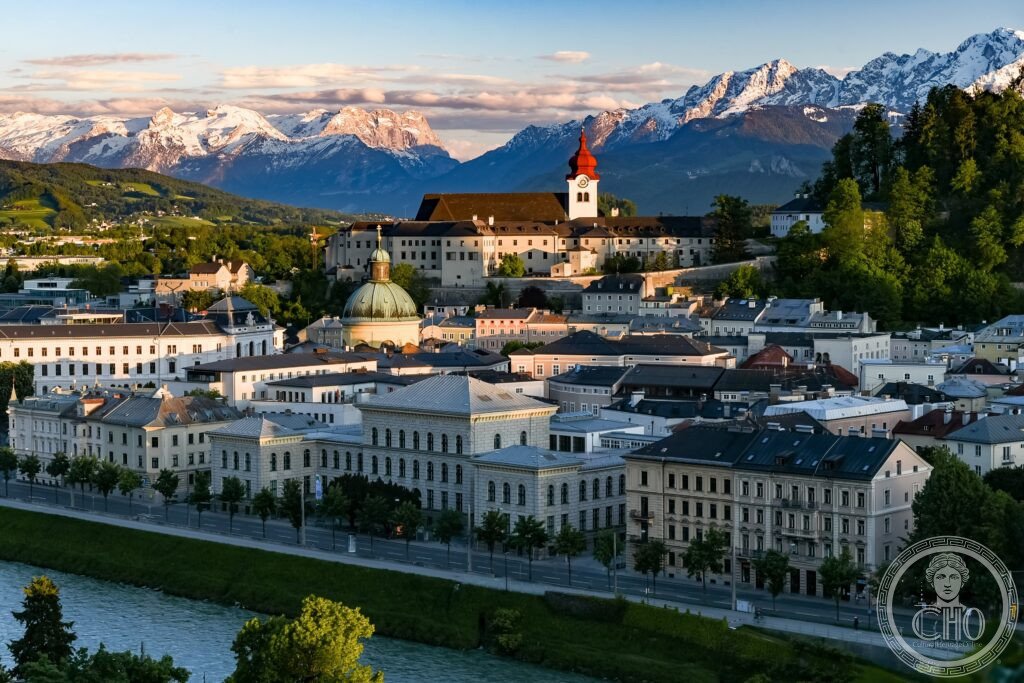
Salzburg’s old town is the seat the Prince-Archbishops rebuilt as an Italian Baroque capital, crowned by the medieval Hohensalzburg Fortress above the Salzach. It is also where Wolfgang Amadeus Mozart was born, and where the Salzburg Festival still fills the summer streets with music each year.
At a glance
Salzburg grew rich on the salt trade of the nearby Salzkammergut, wealth that let its Prince-Archbishops remake the medieval town in Italian Baroque style from the late sixteenth century onward. The historic centre, with the fortress on the Festungsberg above it, was inscribed as a UNESCO World Heritage Site in 1996.
The city is also the birthplace of Wolfgang Amadeus Mozart, born in 1756 at Getreidegasse 9, and it hosts the Salzburg Festival, one of the leading events in the classical music and theatre calendar, every July and August.
Key facts
- Mozart: born in Salzburg on 27 January 1756, died in Vienna on 5 December 1791; he served as Court Composer to Archbishop Colloredo from 1772 and was dismissed from the post in 1781, after which he never returned to his native city.
- Salzburg Festival: founded in 1920 by Hugo von Hofmannsthal, Max Reinhardt and Richard Strauss as a cultural response to the First World War; Hofmannsthal’s play Jedermann has been staged outdoors on the Domplatz almost every year since, barring the Second World War.
- Hohensalzburg Fortress: founded in 1077 by Archbishop Gebhard von Helfenstein and counted among the largest and best-preserved medieval castles in Europe.
- Prince-Archbishops: ruled Salzburg from 798 until Napoleon’s secularisation of the archbishopric in 1803.
- World Heritage status: the historic centre of Salzburg was inscribed by UNESCO in 1996.
History
Salzburg was governed by Prince-Archbishops from 798, and it was under Archbishop Wolf Dietrich von Raitenau, who held the office from 1587 to 1612, that the medieval city was largely demolished and rebuilt to Italian Baroque principles. Educated in Rome, Wolf Dietrich brought in Italian design ideas for the new Residenz and had the old cathedral torn down. The present Dom was completed under his successors Markus Sittikus and Paris Lodron by 1628, and is described as the first Renaissance and Baroque cathedral built north of the Alps.
The rebuilding of Salzburg as a model Baroque capital continued under later archbishops until 1771. The Prince-Archbishopric itself came to an end in 1803, when Napoleon secularised it. Nearly two centuries later, in 1996, UNESCO inscribed the historic centre of Salzburg as a World Heritage Site.
What you see
The old town is threaded by Getreidegasse, its narrow shopping street still lined with wrought-iron guild signs; Mozart’s birthplace stands at No. 9. Nearby, Mirabellplatz opens onto the Mirabell Palace gardens, first laid out in 1606 and rebuilt as formal Baroque gardens between 1721 and 1727; they are recognisable as a filming location for The Sound of Music.
Above the town, the Hohensalzburg Fortress is reached by the Festungsbahn funicular and gives views over the old town’s rooftops, the Salzach River and the surrounding Alps.
Practical information
- Salzburg Card: a combined transport and admission card covering public transport and a range of attractions including the fortress, Mirabell Gardens and the Mozart Museum; details and current terms are available from the city’s official tourism channels.
- Sound of Music sites: Mirabell Gardens, Nonnberg Abbey and the Salzkammergut lake district all feature in the 1965 film; Leopoldskron Palace, used for the exterior of the von Trapp villa, is private and not open to visitors.
- Mozart sites: the birthplace on Getreidegasse is the principal Mozart-related attraction in the old town.
Getting there
Salzburg is served by its own airport a short distance from the centre, with connections from a number of European cities, and by direct rail links to Vienna and Munich. Current timetables, fares and transfer options are best checked with the airport and Austrian rail operators directly.Nearby
- Salzkammergut Lake District — to the east and south; includes Hallstatt, itself a UNESCO World Heritage Site inscribed in 1997, a lakeside salt-mining town with roots in the Iron Age Hallstatt culture, and Wolfgangsee with its Sound of Music associations.
- Berchtesgaden, Germany — just across the border; home to the Eagle’s Nest mountain retreat, the Berchtesgaden National Park and the Königssee, a lake noted for its clarity and the lakeside pilgrimage church of St Bartholomä.
- Vienna — reachable by direct train; its historic centre is itself a UNESCO World Heritage Site, inscribed in 2001, and includes the Schönbrunn Palace, the Ringstrasse institutions and the Belvedere.
Sources
- Wikipedia, Salzburg
- Wikipedia, Wolfgang Amadeus Mozart
- Wikipedia, Salzburg Festival
- Wikipedia, Hohensalzburg Fortress
- UNESCO, Historic Centre of the City of Salzburg, WHS reference 784
- Maynard Solomon, Mozart: A Life, HarperCollins, 1995
Find it on the map
See this place and what’s around it →📷 Become a Cultural Heritage Online photographer
Share your photos of places: they stay published under your name as the author. The more they're seen, the more you get noticed — and soon a contest will reward the most appreciated photos.
Log in or sign up free to add a photo