
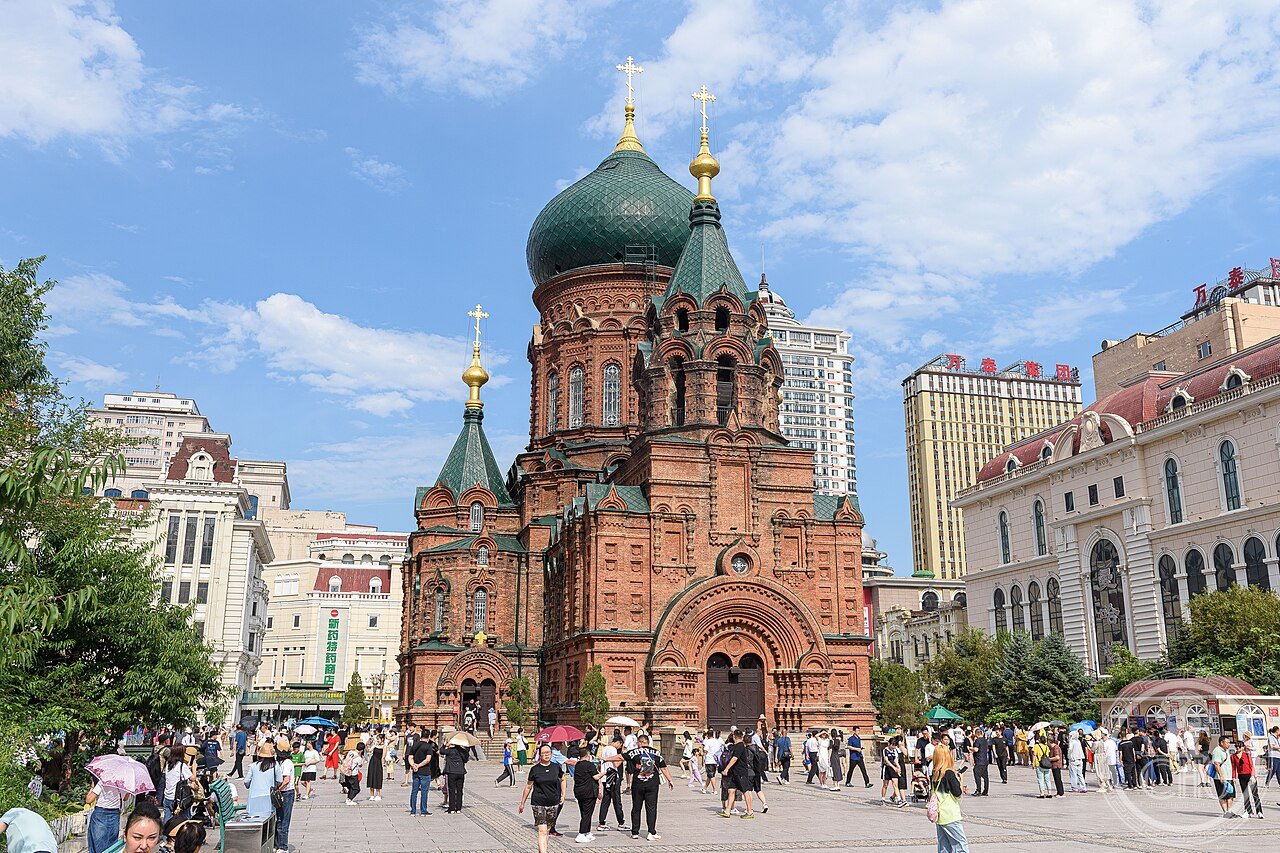
The green onion dome of Russian Manchuria – the largest Orthodox church of the Far East, monument of the Harbin the railway and the exiles built.
At a glance
- Type
- Former cathedral, now museum
- Period
- 1923-1932
- Style
- Russian Revival (Byzantine)
- Location
- Daoli district, Harbin, China
- Coordinates
- 45.7680, 126.6210
- Architect
- M. M. Oskolkov
Overview
Saint Sophia’s great green onion dome rises 53 metres over Harbin’s Daoli district – the largest Orthodox church in the Far East, rebuilt 1923-32 in brick Byzantine splendour for the Russian city the Chinese Eastern Railway created. Around it once spread the Moscow of the East: emigre Harbin’s cathedrals, bakeries, and conservatories north of the Songhua.
History
Railway builders raised the first wooden church in 1907; the revolution’s refugees – White officers, Jewish merchants, musicians – swelled Harbin to Russia-beyond-Russia, and the brick cathedral crowned their exile’s permanence that proved temporary: Manchukuo, war, and 1949’s departures emptied the parish. The Cultural Revolution walled the church behind warehouses; 1997’s restoration cleared the square that made it Harbin’s emblem, a museum of the city’s Russian century.
Architecture and Design
Greek-cross massing carries the central dome and tented bell tower in red brick laced with arcades; the interior’s peeled frescoes exhibit the architectural photographs of vanished Harbin. Evening lights and circling doves stage the square’s perpetual photography.
Cultural significance
The cathedral preserves China’s Russian chapter – railway imperialism, emigre culture, the ice city’s cosmopolitan birth – and anchors Harbin’s identity alongside the ice festival and the Central Street’s European parade.
Visiting today
The museum opens daily; the square’s dusk illumination is the classic shot. Central Street’s Russian facades and the Songhua embankment extend the walk.
Getting there
Harbin metro and buses serve Daoli; the cathedral square lies minutes from Central Street’s pedestrian mile.
Sources and resources
Find it on the map
See this place and what’s around it →Record researched and written by Luigi De Marchi for Cultural Heritage Online, 2026.
📷 Become a Cultural Heritage Online photographer
Share your photos of places: they stay published under your name as the author. The more they're seen, the more you get noticed — and soon a contest will reward the most appreciated photos.
Log in or sign up free to add a photoIs this page about you?
This page is read by travellers and heritage enthusiasts who find it on Google. Tell us how you are connected to this place and we will take it from there.