
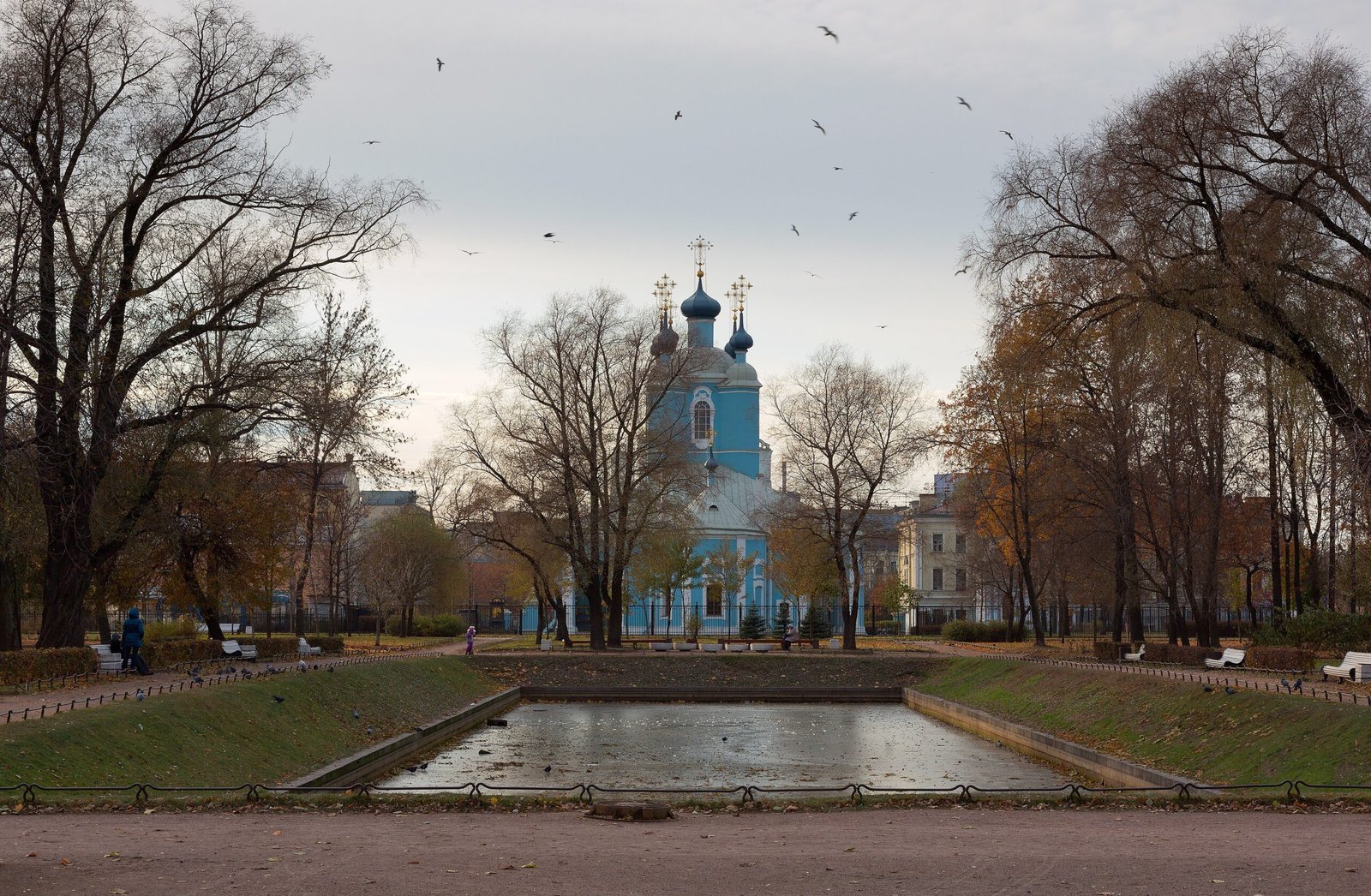
The oldest surviving church in St. Petersburg, built to commemorate Peter the Great’s decisive victory over Charles XII of Sweden and crowned with five golden domes.
At a glance
Saint Sampson’s Cathedral stands on the northern outskirts of St. Petersburg, its name echoing across Sampsonievsky Avenue. Consecrated in 1740, it remains the city’s earliest extant church—a monument to faith and military triumph intertwined.
History
A wooden church first rose on this site in 1710, dedicated to Sampson the Hospitable on the feast day when Peter the Great vanquished Charles XII of Sweden at the Battle of Poltava. Under Empress Anna, architect Pietro Antonio Trezzini redesigned the structure in stone, and it was consecrated in 1740.
Four subsidiary domes were added in 1761, transforming the original single dome into a distinctive quintet. To mark the battle’s bicentennial, the cathedral received a Rastrelliesque chapel and was elevated to cathedral status. Soviet rule brought hardship: the parish dissolved in the 1930s and the building became a warehouse. Restoration arrived in the late 1970s; the cathedral reopened as a museum in 2000. On 5 February 2017, it transferred from state stewardship to the Russian Orthodox Church.
What you see
Five gleaming domes—one principal, four subsidiary—crown the cathedral’s skyline. The tent-like belltower, added after the initial consecration, rises with distinctive character. Inside and out, the building reflects Trezzini’s refined baroque vocabulary.
A statue of Peter the Great, designed by Mark Antokolsky, stands before the cathedral. Removed during the Soviet era, it was restored in 2003 for the city’s tercentenary. A Rastrelliesque chapel adjoins the grounds, its walls inscribed with Peter’s address to his Poltava soldiers.
Cultural significance
Saint Sampson’s embodies the intertwining of military glory and Orthodox piety in Russian imperial consciousness. Legend claims Catherine II married Grigory Potemkin here secretly in 1774, adding a whispered chapter to its history.
The surrounding graveyard holds the remains of St. Petersburg’s earliest foreign architects, including Jean-Baptiste Alexandre Le Blond and Domenico Trezzini. The 1885 tomb of executed officials Artemy Volynsky and Pyotr Yeropkin, by sculptor Alexander Opekushin, commemorates tragedy precisely thirty-one years after Poltava.
Key facts
- Country: Russia
- City: St. Petersburg
- Consecrated: 1740
- Architect: Pietro Antonio Trezzini
- Coordinates: 59.968369, 30.34281
Practical information & getting there
The cathedral stands on the northern outskirts of St. Petersburg, accessible via Sampsonievsky Avenue. It functions as an active Orthodox cathedral following its 2017 transfer to church administration. For current visiting hours and worship schedules, contact the cathedral directly or the St. Isaac’s Cathedral Museum Complex, which previously managed the site.
Sources & resources
Find it on the map
See this place and what’s around it →📷 Become a Cultural Heritage Online photographer
Share your photos of places: they stay published under your name as the author. The more they're seen, the more you get noticed — and soon a contest will reward the most appreciated photos.
Log in or sign up free to add a photoIs this page about you?
This page is read by travellers and heritage enthusiasts who find it on Google. Tell us how you are connected to this place and we will take it from there.