
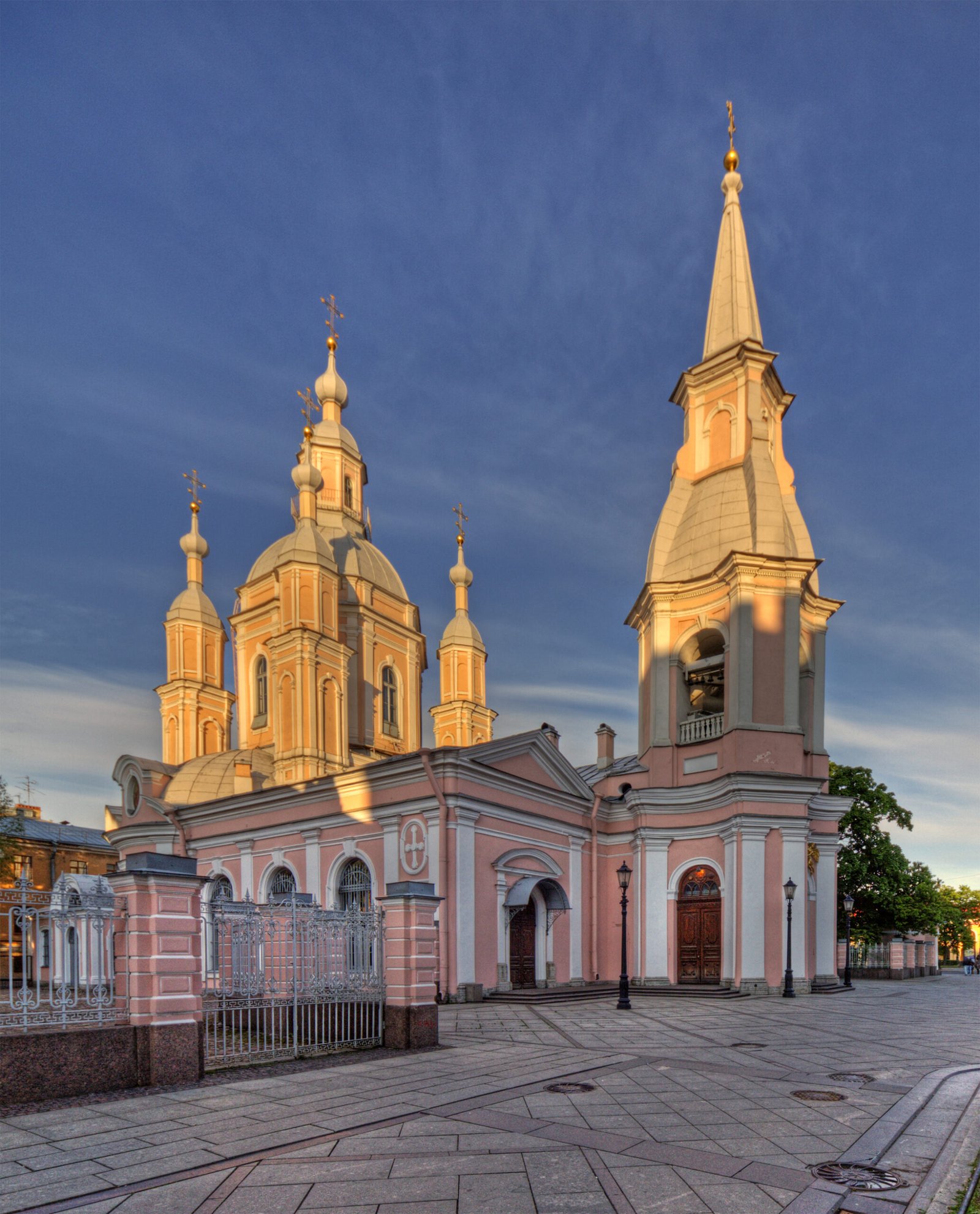
The last Baroque cathedral built in Saint Petersburg, Saint Andrew’s Cathedral stands as a monument to architectural ambition, imperial patronage, and the turbulent history of Orthodox Russia.
At a glance
This five-domed pastel pink cathedral was originally conceived under Peter the Great as the chapter church of Russia’s first chivalric order. Its construction spanned decades, marked by setbacks including the collapse of its dome. Today it remains one of Saint Petersburg’s most significant religious buildings and a testament to 18th-century Russian Baroque style.
History
Peter the Great commissioned the cathedral as the chapter church of the Order of Saint Andrew. Nicodemus Tessin the Younger, a renowned Nordic architect, initially designed a monumental structure modeled on St Paul’s Cathedral in London. The tsar’s death suspended the ambitious project.
In 1732, architect Giuseppe Trezzini erected a modest timber church on the site, consecrated on 8 October. As the congregation grew, Trezzini designed a stone replacement, founded in 1740 and consecrated in 1760. On 4 July 1761, lightning destroyed the wooden cathedral. Alexander Whist designed its successor, founded in 1764. A cupola collapse in 1766 delayed completion until 21 March 1780, when the five-domed cathedral was finally consecrated.
After 1917, the Bolsheviks confiscated valuables and closed the cathedral in 1938, destroying its bells. During the Siege of Leningrad, the dome housed defensive cannons. The Russian Orthodox Church recovered the building in 1992.
What you see
The cathedral presents a restrained Baroque aesthetic in soft pink. Five domes crown the structure, which stands adjacent to a pyramidal bell-tower built in 1784–86 and originally fitted with ten bells, the largest exceeding four tons. A refectory connects the tower to the main church.
Emperor Paul commissioned a relief above the entrance depicting the Order of Saint Andrew carried by two angels, reasserting the cathedral’s ceremonial role. The interior features an impressive 18th-century iconostasis, augmented during renovations in 1857. A special imperial chair was reserved for the tsar until 1813. When the first permanent bridge across the Neva was completed in the 1850s, an affiliated chapel was established on it.
Cultural significance
Saint Andrew’s Cathedral embodies the architectural aspirations of imperial Russia and the evolution of Saint Petersburg’s religious identity. It served as a venue for state ceremonial life and witnessed the inauguration of Mikhail Lomonosov and Vasily Trediakovsky as professors of the Imperial Academy of Sciences in 1745.
The cathedral’s turbulent 20th-century history—confiscation, closure, militarization, and restoration—mirrors the broader trauma of Russian Orthodoxy under Soviet rule. Its return to the Church in 1992 marked a symbolic restoration of religious freedom.
Key facts
- Location: Saint Petersburg, Russia
- Coordinates: 59.939818, 30.283376
- Consecrated: 21 March 1780
- Architect: Alexander Whist (1722–94)
- Style: Late Baroque
- Notable feature: Five-domed structure with attached bell-tower (1784–86)
- UNESCO World Heritage Site: Part of Historic Centre of Saint Petersburg
Practical information & getting there
The cathedral is located on Kazanskaya Street in central Saint Petersburg. Public transport connections serve the area. Check locally for current visiting hours and Orthodox service times. The site remains an active place of worship.
Sources & resources
Find it on the map
See this place and what’s around it →📷 Become a Cultural Heritage Online photographer
Share your photos of places: they stay published under your name as the author. The more they're seen, the more you get noticed — and soon a contest will reward the most appreciated photos.
Log in or sign up free to add a photoIs this page about you?
This page is read by travellers and heritage enthusiasts who find it on Google. Tell us how you are connected to this place and we will take it from there.