
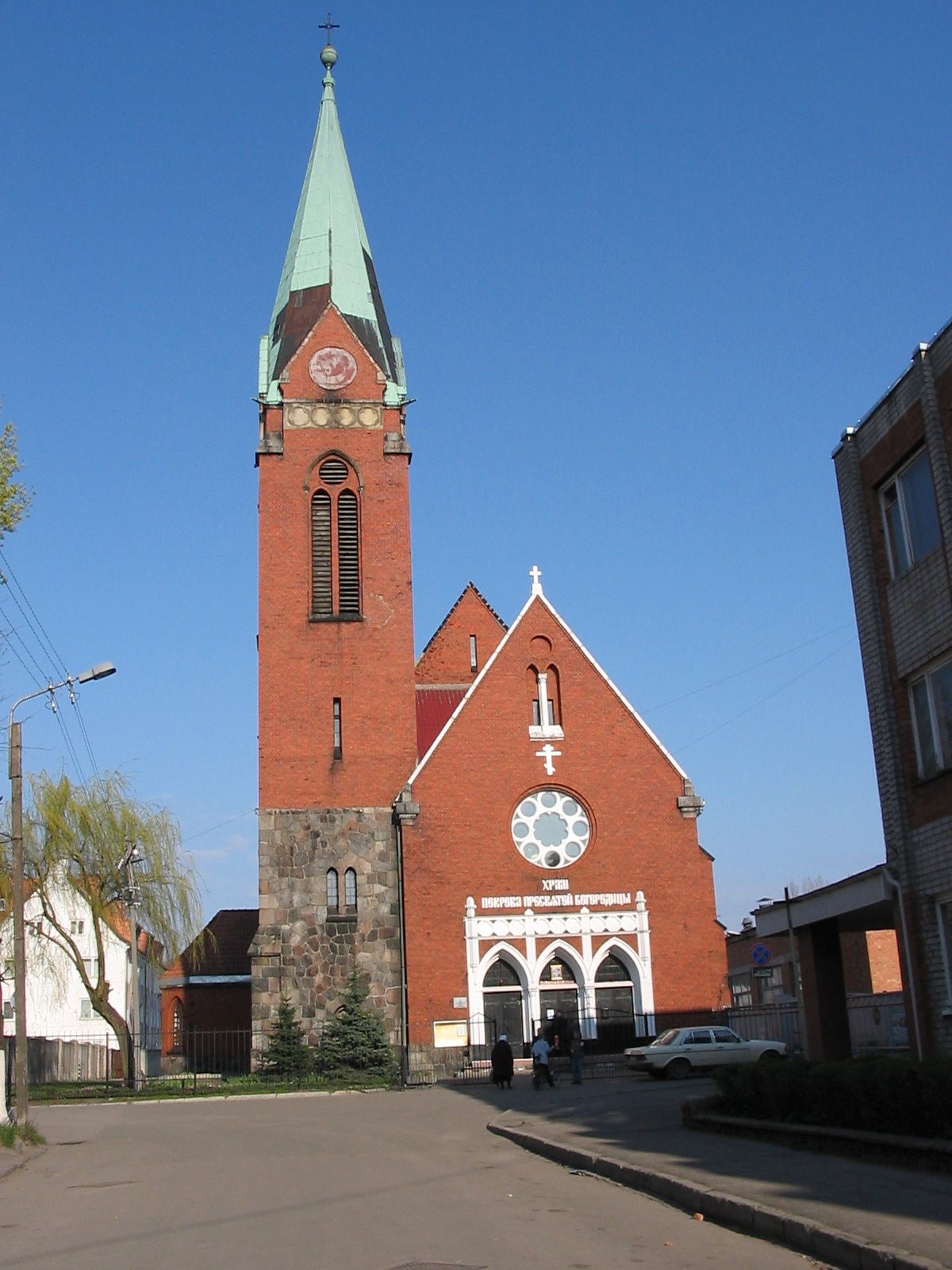
A Neo-Gothic parish church begun under the Kaiser and finished under the Weimar Republic, built partly from stones of a dismantled fortress.
At a glance
Rosenau Church stands in what was once the Rosenau quarter of southern Königsberg, now part of Kaliningrad. Raised as a Protestant church for a growing suburban parish, it was built in the Gothic Revival style favored across German church architecture of the era. Today it serves the Russian Orthodox Church, a change in confession that mirrors the city’s broader transformation after 1945.
History
The land came from the Schulte-Heuthaus family, the last private owners of the Rosenau estate, who donated it for the new church. Construction began on 23 July 1914. Weeks later, war intervened. The outbreak of the First World War halted work indefinitely, leaving the site unfinished for over a decade. Building resumed only in 1925, running from 2 April of that year to completion on 12 December 1926. The church survived the Second World War with light damage, an unusual outcome given the near-total destruction of Königsberg’s center. Under Soviet rule it lost its religious function entirely, repurposed as a storage building. Renovation took place from 1990 to 1992, restoring it to use as a place of worship after decades of secular neglect.
What you see
The church is Neo-Gothic, built to the pointed-arch vocabulary common to Protestant churches of the period. What distinguishes its fabric is its source material. Sections of the Königsberg fortifications, dismantled as the city’s defensive rings became obsolete, were incorporated into the construction. The stone therefore carries a double history: military engineering repurposed as sacred architecture. The result is a building whose walls quietly recycle the city’s own defensive past.
Cultural significance
Few buildings in Kaliningrad so directly embody the region’s layered identity. Built by German Protestants, interrupted by war, completed under a different German government, then converted to Soviet storage and finally to Orthodox worship, the church’s use has shifted with every major political rupture of the twentieth century. Its survival, even lightly damaged, makes it a rare physical link to pre-war Rosenau. The heritage listing recognizes both its architectural merit and its role as surviving evidence of the vanished German suburb.
Key facts
- Location: Kaliningrad, Russia (former Rosenau, Königsberg)
- Style: Gothic Revival (Neo-Gothic)
- Construction begun: 23 July 1914
- Completed: 2 April 1925 – 12 December 1926
- Renovated: 1990–1992
- Current use: Russian Orthodox church
- Heritage-listed: Yes
Practical information & getting there
The church stands within Kaliningrad, reachable as part of a walk or drive through the city’s southern districts. As an active place of worship, you should expect it to be open primarily around services; check the parish’s own channels before visiting. Dress and behave as you would at any working Orthodox church. No admission fee is indicated by available sources.
Sources & resources
Find it on the map
See this place and what’s around it →📷 Become a Cultural Heritage Online photographer
Share your photos of places: they stay published under your name as the author. The more they're seen, the more you get noticed — and soon a contest will reward the most appreciated photos.
Log in or sign up free to add a photoIs this page about you?
This page is read by travellers and heritage enthusiasts who find it on Google. Tell us how you are connected to this place and we will take it from there.