
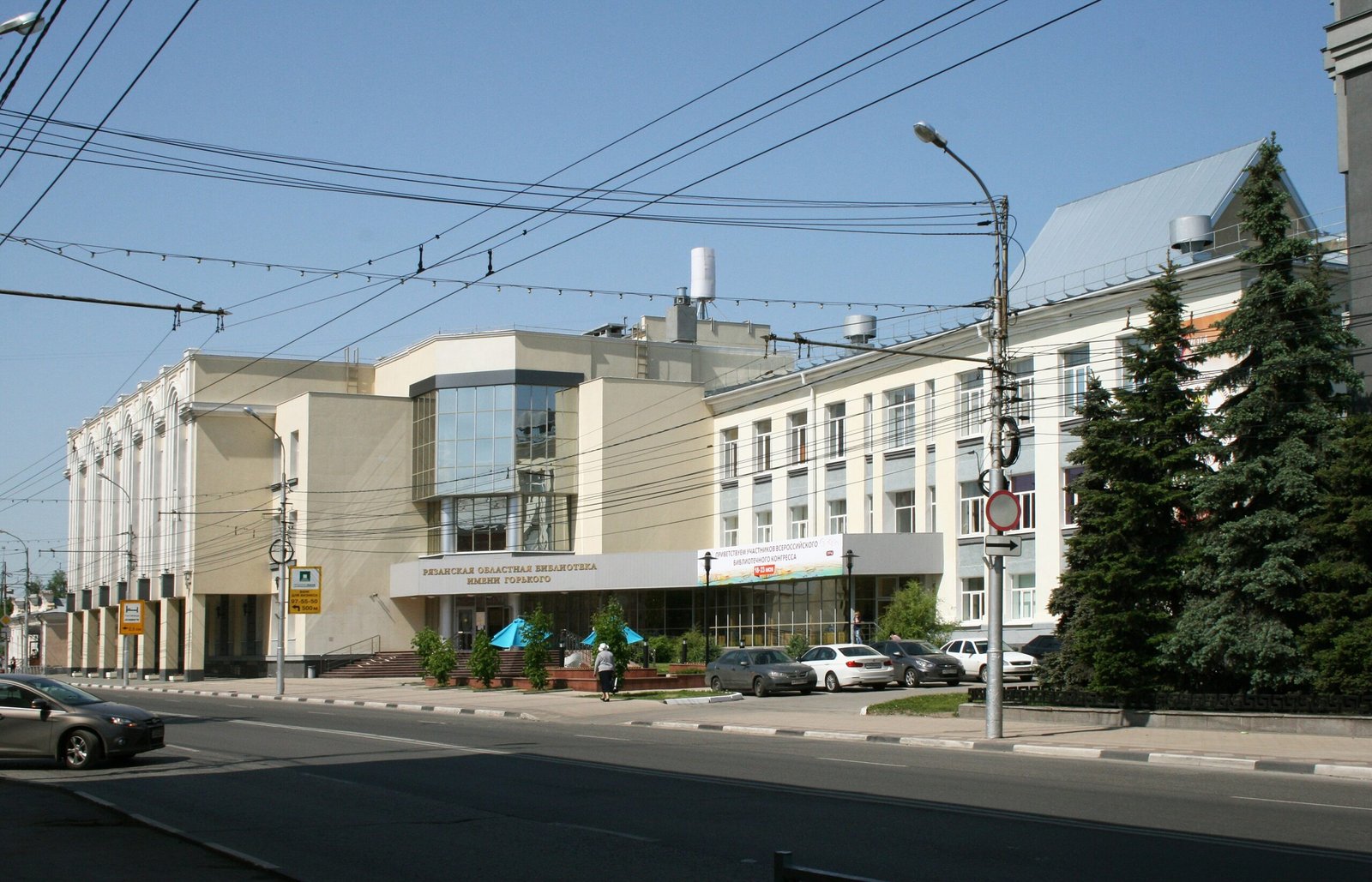
Founded by public subscription in 1858, this Ryazan institution grew from a modest reading room of 1,275 volumes into the region’s central scientific library, and remains a working civic space today.
At a glance
The Ryazan Oblast Universal Scientific Library, popularly known as the Gorky Library, opened in the town center in 1858. It was among the first public libraries in Russia to offer open access to its shelves. Today it functions as the oblast’s principal research library, spread across a two-wing main building and a nearby branch.
History
Public libraries had gained favor in Russian society by the 1830s, but Ryazan lacked the funds to open one until 1858. Local paper Ryazanskiye Gubernskiye Vedomosti published donor lists to raise support. Founders included gymnasium trustee Nikolay Ryumin and merchant-fabulist Alexander Antonov. The reading room was free; the lending subscription cost 6 roubles a year. Ivan Pavlov and writer Nikolay Zlatovratsky were among its early members. Novelist Mikhail Saltykov-Shchedrin, then vice governor of Ryazan, sat on its board of trustees. After the October Revolution the collection grew past 40,000 items through mergers. In 1928 the city council renamed it for Maxim Gorky, marking his 60th birthday. The library became an oblast institution in 1937, adding interlibrary loan and bibliographic services. It stayed open through the Great Patriotic War despite staff shortages, still drawing some 12,000 visitors annually. From the 1990s onward it modernized steadily, launching e-catalogues, a website in 1996, and a business-law information center in 1999.
What you see
The main building holds two distinct wings. The first was built between 1960 and 1964, in the plain functional idiom of that era. A monument to Gorky was placed within the building in 1968. The second wing, added in 2011, carries modern interiors that contrast with the older structure. Together they house reading rooms, offices and event spaces. A single branch stands close by, on Nikolodvoryanskaya Street.
Cultural significance
Few provincial Russian libraries can claim a founding roster touching a future Nobel laureate and a major novelist. The library’s early adoption of open-shelf access set it apart from more restrictive contemporaries. Its long-running Olympus art club, active since 1966, has hosted singers Yevgeny Nesterenko and Zurab Sotkilava alongside poets and composers. Free language clubs, from Arabic to Sanskrit, extend its reach beyond books. The institution has quietly tracked Russia’s civic and technological shifts for over a century and a half.
Key facts
- Founded: 1858, in Ryazan town center
- Renamed for Maxim Gorky in 1928
- Became an oblast library in 1937
- Main building’s first wing built 1960–1964; second wing added 2011
- Gorky monument installed within the building in 1968
- Location: Ryazan, Ryazan Oblast, Russia
Practical information & getting there
The library sits at 24 Lenin Street in central Ryazan, with its branch nearby on Nikolodvoryanskaya Street. You can reach both easily on foot from the historic core of the city. Free Wi-Fi is available throughout, and library laptops can be used on site. Lifts and ramps accommodate wheelchair users. Check the official website before visiting for current opening hours and event schedules.
Sources & resources
Find it on the map
See this place and what’s around it →📷 Become a Cultural Heritage Online photographer
Share your photos of places: they stay published under your name as the author. The more they're seen, the more you get noticed — and soon a contest will reward the most appreciated photos.
Log in or sign up free to add a photoIs this page about you?
This page is read by travellers and heritage enthusiasts who find it on Google. Tell us how you are connected to this place and we will take it from there.