
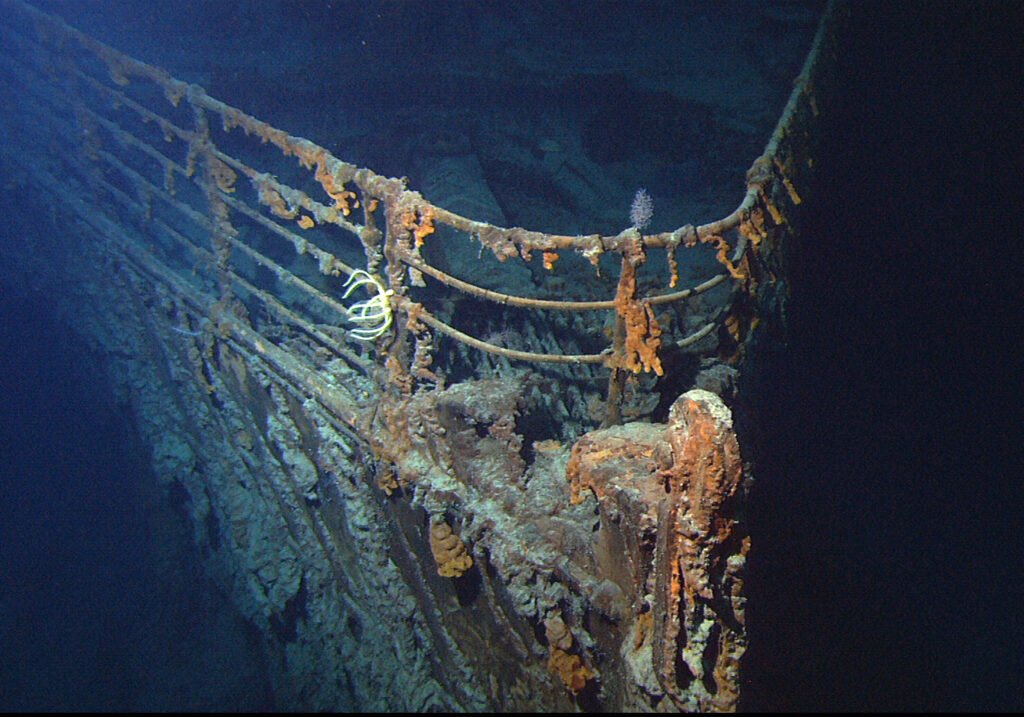
The wreck of the British transatlantic liner that struck an iceberg on 14 April 1912 and sank in the early hours of 15 April, killing over 1,400 people and transforming maritime safety forever.
At a glance
RMS Titanic was a British transatlantic liner of the Olympic class, designed and built at Belfast’s Harland and Wolff shipyards. At the time of her sinking, she was the largest and most luxurious transatlantic vessel in the world. The ship now rests on the floor of the North Atlantic Ocean, approximately 400 miles south-southeast of Newfoundland.
History
Titanic was constructed as one of three Olympic-class liners intended to dominate transatlantic routes for the White Star Line. The ultimate expression of naval technology at the time, she departed Southampton on her maiden voyage bound for New York on 10 April 1912.
At 23:40 ship’s time on Sunday, 14 April 1912, Titanic collided with an iceberg. The impact opened the hull below the waterline, flooding the first five watertight compartments. Two hours and forty minutes later, at 2:20 am on 15 April, the vessel sank, breaking into two sections.
Between 1,490 and 1,523 people perished, including approximately 900 crew members. Only 706 people were rescued; six were saved from the water itself. The disaster shocked global public opinion and prompted the first international conference on maritime safety.
What you see
The wreck lies at a depth of approximately 3,800 meters. The ship rests in two main sections on the Atlantic floor, separated by a debris field. The bow and stern sections remain largely intact, allowing researchers to study the vessel’s construction and the nature of the damage inflicted by the collision.
Cultural significance
The Titanic disaster remains one of history’s most consequential maritime catastrophes. It transformed public discourse around ship design, lifeboat capacity, and safety protocols at sea. The wreck has become an enduring symbol of human ambition, technological hubris, and the unpredictability of nature—inspiring countless books, films, and exhibitions. Full-scale reconstructions have been created in theme parks, keeping the ship’s story alive for new generations.
Key facts
- Sank: 15 April 1912
- Location: North Atlantic Ocean, approximately 400 miles south-southeast of Newfoundland
- Coordinates: 41.7255556, -49.9491331
- Passengers and crew lost: 1,490–1,523
- Survivors: 706
Practical information
The wreck site is inaccessible to the general public. Access requires specialized deep-sea submersibles and is restricted to authorized research expeditions and documentary projects.
Getting there
The wreck lies in international waters of the North Atlantic Ocean. Expeditions depart from ports in Newfoundland, Canada, and require advanced underwater exploration equipment and expertise.
See the place
Sources & resources
Find it on the map
See this place and what’s around it →Events here — now on & upcoming
- Anniversary: The Wreck of the Titanic is Found — September 1, 198501 Sep 2027See the event →
📷 Become a Cultural Heritage Online photographer
Share your photos of places: they stay published under your name as the author. The more they're seen, the more you get noticed — and soon a contest will reward the most appreciated photos.
Log in or sign up free to add a photo