

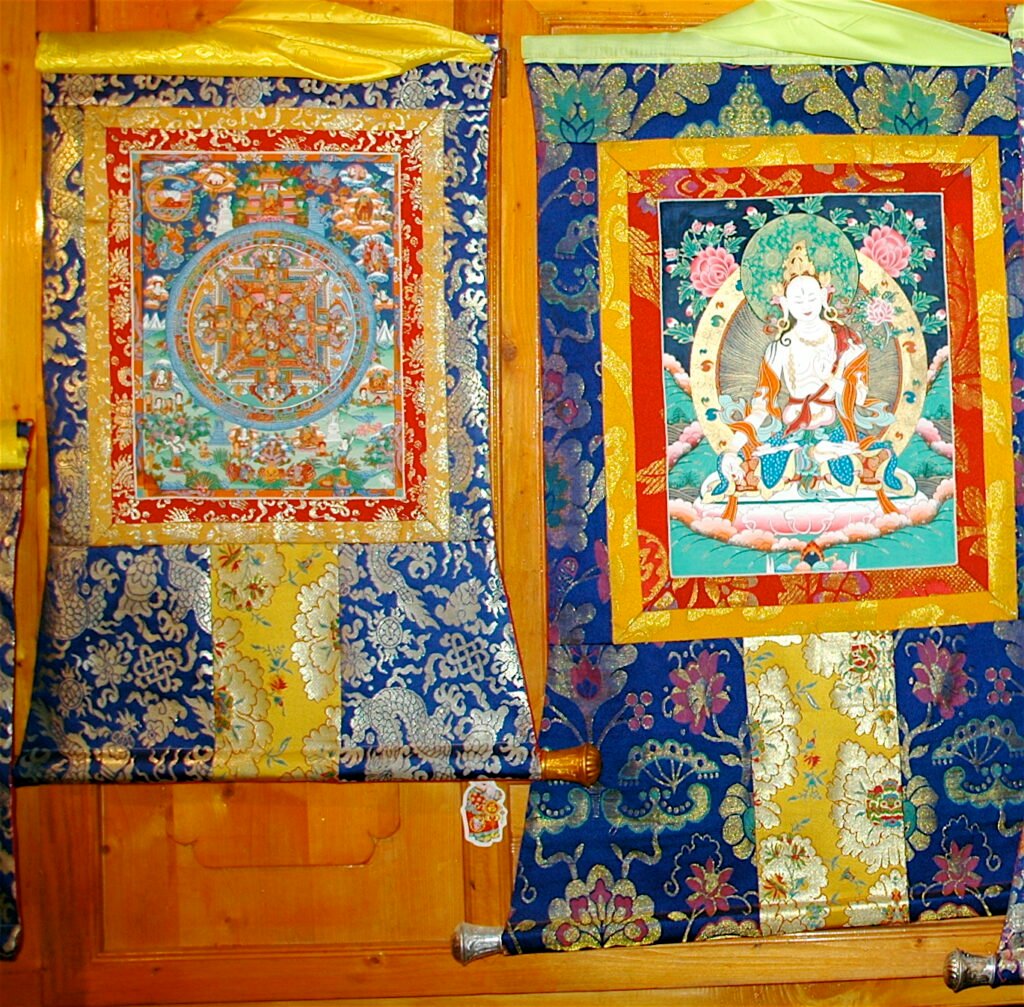
A living constellation of Tibetan Buddhist visual and material practices—painting, sculpture, engraving, architecture, and embroidery—rooted in the high-altitude valleys of Qinghai.
In UNESCO’s words
In monasteries and villages along the Longwu River basin in Qinghai Province in western China, Buddhist monks and folk artists of the Tibetan and Tu ethnicity carry on the plastic arts of painting ''thangka'' and murals, crafting patchwork ''barbola'' and sculpting known collectively as the Regong arts. Their influence extends to nearby provinces and beyond to South-East Asian countries. Thangka, the art of painting religious scrolls used to venerate Buddha, uses a special brush to apply natural dyes to cloth prepared with patterns sketched in charcoal; barbola employs plant and animal forms cut from silk fabric to create soft relief art for veils and column ornaments; and wood, clay, stone or brick Regong sculpture decorates rafters, wall panels, tea tables and cabinets in both temples and homes. The technique is mainly passed from fathers to children or from masters to apprentices strictly following ancient Buddhist painting books that provide instruction on line and figure drawing, colour matching and pattern design. Characterized by a distinctively Tibetan Buddhist religion style and unique regional features, the Regong arts embody the spiritual history and traditional culture of the region and remain an integral part of the artistic life of people there today
Official description, UNESCO Intangible Cultural Heritage List — Regong arts
At a glance
The Regong arts are a collection of plastic arts practised by Buddhist monks and folk artists of Tibetan and Tu ethnicity in monasteries and villages along the Longwu River basin in Qinghai Province. They include thangka painting on cloth, mural painting, patchwork barbola work in silk, and sculpture in wood, clay, stone or brick. These arts decorate temples and homes, and their influence reaches nearby provinces and beyond to South-East Asian countries.
Origins & history
The Regong arts developed within Buddhist monastic and village communities in the Longwu River basin region. The techniques follow ancient Buddhist painting books that provide instruction on line and figure drawing, colour matching and pattern design. Knowledge is passed down strictly from fathers to children or from masters to apprentices, preserving methods refined across generations.
The practice
Thangka painters apply natural dyes to cloth prepared with charcoal-sketched patterns, using a special brush. Barbola artists cut plant and animal forms from silk fabric to create soft relief art for veils and column ornaments. Sculptors work wood, clay, stone or brick to decorate rafters, wall panels, tea tables and cabinets in temples and homes. All practitioners follow ancient Buddhist painting books for guidance on technique and design.
Cultural significance
The Regong arts embody the spiritual history and traditional culture of the region, characterised by a distinctively Tibetan Buddhist religious style and unique regional features. They remain an integral part of the artistic life of communities along the Longwu River basin today, connecting practitioners and viewers to Buddhist devotion and local identity.
Key facts
- Country: China
- Inscribed: 2009
- UNESCO list: Representative List of the Intangible Cultural Heritage of Humanity
- UNESCO reference: 00207
- UNESCO vocabulary: Painting; Religious art; Sculpture
- Map: Longwu River basin — the locality named in UNESCO’s official description of this element
Where to experience it
The Regong arts thrive in monasteries and villages along the Longwu River basin in Qinghai Province, where Buddhist monks and folk artists of Tibetan and Tu ethnicity continue these traditions. Visitors encounter thangka paintings, barbola patchwork, and distinctive sculptures in active monasteries, through artisans' workshops, and in the decorated temples and homes throughout the region. The techniques remain integral to both spiritual practice and daily artistic life, passed down through generations from masters to apprentices following ancient Buddhist traditions.
Sources & resources
- UNESCO — official element page: Regong arts
- UNESCO — open data record: Intangible Heritage List, reference 00207
- UNESCO — official video: UNESCO film on this element — embedded on this page
- UNESCO — official photograph: Photograph of this element — Ka'er Zejie — Qinghai Regong Art Society of China, 2008
- Reference — Wikipedia (secondary): Regong arts — consulted as a secondary reference, not as confirmation
- Cultural Heritage Online: Our archive and city guides

Find it on the map
See this place and what’s around it →📷 Become a Cultural Heritage Online photographer
Share your photos of places: they stay published under your name as the author. The more they're seen, the more you get noticed — and soon a contest will reward the most appreciated photos.
Log in or sign up free to add a photo