

Carved from the Denver Mountain Parks system in the foothills west of Denver, Red Rocks Amphitheatre combines two ancient red sandstone monoliths with a WPA-era permanent stage structure to create one of the world’s most extraordinary outdoor performance venues.
At a glance
Red Rocks Amphitheatre sits in the Jefferson County foothills at an elevation of approximately 6,450 feet, flanked by two massive red sandstone formations — Creation Rock and Ship Rock — that rise 300 and 400 feet respectively above the stage. The natural bowl between the monoliths creates near-perfect acoustics: a geological accident exploited first by informal performers at the turn of the twentieth century, then formalized in 1931 when the City of Denver began planning a permanent venue. Denver architect Burnham Hoyt designed the permanent stage structure and terraced seating, completed in 1941, in the Streamline Moderne and WPA Rustic-Modern idiom that characterized the best federal and municipal public works of the era: poured concrete integrated with locally quarried red sandstone, the man-made elements deferring to the ancient geology rather than competing with it. The result is a venue of 9,525 capacity that has hosted everyone from the Beatles (1964) to U2, whose 1983 concert here became one of rock music’s defining live documents.
Key facts
- Completed: 1941 (permanent stage and seating by Burnham Hoyt; informal use predates 1900)
- Address: 18300 W Alameda Pkwy, Morrison, Colorado 80465
- Elevation: Approximately 6,450 feet above sea level
- Style: WPA Rustic-Modern with Streamline Moderne concrete elements
- Capacity: 9,525 seats (terraced stone seating)
- Geological feature: Two Permian-age red sandstone monoliths (Creation Rock and Ship Rock) rising 300-400 feet above the stage
- National Historic Landmark: Designated 2015
- Operator: Denver Mountain Parks, City and County of Denver
History
The sandstone formations west of Morrison attracted informal outdoor concerts as early as the 1890s, when soprano Mary Garden and other performers began exploiting the natural acoustics of the rock bowl. The City of Denver acquired the site as part of the Denver Mountain Parks system in 1914, but sustained development required both the civic vision and the fiscal resources of the New Deal era. In 1931, Denver initiated a formal plan for a permanent amphitheater; construction under the Civilian Conservation Corps and the Works Progress Administration proceeded through the 1930s, with the permanent stage structure and tiered seating by Denver architect Burnham Hoyt completed in 1941.
Hoyt’s design philosophy was one of integration rather than imposition: the concrete and sandstone construction materials were chosen to echo the dominant red and grey geology of the site, the stage house was kept low to preserve sightlines to the surrounding mountains, and the terraced seating follows the natural contour of the hillside with minimal excavation. The result was a building that looked as if it had grown from the site rather than been placed upon it — a key ambition of the WPA Rustic-Modern tradition that produced some of America’s most enduring public spaces during the Depression decade.
The amphitheater’s international fame grew through the second half of the twentieth century as it attracted the defining concerts of successive rock generations. The Beatles performed here in 1964; Jimi Hendrix, Grateful Dead, John Denver, and Bruce Springsteen made it a pilgrimage site for American audiences. U2’s 1983 recording “Under a Blood Red Sky” — filmed here — introduced the venue to a global audience. Designation as a National Historic Landmark in 2015 acknowledged its significance not merely as a geological feature but as a designed landscape of the highest cultural and architectural consequence.
What you see
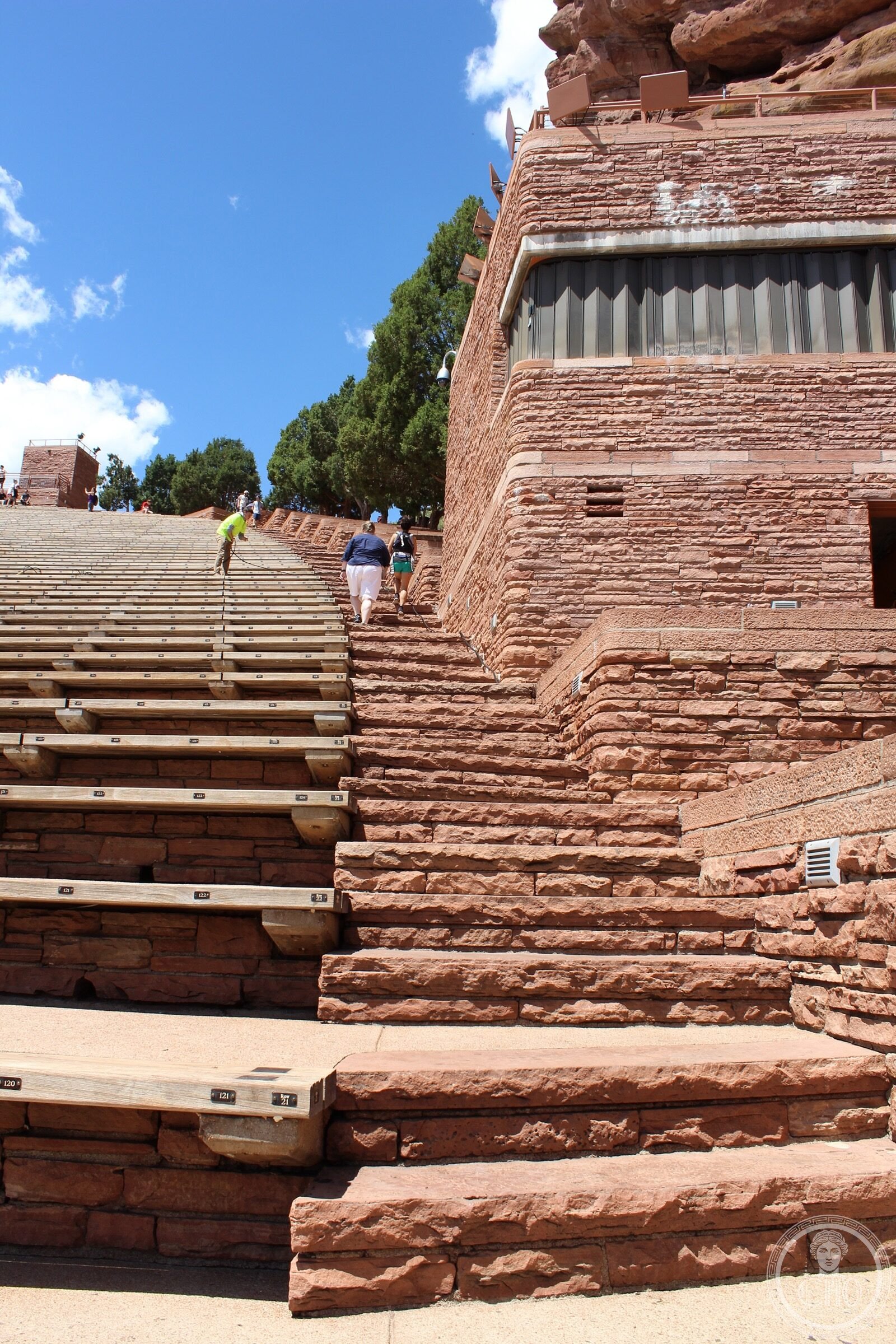
Burnham Hoyt’s permanent structures — the stage house, the terraced seating, the perimeter walls, and the trading post — are executed in poured concrete faced with locally quarried red sandstone, a material palette that allows the manmade elements to recede into the landscape. The stage house is deliberately understated: a low concrete structure with horizontal banding and Streamline Moderne detailing that draws the eye upward to the monoliths rather than toward the architecture itself. The trading post building, at the north end of the amphitheater, displays more decorative stonework: corbeled courses, arched openings, and carefully composed proportions that give it the character of a permanent mountain lodge rather than a temporary concession structure.
The 9,525 seats are cut directly from the hillside in terraced rows of red sandstone, an arrangement that gives every seat a clear view of both the stage and the mountain panorama to the east — a 180-degree horizon of plains, foothills, and Denver skyline that changes character with the light. At sunset the sandstone monoliths shift from terracotta orange through blood red to deep purple as the light withdraws, a chromatic performance that has made evening concerts here a ritual experience as much architectural as musical.
Practical information
- Hours: The park is open year-round; outdoor concerts run April through October — check the Red Rocks website for the full schedule
- Elevation note: The site is at 6,450 feet; visitors from lower elevations should allow time to acclimatize, especially for evening events with physical activity
- Weather: Mountain weather is variable; bring layers even in summer, as temperatures drop sharply after sunset and afternoon thunderstorms are common June-August
- Access: Accessible seating sections available; shuttle service from Denver light rail stations on performance nights
- Time needed: 2-4 hours for a full concert; the park and geological features warrant a half-day visit in daylight hours even without a performance
Getting there
Red Rocks is located in Morrison, Colorado, approximately 15 miles west of Denver via US Highway 285 or Interstate 70. By car, take I-70 west from Denver to the Morrison exit (Exit 259), then follow the signs south and west on Highway 26 to the park entrance. On performance nights, RTD (Denver’s light rail) operates shuttle buses from the Federal Center and Union Stations, making the venue accessible without a car from central Denver. Denver International Airport (DEN) is approximately 40 miles east of the amphitheater via I-70; the trip takes roughly 45 minutes to 1 hour in non-peak traffic. Parking at Red Rocks is ample but fills quickly on major concert evenings: arrive early or use the RTD shuttle.
Nearby
- Dinosaur Ridge National Natural Landmark — Ridge trail just south of Red Rocks where dinosaur tracks and bones are exposed in the Morrison Formation geology; a 15-minute drive
- Denver Art Museum — The Daniel Libeskind-designed addition (2006) houses one of America’s strongest Native American and Western art collections, approximately 20 miles east in downtown Denver
- Paramount Theatre (1930), Denver CO — Art Deco movie palace in downtown Denver, offering a complementary architectural experience from the same era as the Red Rocks stage structures
- Mayan Theatre (1930), Denver CO — Pre-Columbian Revival cinema in south Denver, designed the same year the Red Rocks project was first planned
Sources
- Denver Mountain Parks official history, City and County of Denver
- National Historic Landmark designation documentation, National Park Service (2015)
- Burnham Hoyt architectural records, Denver Public Library Western History Collection
- Phyllis Smith, A Look at Boulder from Afar (2004), regional architectural context
- Wikimedia Commons, Red Rocks Amphitheatre photographic record
Find it on the map
See this place and what’s around it →Record researched and written by Luigi De Marchi for Cultural Heritage Online, 2026.
📷 Become a Cultural Heritage Online photographer
Share your photos of places: they stay published under your name as the author. The more they're seen, the more you get noticed — and soon a contest will reward the most appreciated photos.
Log in or sign up free to add a photoIs this page about you?
This page is read by travellers and heritage enthusiasts who find it on Google. Tell us how you are connected to this place and we will take it from there.