

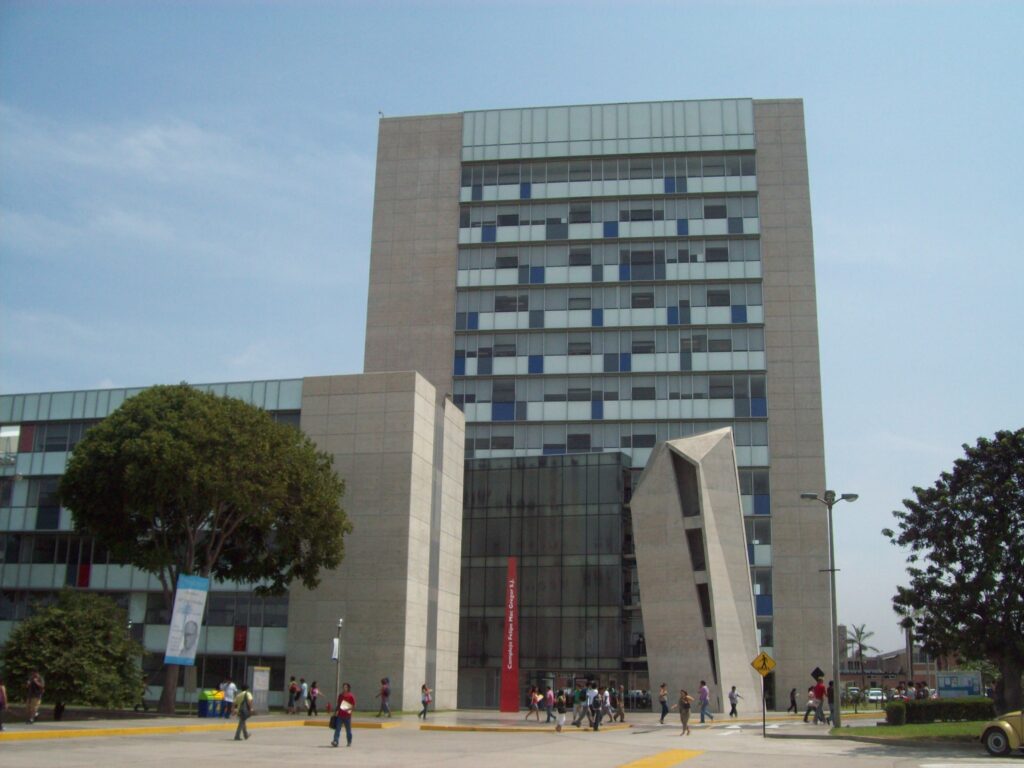
The Escuela de Posgrado of the Pontificia Universidad Católica del Perú runs its master's and doctoral programmes from the Complejo Felipe Mac Gregor S.J., opened on the San Miguel campus in 2008.
At a glance
The graduate school is the part of PUCP that awards master's degrees and doctorates, with more than ninety programmes in all. It works from the Complejo Felipe Mac Gregor S.J., a group of buildings on the university campus in San Miguel, Lima. The complex was inaugurated on 13 November 2008. It belongs to the university's growth plan and takes its name from a former rector. Among its programmes is the Master's in Archaeology with a mention in Andean Studies, part of the Andean Studies Programme.
Key facts
- Graduate school of the Pontificia Universidad Católica del Perú
- Home: Complejo Felipe Mac Gregor S.J., PUCP campus, San Miguel
- Complex inaugurated on 13 November 2008
- More than ninety postgraduate programmes
- 17 doctorates and 90 master's degrees on the school's books
- Andean Studies Programme: master's from 2006, doctorate from 2008
- Address: Avenida Universitaria 1801, San Miguel, Lima
History
The Escuela de Posgrado has been running for more than fifty years. The university behind it is 105 years old. The school presents itself as the first Peruvian university accredited abroad for teaching at postgraduate level. The scheme is IAC CINDA. Its teaching staff of around four hundred includes doctors and masters trained in Peru and abroad.
The complex that houses it belongs to a later stage. PUCP built it under its growth plan, and the university's own news service announced the inauguration on 13 November 2008, in the open air in front of the central garden. The name honours Felipe Mac Gregor S.J., rector from 1963 to 1977, who pushed the modernisation of the university.
The university describes the complex as a sustainable construction, in line with the environmental policy it had adopted. Benjamín Montañez, then head of the infrastructure office, explained the logic in 2008: the basic structure would not change, but the interiors would, as needs changed. The school itself moved into that frame.
The Andean Studies Programme, the school's interdisciplinary project on the Andean world, began its master's courses in Andean anthropology, archaeology, history and linguistics in 2006, and its doctorate in 2008. The Master's in Archaeology with a mention in Andean Studies belongs to it. The programme's director is Rafael Vega Centeno.
What you see
The Mac Gregor complex is a set of concrete and glass buildings around a central garden. It was built to be adapted, not preserved. The graduate school occupies part of it, with seminar rooms, offices and a programme secretariat. Nothing here is a monument: the building is a working frame for teaching, and its value is in what happens inside it.
The school teaches across the disciplines, with 17 doctorates and 90 master's degrees, plus more than 370 specialised courses open to students who are not enrolled in a degree. The Andean Studies Programme brings together the departments of anthropology, archaeology, history and linguistics, and its seminars draw visiting professors from outside Peru. Students have library and database access through the university system. The archaeology master's takes two years, or four academic semesters, and is taught in person.
Practical information
- Address: Avenida Universitaria 1801, San Miguel, Lima 15088, Peru.
- Where: Complejo Mac Gregor on the PUCP campus; the school's office is on an upper floor of the complex.
- Hours: Monday to Friday, 8.30am to 6.30pm.
- Programme enquiries: [email protected], telephone (01) 741 0181.
- Status: in use, on the university campus.
Getting there
The campus is on Avenida Universitaria in San Miguel, west of the historic centre of Lima and close to the district of San Isidro. The complex stands inside the campus, near the central garden.
Nearby
- Parque El Olivar, San Isidro
- Huaca Huallamarca
- Museo de la Nación
Sources
- https://posgrado.pucp.edu.pe/contacto/
- https://posgrado.pucp.edu.pe/la-escuela/presentacion/
- https://posgrado.pucp.edu.pe/maestria/arqueologia-con-mencion-en-estudios-andinos/
- https://posgrado.pucp.edu.pe/maestria/arqueologia-con-mencion-en-estudios-andinos/sobre-el-programa/
- https://www.pucp.edu.pe/climadecambios/noticias/hoy-se-inaugura-el-complejo-felipe-mac-gregor-s-j/
Find it on the map
See this place and what’s around it →📷 Become a Cultural Heritage Online photographer
Share your photos of places: they stay published under your name as the author. The more they're seen, the more you get noticed — and soon a contest will reward the most appreciated photos.
Log in or sign up free to add a photoIs this page about you?
This page is read by travellers and heritage enthusiasts who find it on Google. Tell us how you are connected to this place and we will take it from there.
This entry stays online and free either way — and a free account lets you add to it yourself.