

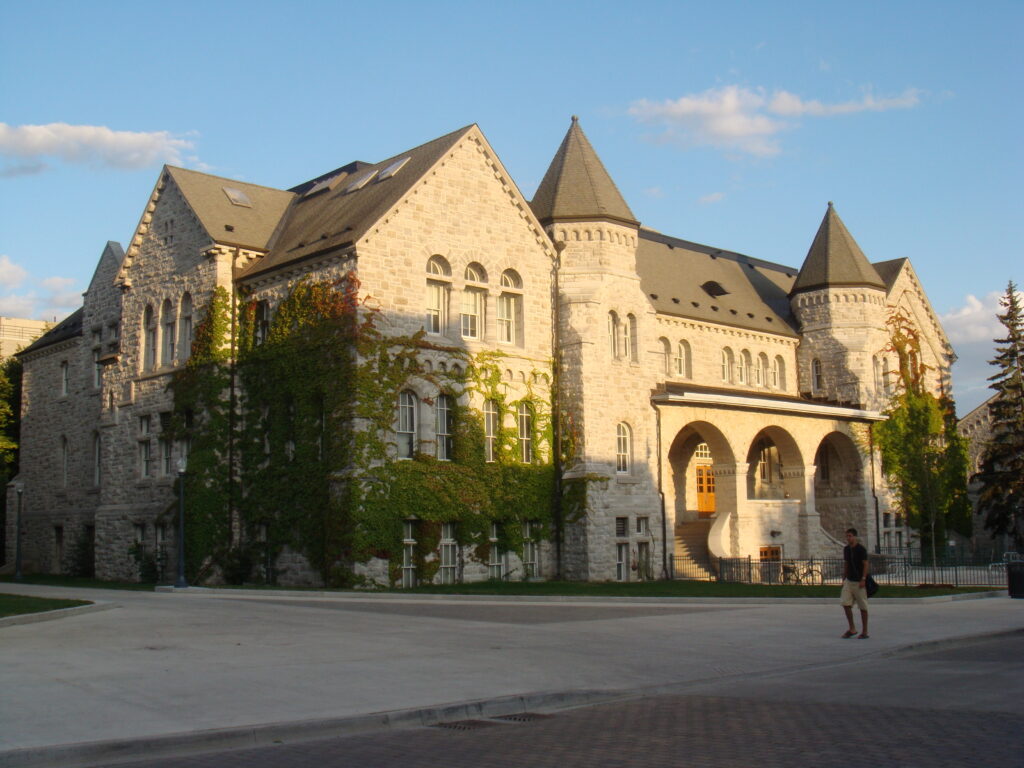
Ontario Hall, a limestone building of 1902 on University Avenue, holds Queen's University's department of art history and art conservation and its master's programme in conservation, founded in 1974.
At a glance
Ontario Hall is a three-storey building of rusticated Kingston limestone on University Avenue, on the lower campus of Queen's University in Kingston, Ontario. It went up in 1902. It now houses the Department of Art History and Art Conservation. The department runs the Master of Art Conservation, a two-year professional degree that trains conservators of paintings, objects and works on paper. The university's heritage study calls it an excellent example of the Romanesque style, part of an important grouping on lower University Avenue.
Key facts
- Built in 1902 to designs by Symons & Rae of Toronto
- A gift from the Province of Ontario
- Romanesque Revival facade in rusticated Kingston limestone
- Houses the Department of Art History and Art Conservation
- Master of Art Conservation founded in 1974 by Ian Hodkinson
- Two-year programme with two twelve-week summer internships
- Conservation laboratories temporarily at Innovation Park, 945 Princess Street
History
Ontario Hall was built in 1902, the first building on lower University Avenue, and it set the setback that the later halls followed. It was paid for by the Province of Ontario, and the cornerstone was laid by the Minister of Education of the day. The architects were Symons & Rae of Toronto, who gave the building a symmetrical front with two engaged towers, a wide arched entrance and a staircase curving up to the first floor.
For its first decades the building held science. Mineralogy, geology and physics were taught there, and the first two left for Miller Hall in 1931. Physics stayed longer. In 1950 an underground addition was built beneath the hall to house a new synchrotron particle accelerator. Chemical engineering, the school of navigation and a geology museum passed through the building too, and in the First World War part of it served as the dining room of the 5th Field Company of the Canadian Engineers.
The art conservation programme came much later. Ian Hodkinson, a paintings conservator trained in Edinburgh, came to Canada in 1969 and pressed the idea of an interdisciplinary training for conservators. He made his case twenty-eight times between 1970 and 1972. The senate approved the programme in December 1972, and the first twelve students began in 1974. They worked for a year in the basement of Gordon Hall, before the programme moved to Bader Lane, behind the Agnes Etherington Art Centre.
The building's science years are over. The department of art history and art conservation now works from it. In 2026 the conservation laboratories are to move again, into a new facility beside the Agnes Etherington Art Centre. Until then the teaching laboratories and the conservation studios are at Innovation Park on Princess Street, and Ontario Hall holds the department's offices and art history teaching.
What you see
From University Avenue the building reads as one long symmetrical front, with two gabled pavilions and two towers that turn hexagonal near the top and end in conical roofs. The entrance is the largest on the campus, reached by twin curving stairs. Inside, much of the original planning has been covered by later alterations, and the interiors are plain teaching rooms and offices rather than period set pieces.
The working life of the place is the conservation programme. Students in the treatment stream spend four terms on advanced lecture courses and laboratory work, then two twelve-week summer internships off campus. They specialise in paintings, artefacts or paper objects. A second stream, for conservators with at least five years of experience, is research-based and ends with a thesis. Places are few. Applicants are interviewed and asked for a portfolio.
Practical information
- Address: Department of Art History and Art Conservation, Ontario Hall, Room 211, 67 University Avenue, Kingston, Ontario K7L 3N6.
- Conservation laboratories: temporarily at Innovation Park, Door 29, 945 Princess Street, Kingston.
- Contact: [email protected], telephone (613) 533-6000 extension 32742.
- Applications: deadline 15 January each year, with interviews in March.
- Status: in use by the university; the heritage study treats it as a key building of lower University Avenue.
Getting there
Ontario Hall faces University Avenue, a few minutes on foot from the Kingston waterfront and from the centre of the Queen's campus. It stands between Douglas Library and Grant Hall.
Nearby
- Agnes Etherington Art Centre
- Grant Hall
- Douglas Library
- Kingston Hall
Sources
- https://www.queensu.ca/facilities/sites/facilwww/files/uploaded_files/CP%26RE/Heritage%20Study.pdf
- https://www.queensu.ca/academic-calendar/graduate-studies/programs-study/art-conservation/art-conservation-mac/
- https://www.queensu.ca/art/contact-us
- https://www.queensu.ca/art/art-conservation/prospective-students
- https://www.queensu.ca/art/sites/artwww/files/uploaded_files/interviews/Ian%20Hodkinson.pdf
Find it on the map
See this place and what’s around it →📷 Become a Cultural Heritage Online photographer
Share your photos of places: they stay published under your name as the author. The more they're seen, the more you get noticed — and soon a contest will reward the most appreciated photos.
Log in or sign up free to add a photoIs this page about you?
This page is read by travellers and heritage enthusiasts who find it on Google. Tell us how you are connected to this place and we will take it from there.
This entry stays online and free either way — and a free account lets you add to it yourself.