
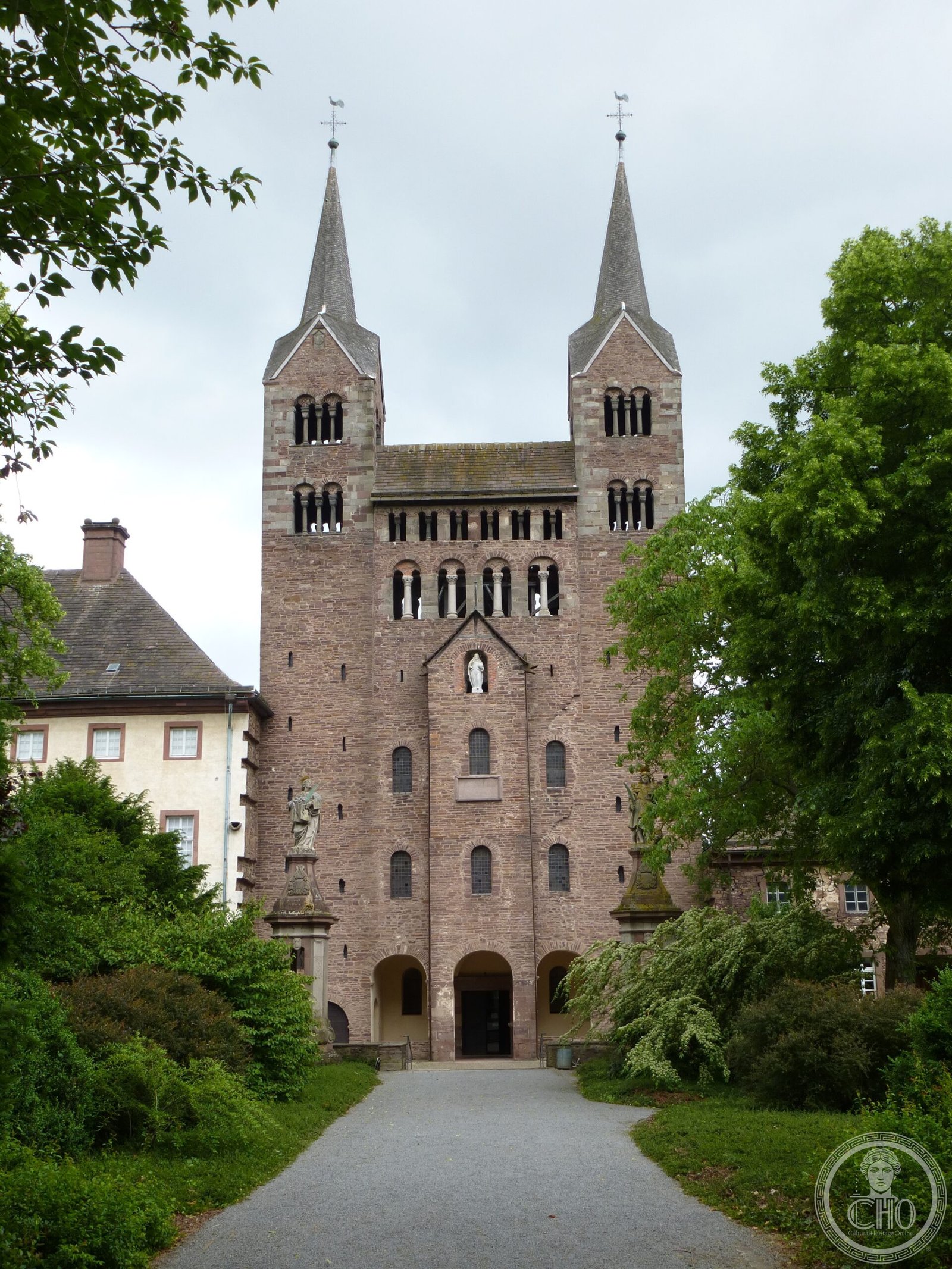
A former Benedictine abbey and one of the Holy Roman Empire’s self-ruling princely abbeys, Corvey preserves the oldest surviving westwork in Europe and rare Carolingian wall paintings interpreting classical mythology through Christian belief.
At a glance
Corvey stands as an architectural landmark spanning from the 9th century to the Baroque period. The abbey complex showcases exceptional Carolingian design and served as a model for subsequent medieval architecture across Western Europe.
History
Originally constructed in 822 and 885, Corvey emerged as one of only half a dozen self-governing princely abbeys within the Holy Roman Empire during the Late Middle Ages. In 1792, it was elevated to prince-bishopric status. Following the Napoleonic reorganization of German territories, the abbey was secularized in 1803 and absorbed into the newly formed Principality of Nassau-Orange-Fulda. Its vast territorial holdings made it a significant ecclesiastical power center for nearly a thousand years.
What you see
The abbey underwent extensive Baroque remodeling, yet its foundational Carolingian structure remains remarkably intact. The westwork—the monumental west-facing structure—is the oldest known example surviving from medieval Europe. Inside the westwork lie unique wall paintings that blend ancient mythological subjects with Christian interpretation, an extremely rare achievement in Carolingian art. The abbey’s innovative vaulted hall and encircling galleries profoundly influenced the development of Romanesque and Gothic architecture throughout the medieval west. Corvey represents the oldest standing medieval structure in Westphalia.
Cultural significance
Corvey’s architectural innovations established templates that shaped European sacred architecture for centuries. The integration of classical and Christian imagery in its wall paintings illuminates the intellectual and spiritual synthesis of the Carolingian Renaissance. Its persistence as a physical monument provides unparalleled insight into monastic life, imperial ecclesiastical governance, and medieval artistic achievement.
Key facts
- Country: Germany
- Location: North Rhine-Westphalia
- Coordinates: 51.77885, 9.40943
- Original construction: 822 and 885
- Status: UNESCO World Heritage Site (inscribed 2014)
- Secularized: 1803
Practical information & getting there
Corvey is located in North Rhine-Westphalia and is accessible to visitors as a UNESCO World Heritage Site. For current opening hours, admission fees, and detailed travel directions, consult the site’s official information or regional tourism resources.
Sources & resources
Find it on the map
See this place and what’s around it →📷 Become a Cultural Heritage Online photographer
Share your photos of places: they stay published under your name as the author. The more they're seen, the more you get noticed — and soon a contest will reward the most appreciated photos.
Log in or sign up free to add a photoIs this page about you?
This page is read by travellers and heritage enthusiasts who find it on Google. Tell us how you are connected to this place and we will take it from there.