
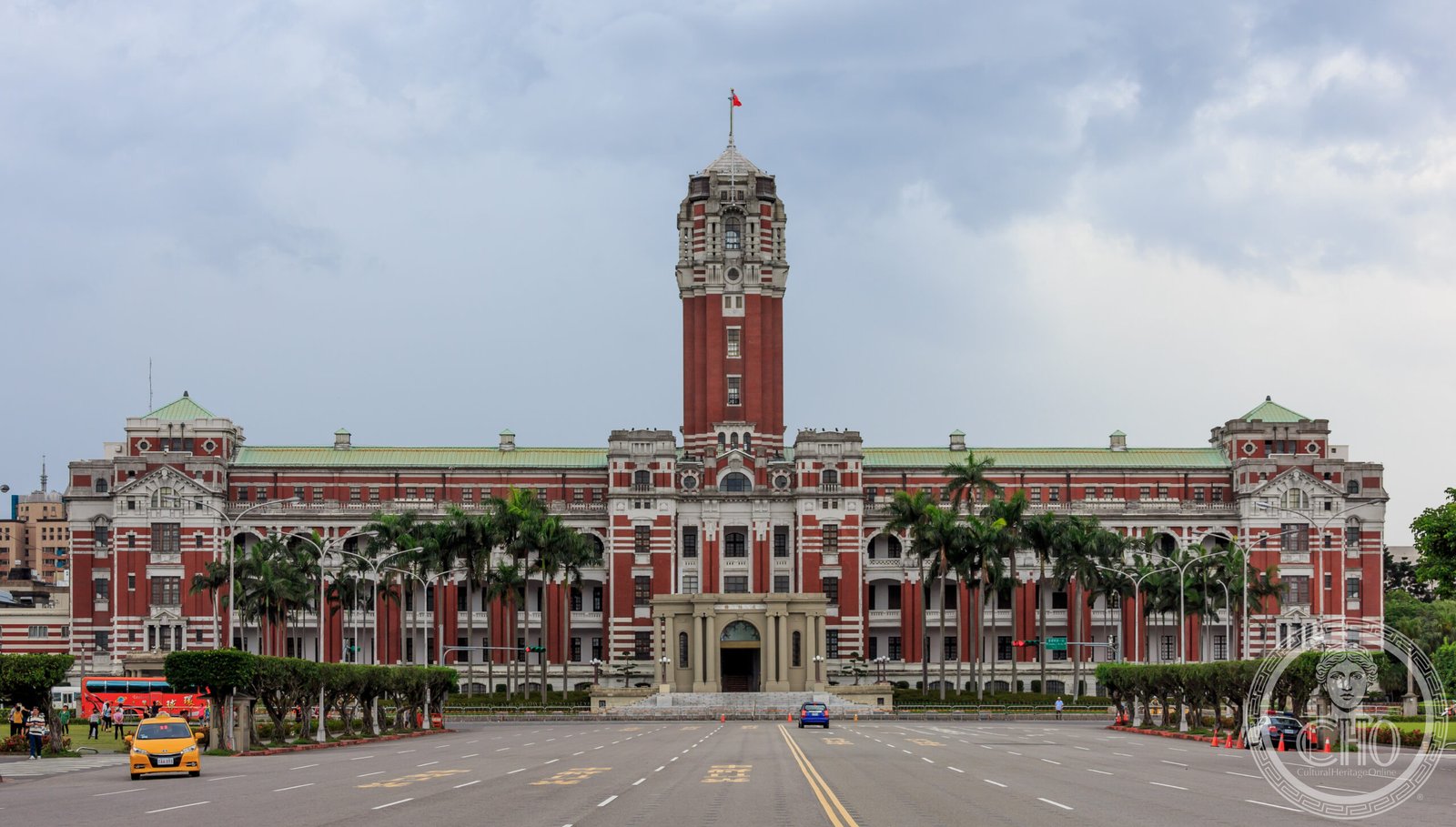
Built as the Governor-General’s Office during Japan’s colonial rule of Taiwan, this red-brick Renaissance Revival landmark has been the seat of the Republic of China government since 1945 and appears on the NT$100 banknote.
At a glance
- Type
- Government building / heritage landmark
- Period
- 1912-1919 (construction)
- Style
- Renaissance Revival / Japanese Colonial civic architecture
- Location
- No. 122, Chongqing South Road, Zhongzheng District, Taipei, Taiwan
- Coordinates
- 25.0405 N, 121.5117 E
- Architect
- Nagano Uheiji (Japanese colonial public works department)
Overview
The Presidential Office Building is one of the most historically charged structures in East Asia. Completed in 1919 as the seat of Japanese colonial administration in Taiwan, it was the most expensive building ever constructed in colonial Taiwan and embodies the hybrid architectural language — European Renaissance applied through Japanese imperial ambition — that defined civic buildings across Japan’s overseas territories. Since October 25, 1945, when Taiwan was formally transferred to the Republic of China following Japan’s defeat in WWII, it has served continuously as the seat of the ROC presidency. Opened to public visits in 2000, it now receives over 2 million visitors annually and appears prominently on the NT$100 banknote.
History
Japan acquired Taiwan from Qing China in 1895 following the First Sino-Japanese War. The colonial administration, based in Taipei (then Taihoku), commissioned an ambitious new Governor-General’s Office to project imperial authority and administrative permanence. Construction began in 1912 and took seven years, reflecting the scale and ambition of the project. The architect Nagano Uheiji drew on European Renaissance precedents — the same vocabulary used for major civic buildings across the British and French empires — filtered through Japanese Meiji-era modernization. The building survived the 1945 Taipei Air Raid and the subsequent transition of sovereignty largely intact. During the Nationalist period (post-1949) it became the Office of the President of the Republic of China. A significant renovation was completed after the 1999 Chi-Chi earthquake caused minor structural damage.
Architecture and Design
The building is laid out on a cruciform plan with a central tower rising approximately 60 metres — the dominant element of the Taipei skyline until the late 20th century. The exterior is clad in red brick with Baroque and Renaissance detailing: arched windows, rusticated stonework, decorative cornices, and a mansard-influenced roofline. The central tower combines clock and bell tower functions with a ceremonial lantern that was deliberately designed as the tallest point in the city. The floor plan, when viewed from above, was said to resemble the Japanese character for “sun” (nichi), though this may be retrospective interpretation. The main entrance hall and reception rooms retain much of their original Imperial Japanese decorative character, making the building a palimpsest of colonial and post-colonial history.
Cultural significance
Few buildings in the world embody political transformation as concretely as this one. The same structure that housed Japanese colonial authority for fifty years has served as the nerve center of the Republic of China’s democracy for the eight decades since. The building’s continued use — rather than demolition or conversion to a museum — reflects Taiwan’s complex negotiation with its colonial past: acknowledging the heritage while actively repurposing it. The annual October 10 National Day ceremony (celebrating the 1911 Republic of China revolution) held at the building’s main entrance is among the most symbolically freighted events in Taiwanese civic life. The building’s appearance on the NT$100 note underscores its role as a national icon.
Visiting today
The Presidential Office Building is open to the public on weekdays (Monday through Friday) and on specific holiday dates; advance online reservation is recommended as visitor numbers are capped. Tours cover the main hall, ceremonial rooms, and historical exhibitions documenting Taiwan’s governance history across Japanese and post-war periods. The building is closed during official state functions. Photography is permitted in most public areas. An adjacent park and the surrounding Zhongzheng District offer excellent walking; the National Taiwan Museum and 228 Peace Memorial Park are within easy walking distance.
Getting there
The nearest MRT station is Taipei Main Station (Blue and Red lines), approximately 10 minutes on foot via Zhongshan South Road. Alternatively, NTU Hospital station (Red Line) is slightly closer on the eastern side. Bus routes serving Zhongzheng District stop along Ketagalan Boulevard directly in front of the building. From Taiwan Taoyuan International Airport, the Airport MRT connects to Taipei Main Station in approximately 35 minutes. Taxis and ride-hailing apps (Uber, Line Taxi) are widely available.
Sources and resources
Find it on the map
See this place and what’s around it →📷 Become a Cultural Heritage Online photographer
Share your photos of places: they stay published under your name as the author. The more they're seen, the more you get noticed — and soon a contest will reward the most appreciated photos.
Log in or sign up free to add a photoIs this page about you?
This page is read by travellers and heritage enthusiasts who find it on Google. Tell us how you are connected to this place and we will take it from there.