

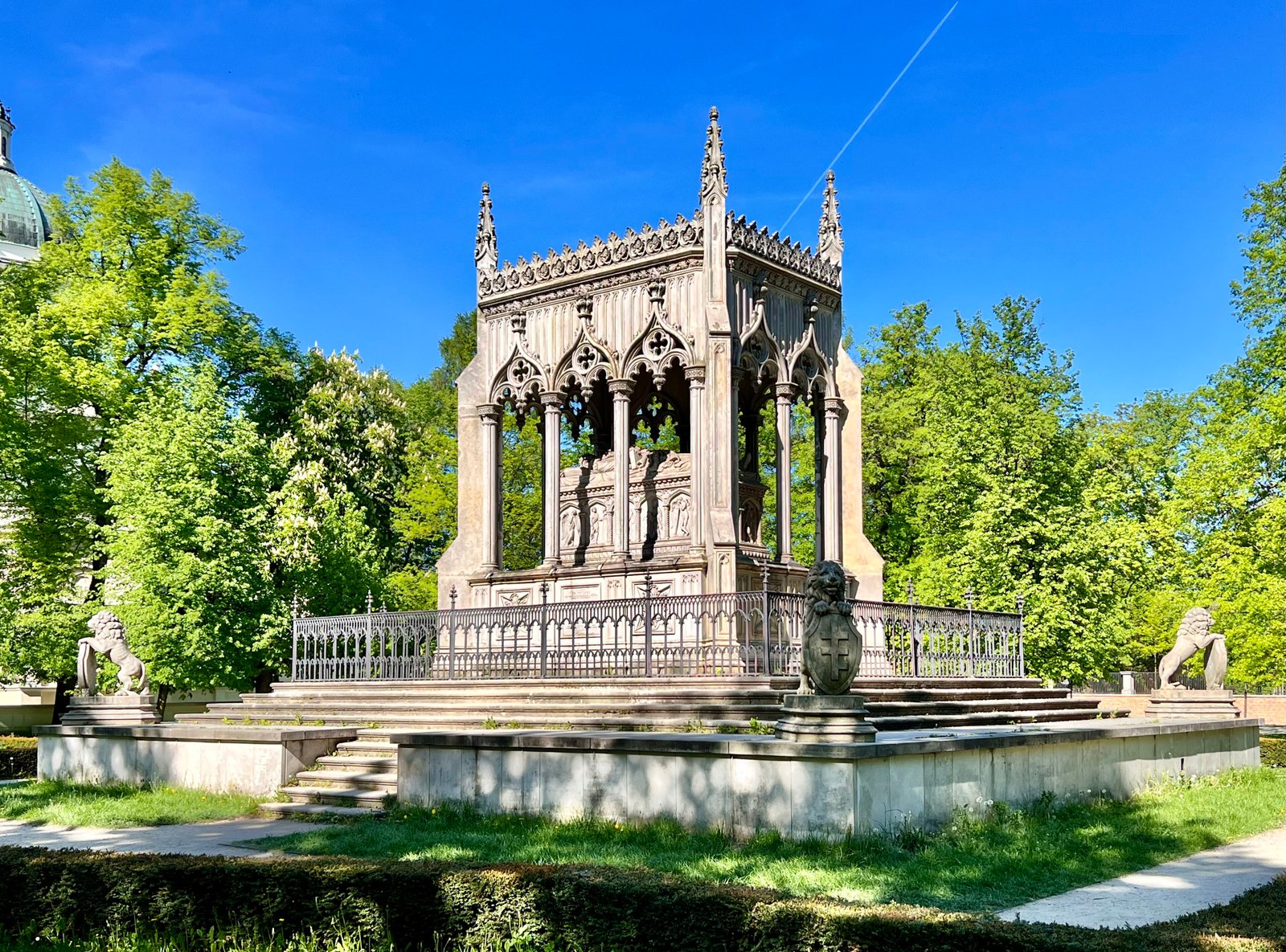
A Gothic Revival mausoleum designed by Enrico Marconi to honour a nobleman, politician, and cultural patron of the Romantic era.
At a glance
Built adjacent to Wilanów Palace, this intimate monument commemorates Stanisław Kostka Potocki and his wife Aleksandra. Its neo-Gothic style reflects early-nineteenth-century taste in monumental design.
History
Stanisław Kostka Potocki (1755–1821) was a nobleman, politician, writer, and landowner whose intellectual and public achievements shaped cultural life in Warsaw. His widow, Aleksandra Potocka (1760–1836), commissioned this mausoleum in his memory. Designed by Enrico Marconi and completed in 1836, it stands as a permanent record of their lives and social standing.
What you see
The structure exemplifies Gothic Revival principles popular across Europe in the early nineteenth century. Marconi’s design combines pointed arches, stone detailing, and verticality characteristic of the style. Set within the Wilanów district on Potockiego Street, the mausoleum forms an integral part of the historic palace precinct.
Cultural significance
The mausoleum testifies to the importance of the Potocki family in Polish intellectual and political life. It reflects the Romantic period’s elevation of individual commemoration and the relationship between patronage and architectural ambition in early-modern Warsaw.
Key facts
- Country: Poland
- City: Wilanów, Warsaw
- Coordinates: 52.1656, 21.0876
- Architect: Enrico Marconi
- Built: 1834–1836
- Style: Gothic Revival
Practical information & getting there
The mausoleum is located at 10 Potockiego Street in the Wilanów district, adjacent to Wilanów Palace. This area of Warsaw is accessible by public transport and forms part of a larger historic precinct worth exploring.
Sources & resources
Find it on the map
See this place and what’s around it →📷 Become a Cultural Heritage Online photographer
Share your photos of places: they stay published under your name as the author. The more they're seen, the more you get noticed — and soon a contest will reward the most appreciated photos.
Log in or sign up free to add a photoIs this page about you?
This page is read by travellers and heritage enthusiasts who find it on Google. Tell us how you are connected to this place and we will take it from there.