

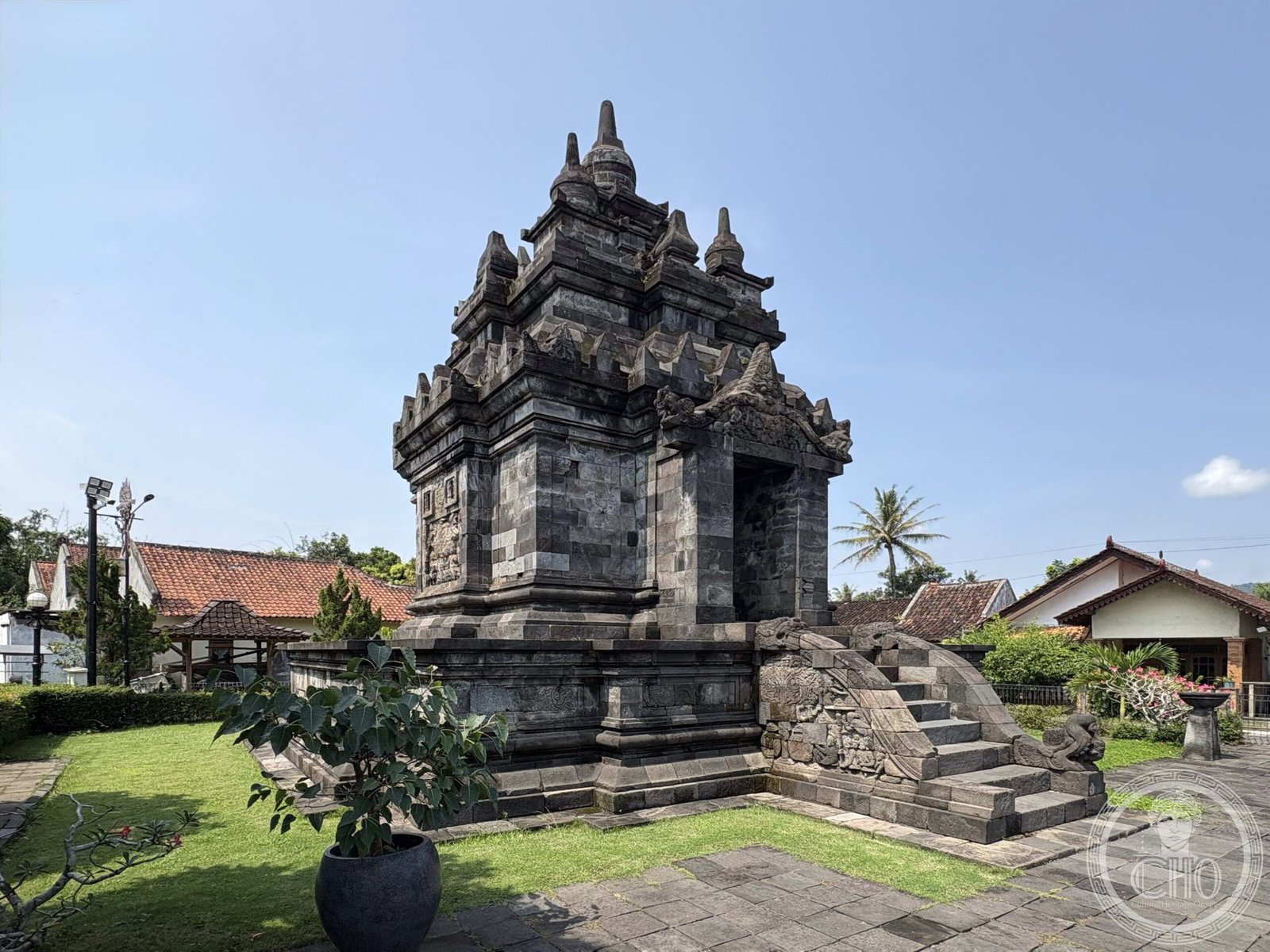
A Buddhist temple built during the Sailendra dynasty, Pawon stands as a link in a sacred processional axis connecting three major temples in Central Java.
At a glance
Pawon is a Buddhist temple constructed during the Sailendra dynasty in the 8th–9th centuries. It forms part of the Borobudur Temple Compounds, a trio of temples aligned on the same axis. All three structures—Borobudur, Pawon, and Mendut—are inscribed UNESCO World Heritage Sites, reflecting their significance to Buddhist art and architecture.
History
Built during the Sailendra dynasty’s reign, Pawon was constructed in Central Java during a period of significant Buddhist temple-building. It was deliberately positioned as a middle point along a sacred axis connecting Borobudur and Mendut, three major Buddhist temples of the region.
What you see
Pawon shares architectural characteristics with its companion temples along the processional axis. Specific details of its current state and design elements are preserved in scholarly documentation and on-site observation.
Cultural significance
As one of three temples on the same sacred axis, Pawon played a ceremonial role in the religious landscape of Sailendra Java. Its alignment with Borobudur and Mendut suggests ritualistic importance, likely serving pilgrims and monks during Buddhist observances. The compound’s UNESCO inscription underscores the temples’ outstanding universal value to world heritage.
Key facts
- Country: Indonesia
- Region: Central Java
- Period: 8th–9th centuries (Sailendra dynasty)
- Coordinates: -7.60613, 110.21958
- UNESCO World Heritage status: Inscribed as part of the Borobudur Temple Compounds
Practical information & getting there
Pawon is located in Central Java within the UNESCO-designated Borobudur Temple Compounds. Visitors typically access the site as part of a tour of all three temples along the axis. Check current opening hours and visitor guidelines through official heritage site resources before your visit.
Sources & resources
Find it on the map
See this place and what’s around it →📷 Become a Cultural Heritage Online photographer
Share your photos of places: they stay published under your name as the author. The more they're seen, the more you get noticed — and soon a contest will reward the most appreciated photos.
Log in or sign up free to add a photoIs this page about you?
This page is read by travellers and heritage enthusiasts who find it on Google. Tell us how you are connected to this place and we will take it from there.