

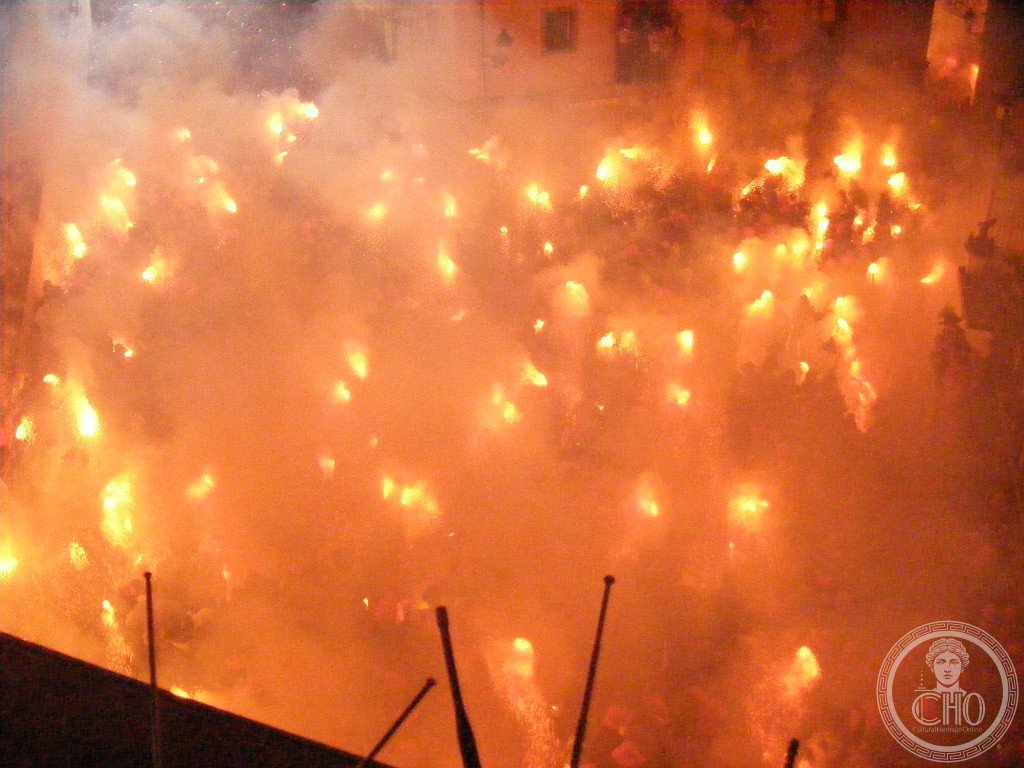
Each Corpus Christi, the Catalan city of Berga erupts in a cascade of fire, drums, and sacred theatre. The Patum de Berga—a festival of processional “dances” performed by townspeople bearing mystical figures—transforms the streets into a stage where solemnity and pyrotechnics merge in a ritual older than memory.
At a glance
La Patum is an annual festival held during Corpus Christi in which local participants carry symbolic and mystical figures through Berga in a series of coordinated processions called Salts. Each Salt is accompanied by the thunderous tabal drum or brass-band music, creating a soundscape as essential to the ritual as its visual spectacle. Fire and pyrotechnics punctuate the performances, lending the celebration an intensity that has captivated generations of Berguedan residents and visitors.
Origins and history
The precise origins of the Patum remain rooted in local memory rather than documented archive. The festival’s name derives from the tabal, the traditional drum whose rhythmic beating accompanies the Salts and gave rise to the Catalan word patum (beating or rhythm). Over centuries, the Patum evolved into a defining expression of Berguedan identity, interweaving Catholic liturgy, civic ritual, and popular festivity.
Recognition came gradually. The Generalitat de Catalunya designated the Patum a Traditional Festival of National Interest in 1983. UNESCO elevated its status in 2005, naming it a Masterpiece of the Oral and Intangible Heritage of Humanity, and formally inscribed it on the Representative List of the Intangible Cultural Heritage of Humanity in 2008.
The tradition today
The Patum remains a living, evolving tradition centred entirely within Berga’s community. Townspeople of all ages participate as carriers and performers, learning the movements, music, and meanings through participation and transmission. The festival unfolds as a sequence of Salts—each with distinct figures, music, and choreography—that process through the city streets during the Corpus Christi celebration.
Fire is integral to the experience. Pyrotechnics punctuate key moments, creating a sensory landscape in which sound, sight, and symbolism unite. The tabal drum remains the heartbeat, though brass bands also accompany certain Salts, adapting the tradition while honouring its core.
Cultural significance
The Patum embodies Berguedan collective memory and identity. It bridges the sacred and the secular, the solemn and the exuberant, allowing the community to enact shared mythology and reinforce social bonds through performance. For UNESCO and cultural scholars, the Patum exemplifies how oral transmission and embodied practice preserve meaning across generations without written codification—a hallmark of living intangible heritage.
Key facts
- Country: Spain
- Anchor community: Berga, Catalonia
- Celebration: Corpus Christi (moveable, typically May or June)
- UNESCO inscription: Representative List of the Intangible Cultural Heritage of Humanity (2008)
- National designation: Traditional Festival of National Interest (1983)
- Core element: Tabal drum, pyrotechnics, processions (Salts)
Where to experience it
The Patum de Berga is celebrated annually in Berga during Corpus Christi. The festival is free and open to all; you can watch the processions from the streets or join locals in following the Salts throughout the city. Visit during Corpus Christi to witness the full sequence of performances, or consult local tourism information for specific dates and routes.
Sources & resources
Find it on the map
See this place and what’s around it →📷 Become a Cultural Heritage Online photographer
Share your photos of places: they stay published under your name as the author. The more they're seen, the more you get noticed — and soon a contest will reward the most appreciated photos.
Log in or sign up free to add a photo