
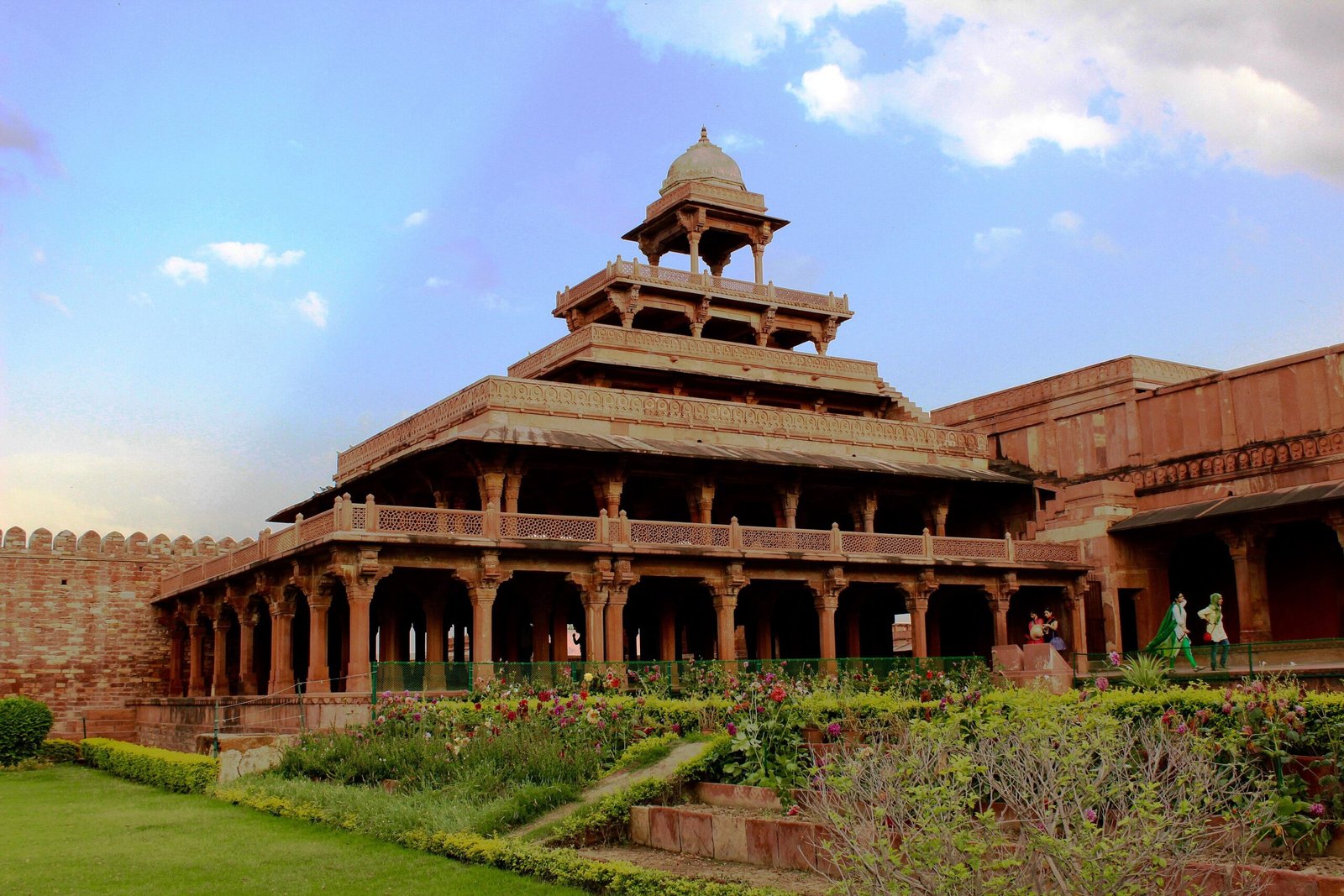
A five-story palace of pure columns and light, commissioned by Emperor Akbar as a retreat for the imperial women of Fatehpur Sikri.
At a glance
The Panch Mahal—meaning “Five Level Palace”—stands as one of the most distinctive structures in Fatehpur Sikri. Positioned near the Zenana quarters, this open-air pavilion was designed for entertainment and relaxation, offering views across the fortified city and surrounding landscape from its terraces.
History
Emperor Akbar commissioned this extraordinary palace to serve the imperial court. Its proximity to the women’s quarters suggests it functioned as a space where queens and princesses could enjoy cool breezes, observe the fort and town below, and attend musical concerts and entertainments—all while screened from public view by ornamental jaali work.
What you see
The Panch Mahal employs Buddhist temple design principles through its entirely columnar construction. Four stories of decreasing size rest asymmetrically on a ground floor containing 84 columns. The structure rises through 176 individually carved pillars: 56 on the first story, 20 on the second, 12 on the third, and 4 supporting a chhattri on top. Originally, delicate jaali screens between the columns provided privacy while permitting air circulation. The Anoop Talab pool lies directly before the palace, once a venue for court entertainments.
Cultural significance
The Panch Mahal represents a unique fusion of architectural traditions—Hindu, Islamic, and Buddhist elements combined in service to Mughal court life. Its innovative design prioritizes openness and ventilation while maintaining the purdah system that governed royal women’s seclusion, making it a sophisticated response to both practical and social requirements of 16th-century imperial culture.
Key facts
- Country: India
- City: Fatehpur Sikri, Uttar Pradesh
- Commissioned by: Emperor Akbar
- Total columns: 176, each with unique carved designs
- Coordinates: 27.0972405, 77.6656639
Practical information & getting there
The Panch Mahal is located within the Fatehpur Sikri complex, a UNESCO World Heritage Site near Agra. The palace is open to visitors as part of the wider heritage monument. For current visiting hours, admission details, and access information, consult official heritage site resources or local tourism authorities.
Sources & resources
Find it on the map
See this place and what’s around it →📷 Become a Cultural Heritage Online photographer
Share your photos of places: they stay published under your name as the author. The more they're seen, the more you get noticed — and soon a contest will reward the most appreciated photos.
Log in or sign up free to add a photoDo you manage this place?
This page is read by travellers and heritage enthusiasts who find it on Google. Keep it accurate — and make it work for you. Free for non-profit heritage institutions.