
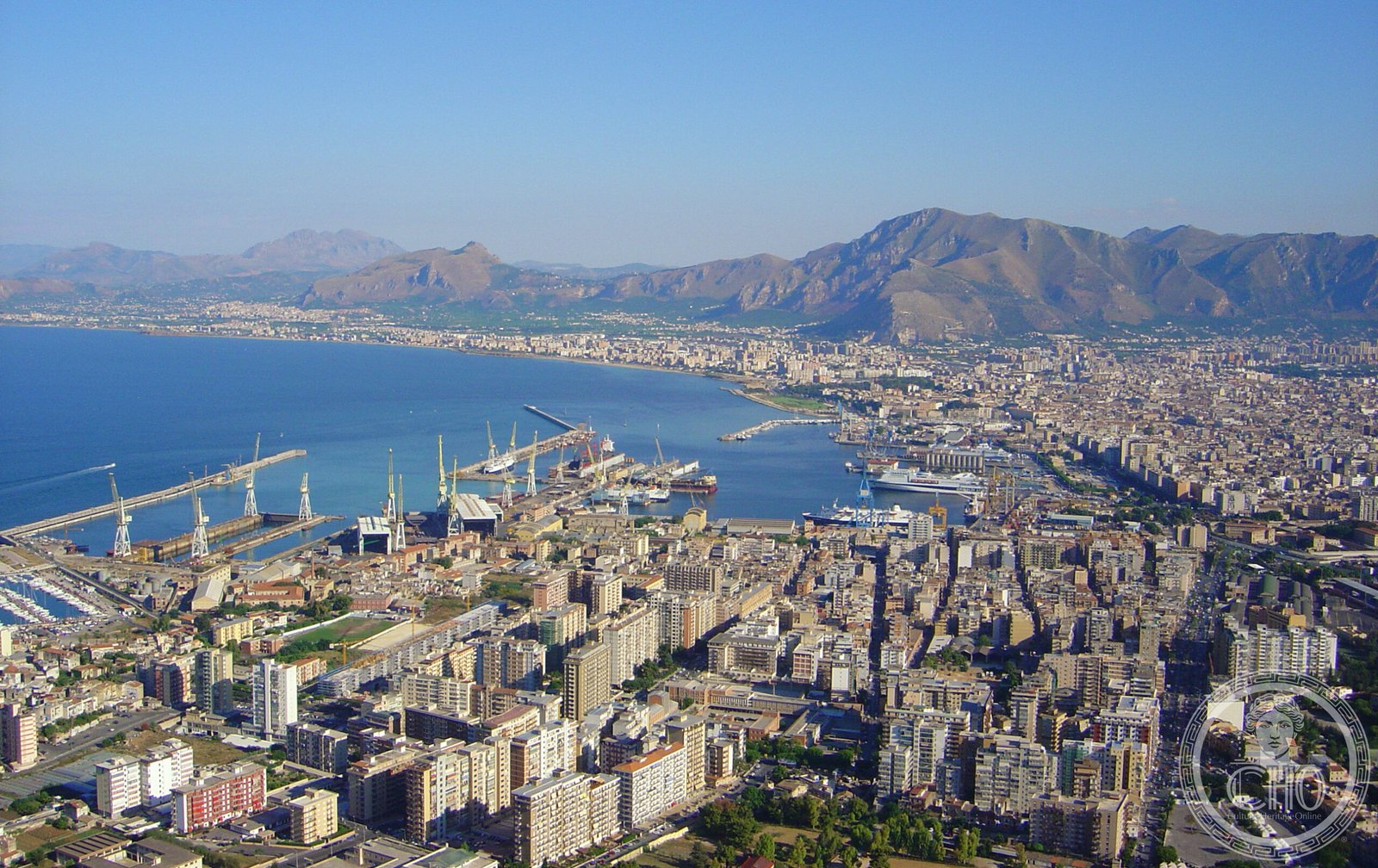
Sicily’s principal city and the fifth-largest municipality in Italy, Palermo has shaped Mediterranean history across three millennia. Its layered past—Phoenician, Roman, Byzantine, Arab, and Norman—produced one of Europe’s most distinctive artistic and architectural heritages.
At a glance
Palermo stands as the main urban center of Sicily and insular Italy. Founded by the Phoenicians in the 7th or 6th century BC, it rose to prominence under successive rulers and became Sicily’s coronation city under Norman kings. Today it remains a living record of the cultures that have passed through the Mediterranean.
History
The Phoenicians established Palermo between the 7th and 6th centuries BC. Roman conquest came in 254 BC, making it the island’s principal center, though Syracuse retained administrative status until Augustus settled veterans there.
Successive waves of conquest defined the medieval city. The Vandals took it in 429; Byzantium reclaimed it in 536; the Saracens conquered it in 831. With Norman arrival, Palermo’s role transformed. The city became coronation seat for Sicily’s kings, earning the titles «Prima Sedes, Corona Regis et Regni Caput»—First See, Crown of the King and Head of the Kingdom.
The Sicilian Vespers, a major rebellion, erupted in Palermo in 1282. From 1816 to 1817 the city served as capital of the Kingdom of the Two Sicilies, then its second city until Italian unification in 1861.
What you see
Palermo’s built fabric testifies to centuries of coexistence. Arab-Norman monuments showcase the fusion of Islamic, Byzantine, and Western Christian traditions. Numerous churches and palaces throughout the city carry designation as Italian national monuments, preserving the architectural vocabulary of empires and dynasties.
The Arab-Norman Palermo serial site, inscribed alongside the cathedrals of Cefalù and Monreale, encompasses monumental assets that span Phoenician foundations through Renaissance elaboration.
Cultural significance
Palermo’s thousand-year documented history reflects its role as a crossroads of Mediterranean civilizations. The succession of Phoenician, Roman, Byzantine, Arab, Norman, Angevin, and Spanish rulers created a unique cultural synthesis—visible in language, cuisine, urban form, and artistic production.
UNESCO’s 2015 World Heritage designation recognized the Arab-Norman heritage sites as outstanding universal value, acknowledging Palermo’s influence on European and Mediterranean development.
Key facts
- Address: Piazza Pretoria 1, Palermo
- Coordinates: 38.109708, 13.354568
- Official website: comune.palermo.it
- Phone: +39 091 7401111
- UNESCO status: World Heritage Site (Arab-Norman Palermo and the cathedrals of Cefalù and Monreale), 2015
Practical information
Palermo functions as an active city and regional capital. Many churches and palaces require appointments or have specific visiting hours; check individual sites or the official municipality website for current access details.
Getting there
Palermo is served by Falcone-Borsellino International Airport. Direct trains and bus services connect the city to other Sicilian centers and mainland Italy. Public transport within the city includes bus, tram, and metro networks.
See the place
Sources & resources
Find it on the map
See this place and what’s around it →Events here — now on & upcoming
- Death Anniversary: Ernesto Basile — August 26, 193226 Aug 2027See the event →
- Birth Anniversary: Topazia Alliata — September 191301 Sep 2027See the event →
Historical events at this place (6)
- 2019 Omaggio a ceramiche di Giovanni De Simone
- 2019 Natività di Caravaggio
- 2019 La Siria raccontata nelle foto di Tiziana Gulotta
- 2022 La Rinascita del Carmine
- 2023 Miniatura in Sicilia. Nuovi studi e prospettive di ricerca sulle orme di Angela Daneu Lattanzi
- Birth Anniversary: Ernesto Basile — January 31, 1857
📷 Become a Cultural Heritage Online photographer
Share your photos of places: they stay published under your name as the author. The more they're seen, the more you get noticed — and soon a contest will reward the most appreciated photos.
Log in or sign up free to add a photo