
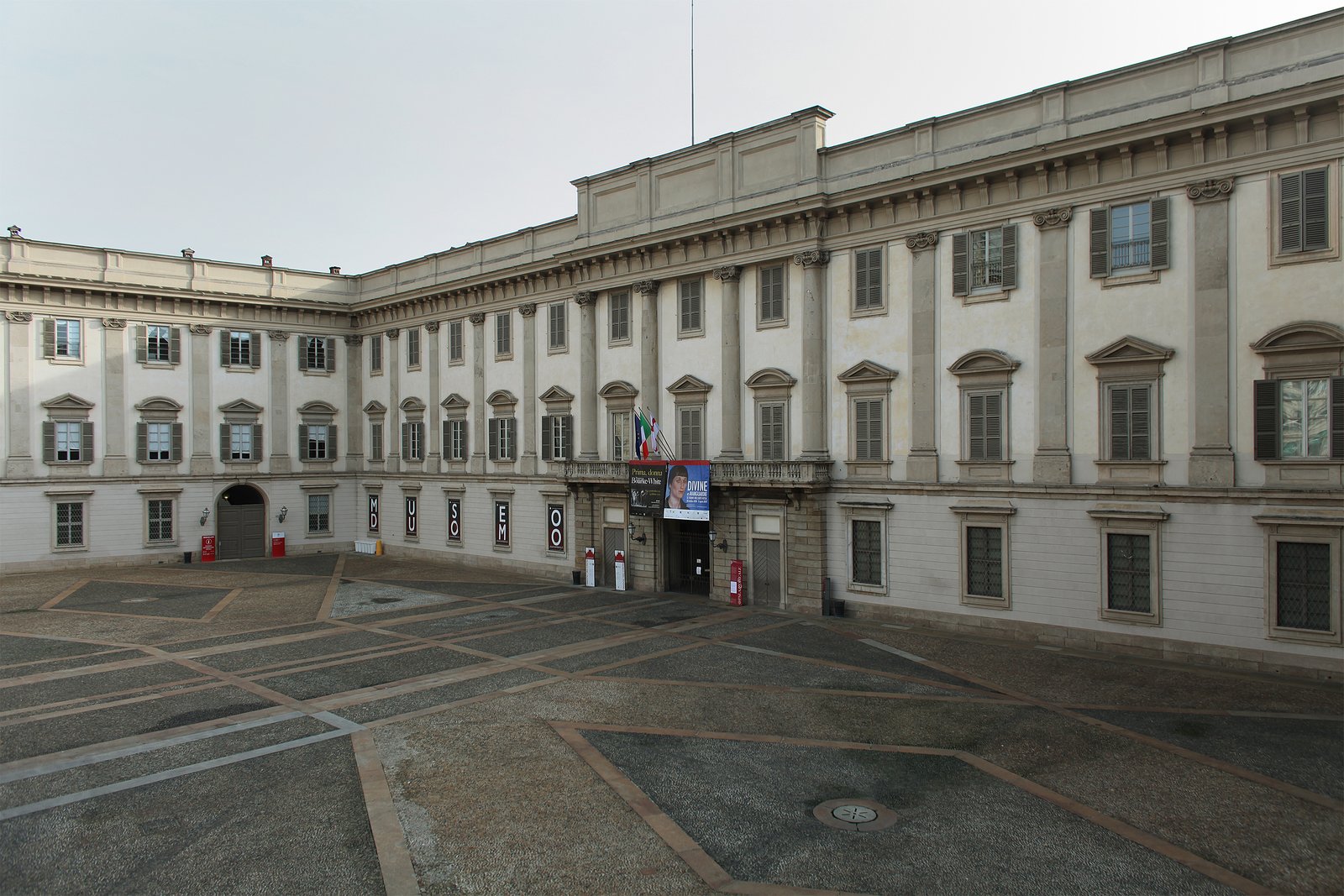
A thousand years of Milanese power in one building — town hall, ducal seat, royal palace, bombed ruin — now the city’s principal venue for temporary art exhibitions, right beside the Duomo.
At a glance
Palazzo Reale stands directly beside Milan Cathedral, on the site of the medieval Broletto Vecchio, the city’s communal seat from as early as the tenth century. Rebuilt across the centuries by Visconti, Sforza and Spanish rulers, given its present neoclassical face by Giuseppe Piermarini in the 1770s, and named royal in 1805 under the Napoleonic Kingdom of Italy, it survived a devastating Allied bombing in 1943 and today serves as Milan’s principal venue for major temporary exhibitions.
Key facts
- Origins — the Broletto Vecchio, Milan’s medieval communal palace, documented from the 10th century and used as the seat of government until 1251
- Ducal and royal seat — Palazzo Ducale under the Visconti and Sforza; a full royal residence from 1546 under the Spanish governor Ferrante Gonzaga, remodelled by Pellegrino Tibaldi (1573–98)
- Neoclassical rebuilding — by Giuseppe Piermarini, 1773–78
- Named “Reale” — 1805, when Milan was capital of the Napoleonic Kingdom of Italy
- Interiors — decorated by Andrea Appiani and Francesco Hayez
- 1919 — ceded by the House of Savoy to the Italian state on 11 October
- 1943 — the Sala delle Cariatidi gutted by Allied bombing; left unrestored as a memorial space
History
Before it was anything royal, this was Milan’s town hall. The Broletto Vecchio stood here from at least the tenth century, possibly on Roman foundations, and served as the seat of the medieval commune until 1251. Under the Visconti and then the Sforza it became the Palazzo Ducale, the seat of the ruling dynasty; French governors under Louis XII and Francis I kept their court here too. From 1546, under the Spanish governor Ferrante Gonzaga, it took on the character of a true royal residence, with state apartments remodelled between 1573 and 1598 under the architect Pellegrino Tibaldi.
The palace also has a long history of burning down. A fire destroyed the court theatre in 1695; another, in 1723, badly damaged the state apartments; a third, in 1776, burned the rebuilt theatre again — the fire that led Milan to build a new opera house altogether, La Scala. The palace’s present neoclassical appearance dates from the renovation Giuseppe Piermarini directed from 1773, completed in 1778. It became officially “Reale” — royal — in 1805, when Milan was capital of Eugène de Beauharnais’s Napoleonic Kingdom of Italy, and its interiors were decorated through the following decades by Andrea Appiani and, later, Francesco Hayez.
On 11 October 1919 the House of Savoy ceded the palace to the Italian state, with a clause reserving some apartments for the royal family’s use. On the night of 15–16 August 1943, Allied bombing gutted the building: the Sala delle Cariatidi, one of its grandest ceremonial rooms, lost its roof, floor and every piece of furniture, its caryatid statues left scarred and headless. Rather than restore it, the room was left as it was. In 1953 Pablo Picasso chose the ruined hall to show his Guernica there, an exhibition that made the bombed room itself part of the artwork’s public history.
What you see
The Sala delle Cariatidi remains the palace’s single most striking space precisely because it has not been repaired: bare brick and scarred plasterwork, the eight caryatid figures that give the room its name still visibly damaged, used today as an exhibition space that carries its own history inside it. Elsewhere the palace keeps its eighteenth- and nineteenth-century decoration, including rooms touched by Appiani and Hayez, though the building today functions primarily as exhibition space rather than a house-museum of period rooms.
Palazzo Reale hosts Milan’s largest temporary art exhibitions, from old-master surveys to major twentieth-century retrospectives, and coordinates its programme with the city’s other main exhibition venues.
Practical information
Open Tuesday to Sunday, 10:00–19:30, with late opening on Thursday until 22:30 (last admission one hour before closing); closed Monday. Admission and prices vary by exhibition, since the palace has no permanent collection of its own — check the current programme before visiting.
Getting there
Palazzo Reale is in Piazza del Duomo, immediately beside the cathedral, in the historic centre of Milan. The Duomo metro station (lines M1 and M3) opens directly onto the square, and numerous tram and bus routes converge on the piazza.
Sources & resources
- Palazzo Reale, Milan — Wikipedia (EN), for the Piermarini renovation, the 1805 “Reale” designation, Appiani and Hayez, the 1919 cession, the Sala delle Cariatidi bombing and the 1953 Picasso exhibition
- Palazzo Reale (Milano) — Wikipedia (IT), for the medieval Broletto Vecchio origins, the Visconti and Sforza period, Ferrante Gonzaga and Pellegrino Tibaldi, and the pre-1776 fires
Find it on the map
See this place and what’s around it →Record researched and written by Lorenzo Valentino for Cultural Heritage Online, 2026.
Events here — now on & upcoming
- «Milano messa in opera» by Marina Previtali: Book Presentation at Palazzo Reale20 Oct 2026See the event →
📷 Become a Cultural Heritage Online photographer
Share your photos of places: they stay published under your name as the author. The more they're seen, the more you get noticed — and soon a contest will reward the most appreciated photos.
Log in or sign up free to add a photoIs this page about you?
This page is read by travellers and heritage enthusiasts who find it on Google. Tell us how you are connected to this place and we will take it from there.