

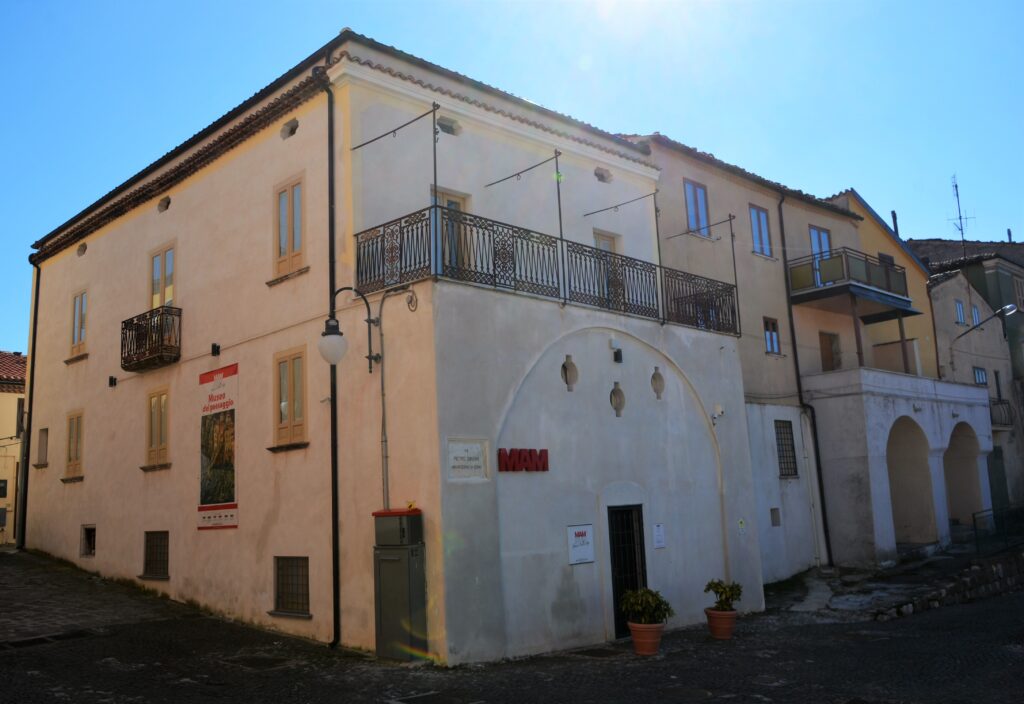
Palazzo Aiello 1786 stands in the historic centre of Moliterno, in the province of Potenza, opposite the church of Santa Maria Assunta, and takes the date 1786 in its name. It houses the Museo del Paesaggio, the landscape museum of the MAM — Musei Aiello Moliterno: a collection that runs from the eighteenth century to the twentieth and follows the Italian and European painting of landscape from the School of Posillipo to the Divisionists.
At a glance
- Type
- Historic palace and landscape museum
- Name
- Palazzo Aiello 1786, from the date carried in the name; the building is eighteenth-century
- Museum opened
- Saturday 2 July 2016
- Collection
- Landscape painting from the eighteenth century to the twentieth: School of Posillipo, Grand Tour painters, Romantics, Divisionists
- Location
- Largo Chiesa Madre 1, 85047 Moliterno (PZ), Basilicata, Italy
- Coordinates
- 40.2399° N, 15.8705° E
Overview
The palace faces the Chiesa Madre of Santa Maria Assunta, in the old centre of Moliterno, and is one of the two poles around which the museums of the Fondazione Aiello are arranged; the other, a few streets away, is Palazzo Aiello 1825, which houses the Museo del Novecento Lucano. Inside, the building has kept its eighteenth-century character: chestnut beams on the ceilings, floors of handmade cotto, and rooms that open towards the Lucanian landscape outside. The Museo del Paesaggio is described by its foundation as the only museum of its kind in Italy.
History
Moliterno lies in the Val d’Agri, in the upper valley of the Agri, and its historic centre grew around a Norman castle; the town is known today, among other things, for its Pecorino Canestrato and for the concentration of museums created by the Fondazione Aiello. The palaces that host them were bought and restored by the foundation, which opened its first seat, the Casa Museo Domenico Aiello, in 2010 and has since gathered its collections into seven historic palaces, with nine museum seats in two poles.
Palazzo Aiello 1786, with the Museo del Paesaggio, is one of the two poles; the other is Palazzo Aiello 1825, which houses the Museo del Novecento Lucano. The palace carries the date 1786 in its name, but no document supports an inscription: the building is described everywhere as eighteenth-century, and one municipal document of 2021 writes 1766. The Museo del Paesaggio opened on Saturday 2 July 2016. The foundation is directed by Gianfranco Aiello as president and Emanuele Aiello as director, with Pasquale Dicillo as co-director and Massimo Bignardi, of the Brera Academy and the University of Siena, as scientific curator of the museum system.
What you see
The collection is told across four floors, as a continuous history of landscape painting. The route begins with the eighteenth-century beginnings of the School of Posillipo — Gabriele Carelli, Nicola Palizzi, Achille Vianelli, Guglielmo Giusti — then passes to the foreign painters of the Grand Tour, among them Florent Fidèle Constant Bourgeois and Franz Schreyer, to the landscapists Vincenzo Loria, Antonio Ferrigno and Luigi Paolillo and to the Divisionists, and climbs into the twentieth century as far as the material, informal and sign painting of the years after 1950. The chestnut beams and the handmade cotto floors give the rooms the character of an old house rather than a museum hall, and the windows open onto the landscape around Moliterno.
Cultural significance
The Museo del Paesaggio is unusual in Italy: a museum built entirely around the painting of landscape, from the vedute of the eighteenth century to the experiments of the early twentieth, assembled in a small town of the Lucanian Apennines. Together with the picture gallery of nineteenth-century Lucanian painting in the Casa Domenico Aiello and the contemporary collections of the Museo di Arte Contemporanea, with works by Marino Marini and Michelangelo Pistoletto, it makes Moliterno one of the densest centres of art in Basilicata, in a town of fewer than four thousand inhabitants.
Practical information
- Address
- Largo Chiesa Madre 1, 85047 Moliterno (PZ), Basilicata
- Hours
- Every day, 9:30–12:30 and 16:30–19:30
- Tickets
- €10 for the museums of the system other than the Tedesco house; guided tour of the whole system €50, with a 30% reduction for school and group visits
- Booking
- +39 339 5725077 · [email protected]
Getting there
Moliterno lies in the Val d’Agri, about 45 km south of Potenza, inside the Parco Nazionale dell’Appennino Lucano. By car it is reached from the A3 Salerno–Reggio Calabria, leaving the motorway at Atena Lucana and following the valley road up the Agri. The palace is in the historic centre, facing the Chiesa Madre, a short walk from the castle.
Sources & resources
Find it on the map
See this place and what’s around it →

Advertisement. Pictured, from the Cleveland Museum of Art (CC0) and not for sale: Latz commode, Meissen group, Paul Storr tureen. How we handle this
📷 Become a Cultural Heritage Online photographer
Share your photos of places: they stay published under your name as the author. The more they're seen, the more you get noticed — and soon a contest will reward the most appreciated photos.
Log in or sign up free to add a photoIs this page about you?
This page is read by travellers and heritage enthusiasts who find it on Google. Tell us how you are connected to this place and we will take it from there.
This entry stays online and free either way — and a free account lets you add to it yourself.