

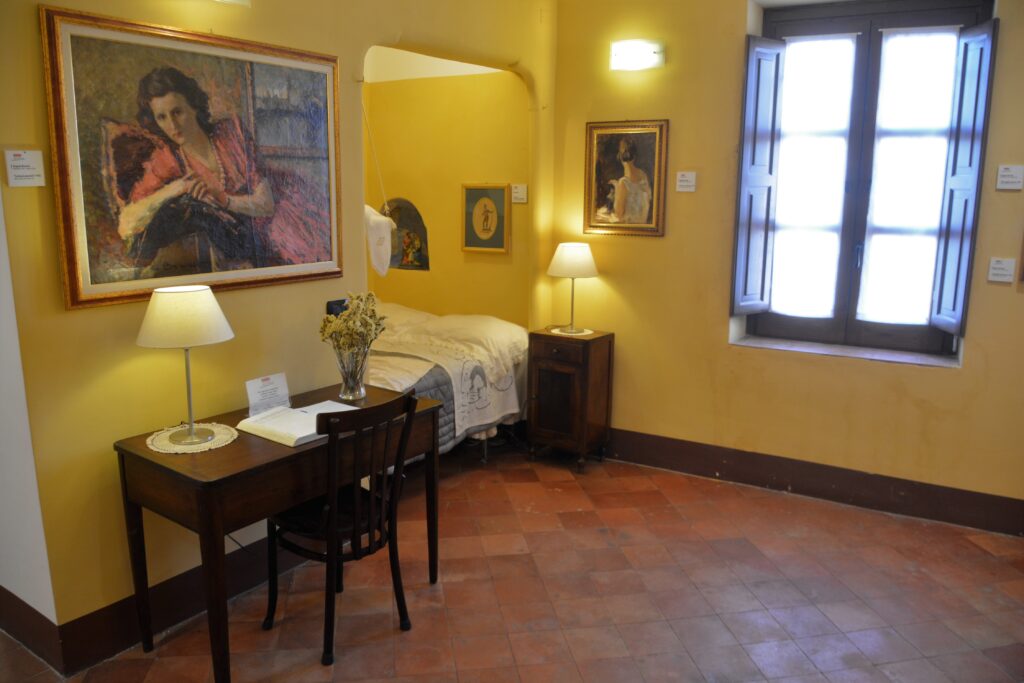
Casa Domenico Aiello is a house museum in the historic centre of Moliterno, in the province of Potenza, and the first seat of the MAM — Musei Aiello Moliterno, a system of museums spread through seven historic palaces of the town. Since June 2016 the house has held the Museo Michele Tedesco e dell’Ottocento Lucano, the collection of the greatest painter born in Moliterno.
At a glance
- Type
- House museum and picture gallery
- Opened
- July 2010; refitted and dedicated to Michele Tedesco in June 2016
- Collection
- Nineteenth-century painting in Lucania, with five works and eighteen sketchbooks by Michele Tedesco
- Location
- Via San Rocco, 85047 Moliterno (PZ), Basilicata, Italy
- Coordinates
- 40.2386° N, 15.8705° E
Overview
The house is not a noble palace but a Lucanian family home, restored in its original forms and turned into a museum: the ground floor keeps the furniture and household objects of the family, arranged as an ethnographic collection, while the upstairs rooms hold the picture gallery. It stands in the old centre of Moliterno, the hill town of the Val d’Agri that the foundation calls a «borgo-miracolo», a few streets from the Palazzo Aiello 1786 and Palazzo Aiello 1825 around which the rest of the MAM is organised.
History
The house is where Domenico Aiello was born and lived with his farming parents. His son Gianfranco Aiello, a dentist and collector, bought it back and restored it, and in July 2010 the Casa Museo opened as the first museum of what would become the MAM, run by the Fondazione Aiello. In June 2016, six years after opening, the house was rearranged and dedicated to Michele Tedesco and to nineteenth-century painting in Lucania; the foundation dates its public presentation to 12 October 2019.
The system has grown since: the Palazzo SantaCroce opened in October 2023 with a tribute to Rocco Scotellaro and thirty artists of the Brera Academy, a convention with Brera followed in January 2025, Casa Trufelli opened in June 2025, and in April 2026 the Fondazione Aiello signed an agreement with the Regional Council of Basilicata for joint initiatives. The museum is listed among the Case della Memoria, the national network of houses of notable figures, and among the historic houses of the ADSI.
What you see
The picture gallery is built around Michele Tedesco. Five of his works hang here — Cari colombi, La morte del cardellino, Segreta attesa, Maternità and Il palazzo dello Sceicco — together with eighteen of his sketchbooks, drawings and watercolours covering some twenty years of work. Around them the rooms gather other painters of the southern nineteenth century: Vincenzo Marinelli, Giacomo Di Chirico, Angelo Brando and Andrea Petroni, and a work by Tedesco’s wife, the German painter Julia Hoffmann Tedesco, Dolcezze materne of 1881.
Cultural significance
Michele Tedesco was born in Moliterno on 24 August 1834 and died in Naples on 3 February 1917. Trained at the Royal Institute of Fine Arts in Naples, he reached Florence at the end of 1860 and entered the circle of the Macchiaioli, then turned to a painting of social realism and, later, to a symbolist vein close to the neo-Greek taste of the time. The house holds the largest body of his drawings, and in 2019 three of its works — La morte del cardellino, Segreta attesa and Dolcezze materne — were lent to the exhibition Lessico femminile at Palazzo Pitti in Florence, from 7 March to 26 May.
Practical information
- Address
- Via San Rocco, 85047 Moliterno (PZ), Basilicata
- Hours
- Every day, 9:30–12:30 and 16:30–19:30
- Tickets
- Museo Michele Tedesco €5; the other museums of the system €10; guided tour of the whole system €50, with a 30% reduction for school and group visits
- Booking
- +39 339 5725077 · [email protected]
Getting there
Moliterno lies in the Val d’Agri, about 45 km south of Potenza, inside the Parco Nazionale dell’Appennino Lucano. By car it is reached from the A3 Salerno–Reggio Calabria, leaving the motorway at Atena Lucana and following the valley road up the Agri. The museum is in the historic centre, a short walk from the castle and the church of Santa Croce.
Sources & resources
Find it on the map
See this place and what’s around it →📷 Become a Cultural Heritage Online photographer
Share your photos of places: they stay published under your name as the author. The more they're seen, the more you get noticed — and soon a contest will reward the most appreciated photos.
Log in or sign up free to add a photoIs this page about you?
This page is read by travellers and heritage enthusiasts who find it on Google. Tell us how you are connected to this place and we will take it from there.
This entry stays online and free either way — and a free account lets you add to it yourself.