
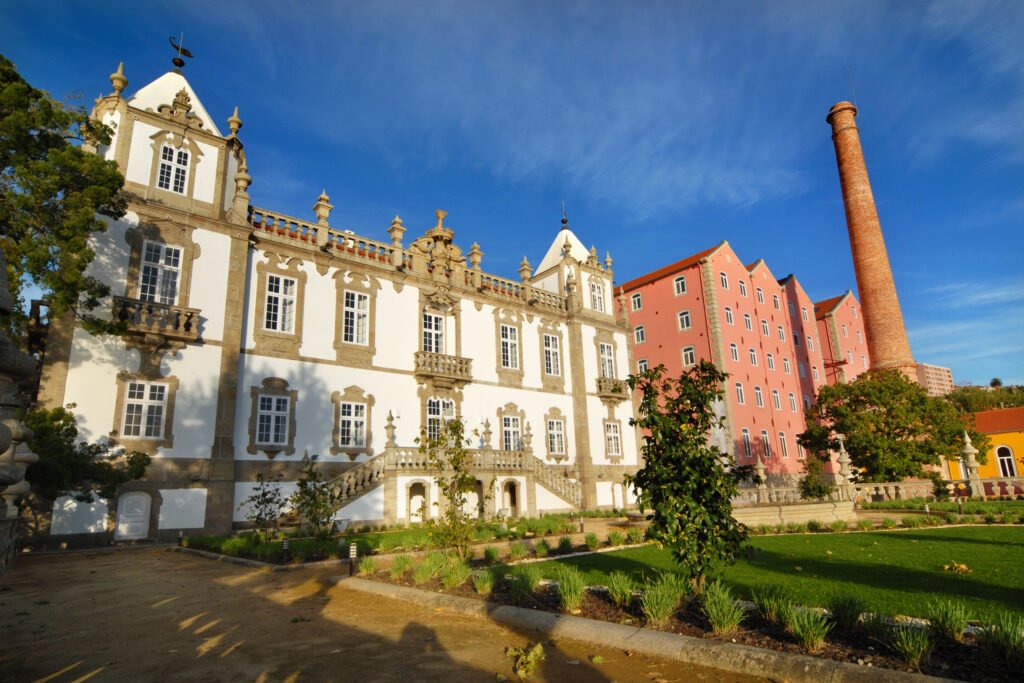
Nasoni built it as a country residence facing the Douro, and the nineteenth century turned it into a soap works and then a flour mill with a forty-five-metre silo beside it. The palace survived both. It reopened in October 2009 as a hotel, with the mill converted into bedrooms.
At a glance
- Type
- Baroque palace, now a hotel
- Built
- Mid-18th century
- Architect
- Nicolau Nasoni (1691–1773)
- Built for
- Jerónimo de Távora
- Style
- Portuguese Baroque
- Status
- Classified a national monument in 1910; restored 2000–2003 under Fernando Távora
- Location
- Campanhã, Porto, Portugal, on the north bank of the Douro
- Coordinates
- 41.1425° N, 8.5749° W
Overview
Nicolau Nasoni came to Porto from Italy and gave the city the shape it still trades on: the Clérigos tower, the cathedral loggia, and a handful of palaces in which the Portuguese Baroque stops being an imported style and becomes a local one. The Palácio do Freixo is the domestic end of that work. It sits low on the river, a rectangular block with corner towers, and every one of its four fronts is drawn differently — a building that never shows the same face twice as you walk around it.
History
Nasoni designed the palace in the middle of the eighteenth century for Jerónimo de Távora, on ground that had held a country estate since the previous century. It was a rich man’s house built for the view: three storeys, balustraded balconies over the water, staircases and terraces on the eastern side arranged so that arrival was itself a piece of architecture.
Then the river did what rivers do to riverside land in the nineteenth century — it attracted industry. A merchant, António Afonso, put a soap factory on the site; he was made Baron of Freixo in 1866 and the palace was renovated around that title. Later came grain: a distillery first, then the Moagens Harmonia milling company, which built its offices against the palace and raised a silo forty-five metres high next to Nasoni’s roofline. For over a century the finest domestic Baroque in Porto stood in a working industrial yard.
Recovery took decades and was not smooth. Fernando Távora led the restoration under the Metrópolis programme; his first proposal, which would have moved the factory buildings below the palace, was rejected by the city council in January 1998 and had to be redrawn. The work ran from 2000 to 2003, with his son José Bernardo. In October 2009 the complex opened as a hotel: the palace itself for public rooms, and the old mill — the thing that had almost swallowed it — rebuilt as the bedrooms.
What you see
The south front is the one to look at first, because it was made to be seen from the water: three balconies with stone balustrades, and above them the pinnacles and pyramidal merlons that Nasoni scattered along every roofline he touched. The ornament is carved granite, not stucco, which is why it has survived a soap factory, a mill and two centuries of river weather with its edges still sharp.
Walk round to the east and the building changes character: staircases, landings and platforms step down the slope in a sequence of advancing and receding planes. Broken and undulating pediments, deep window surrounds, carved fruit and dolphins. Inside, the surviving decoration runs to frescoes and moulded stucco ceilings.
Cultural significance
Freixo is where Nasoni’s church vocabulary — movement, theatre, a facade that behaves like a stage set — is applied to a private house, and it is counted among the essential works of Portuguese Baroque for that reason. Its second life matters too. The palace was not saved by being kept empty: it was saved by a restoration that admitted the mill into the story rather than erasing it, and the industrial building it once fought with now pays for its upkeep.
Practical information
- Access
- The palace operates as a hotel. Public rooms and the restaurant are open to non-residents; the exterior and the riverside setting can be seen from the road and the Douro bank
Getting there
The palace stands on the Douro in Campanhã, about four kilometres upstream of the Ribeira. Porto Campanhã is the nearest mainline station; from the centre the riverside road runs the whole way. Francisco Sá Carneiro airport is around twenty kilometres north-west.
Sources
Find it on the map
See this place and what’s around it →📷 Become a Cultural Heritage Online photographer
Share your photos of places: they stay published under your name as the author. The more they're seen, the more you get noticed — and soon a contest will reward the most appreciated photos.
Log in or sign up free to add a photoIs this page about you?
This page is read by travellers and heritage enthusiasts who find it on Google. Tell us how you are connected to this place and we will take it from there.