

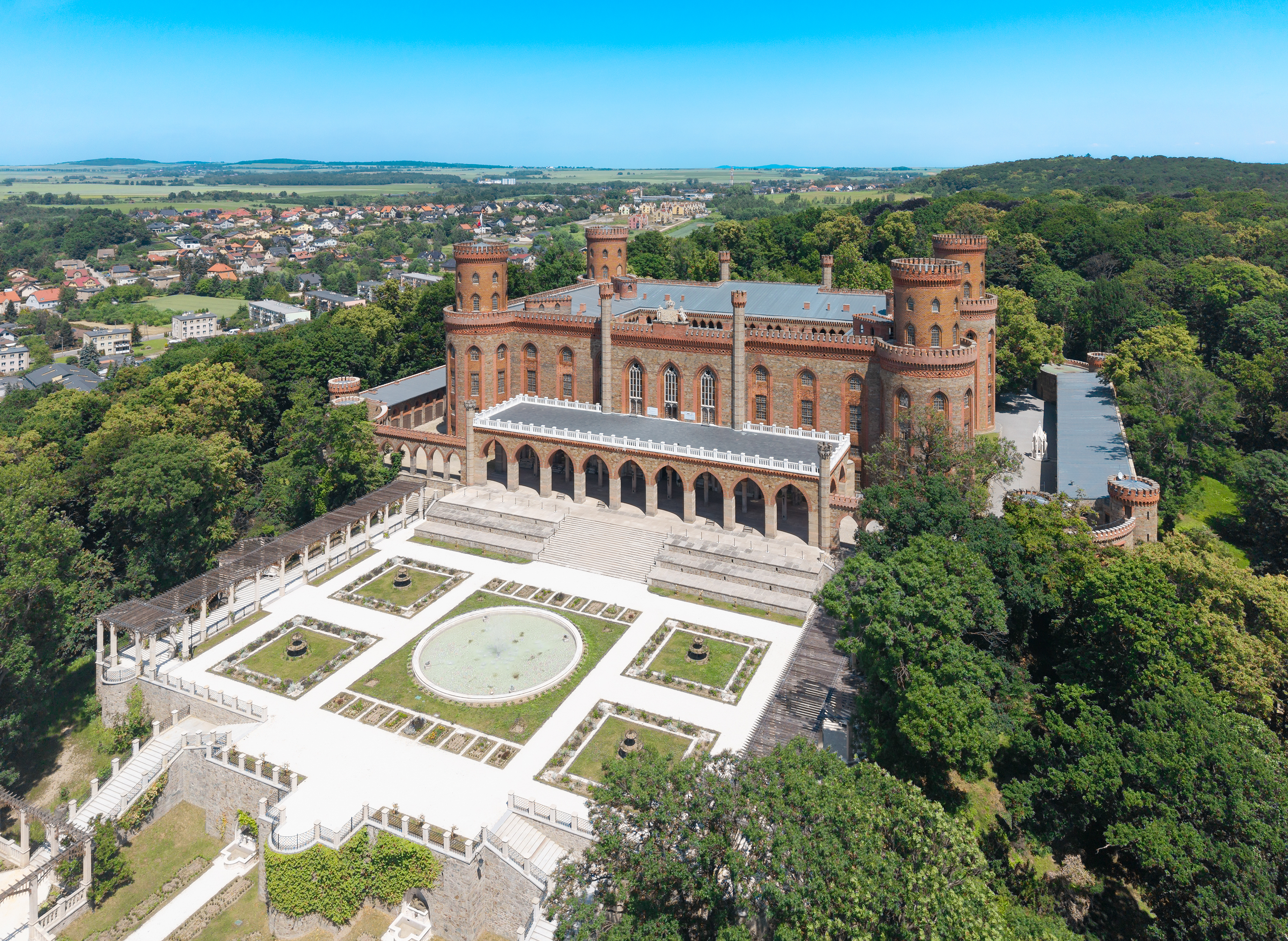
A monumental Neo-Gothic palace designed by Karl Friedrich Schinkel for Princess Marianne of the Netherlands, completed in 1872 under the German Empire.
At a glance
This 19th-century palace in southwestern Poland takes the form of a medieval castle. Schinkel’s design transformed it into a striking symbol of 19th-century romantic architecture, blending historical reference with contemporary ambition.
History
The palace was designed by Karl Friedrich Schinkel, one of Prussia’s most influential architects, for Princess Marianne of the Netherlands. Construction concluded in 1872, during the German Empire period. The building emerged as a statement of princely power and refined taste.
What you see
The palace presents itself as a medieval castle reinterpreted through 19th-century Neo-Gothic sensibility. Schinkel’s design employs the vocabulary of fortress architecture—crenellations, towers, and dramatic silhouettes—while maintaining the comfort and spatial logic of a grand residence. The exterior dominates the landscape.
Cultural significance
Kamieniec Ząbkowicki Palace exemplifies the Romantic era’s fascination with medieval forms and noble heritage. Schinkel’s involvement places it within a broader European movement that sought to resurrect historical architectural languages for contemporary patrons. The palace remains a testament to 19th-century aspirations toward grandeur and historical continuity.
Key facts
- Country: Poland
- City: Kamieniec Ząbkowicki, Lower Silesia
- Architect: Karl Friedrich Schinkel
- Style: Neo-Gothic
- Completed: 1872
- Original patron: Princess Marianne of the Netherlands
- Coordinates: 50.52°N, 16.88°E
Practical information & getting there
Kamieniec Ząbkowicki lies in Lower Silesia, southwestern Poland. The town is accessible by road from regional centers. Visiting hours and admission details are best confirmed directly with local tourism information before planning your visit.
Construction ran almost 33 years and was declared finished on 8 May 1872, when a statue of Nike was unveiled on the hill behind the grotto, at a total cost of 971,692 thalers.
Sources & resources
Find it on the map
See this place and what’s around it →
Advertisement. Pictured, from the Cleveland Museum of Art (CC0) and not for sale: Latz commode, Meissen group, Paul Storr tureen. How we handle this
📷 Become a Cultural Heritage Online photographer
Share your photos of places: they stay published under your name as the author. The more they're seen, the more you get noticed — and soon a contest will reward the most appreciated photos.
Log in or sign up free to add a photoIs this page about you?
This page is read by travellers and heritage enthusiasts who find it on Google. Tell us how you are connected to this place and we will take it from there.
This entry stays online and free either way — and a free account lets you add to it yourself.