

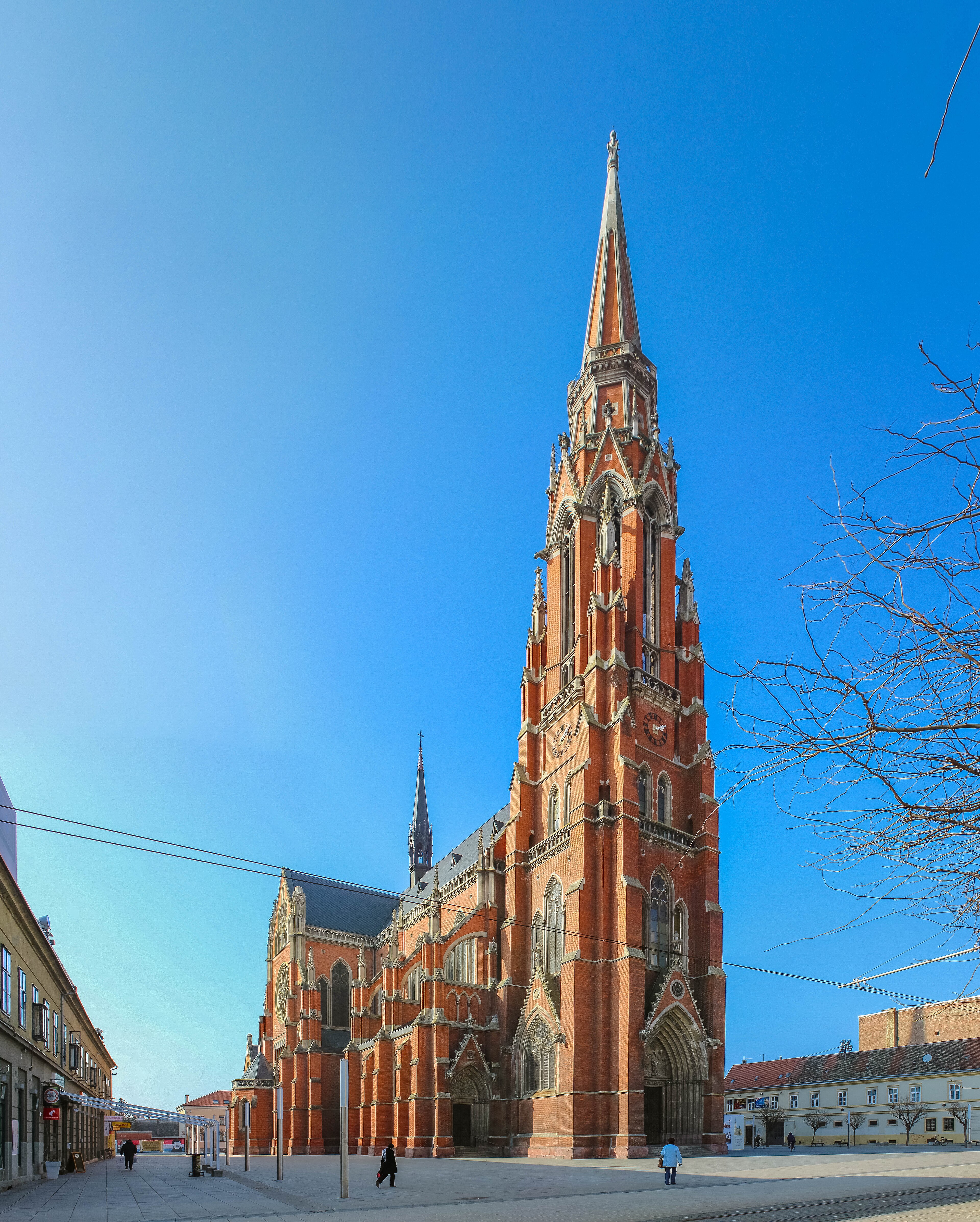
A soaring neo-Gothic church crowned by a 94-metre spire, its interior transformed in the 1930s by vivid frescoes depicting biblical narratives.
At a glance
The Church of St Peter and St Paul stands as one of Osijek’s defining landmarks. Its striking multi-tiered spire dominates the city skyline, while the interior showcases neo-Gothic ornamentation at its most exuberant—pinnacled altars, ornate stained glass, and expansive wall frescoes by Croatian master Mirko Rački.
History
Construction began in 1898 on the initiative of Bishop Josip Juraj Strossmayer of Đakovo, a figure of considerable influence in 19th-century Croatian ecclesiastical life. The architectural shell was completed relatively quickly, but the interior decoration extended well into the 20th century. Between 1938 and 1942, renowned Croatian painter Mirko Rački undertook an ambitious fresco campaign, covering walls and ceilings with richly coloured biblical scenes that transformed the space into a vivid statement of faith and artistic vision.
What you see
The building exemplifies neo-Gothic design principles. Entry is via two modest side doors flanking the main portal, which are watched over by a trio of gargoyles—a traditional Gothic motif. The interior is densely ornamented with pinnacled altars and soaring stained glass windows that flood the space with coloured light. Rački’s frescoes illustrate famous episodes from the Old and New Testaments, their bright hues and narrative richness dominating the architectural frame.
Cultural significance
The co-cathedral represents the convergence of 19th-century ecclesiastical ambition and 20th-century artistic renewal in Croatia. Strossmayer’s patronage reflected the church’s role in asserting Catholic and Croatian identity. Rački’s frescoes place the building within the broader modernist rediscovery of religious art, combining traditional iconographic subjects with contemporary expressiveness.
Key facts
- Location: Osijek, Croatia
- Coordinates: 45.5606, 18.6761
- Built: 1898; interior completed 1938–1942
- Spire height: 94 metres
- Status: Co-cathedral of the Roman Catholic Archdiocese of Đakovo-Osijek
Practical information & getting there
Osijek is located in eastern Croatia along the Danube. The co-cathedral is situated in the city centre and is accessible by local transport. As an active place of worship, visiting hours may be restricted; check ahead for services and opening times.
Sources & resources
Find it on the map
See this place and what’s around it →📷 Become a Cultural Heritage Online photographer
Share your photos of places: they stay published under your name as the author. The more they're seen, the more you get noticed — and soon a contest will reward the most appreciated photos.
Log in or sign up free to add a photoIs this page about you?
This page is read by travellers and heritage enthusiasts who find it on Google. Tell us how you are connected to this place and we will take it from there.