
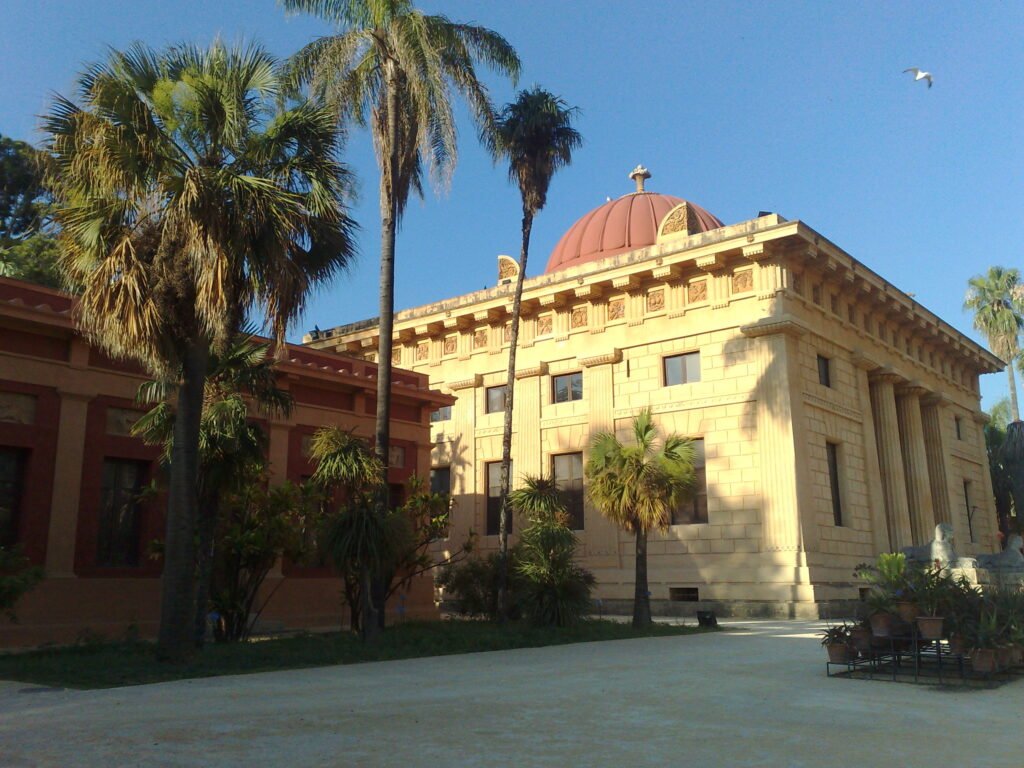
Planted in 1789 beside Villa Giulia and inaugurated in December 1795, the University of Palermo’s botanical garden grew from a physic plot into ten hectares of Mediterranean and tropical flora at the edge of the old city.
At a glance
The Orto Botanico is the botanical garden of the University of Palermo and one of the oldest academic gardens in Italy, active for more than two centuries. Today it covers about ten hectares and cultivates some 6,000 species, many of them from tropical and subtropical regions that found in Palermo’s climate a European foothold. The garden works as an open-air museum within the university’s museum system, and it doubles as a living stage: concerts, night visits and botanical fairs run through the year. Its herbarium, the Herbarium Mediterraneum, preserves around 600,000 specimens.
Key facts
- Origins: 1779, with the chair of Natural History and Botany of Palermo’s Regia Accademia degli Studi and a first plot of medicinal plants at Porta Carini.
- Planted: 22 February 1789 on the Vigna del Gallo, beside Villa Giulia; inaugurated 9 December 1795.
- Design: original ensemble by the French architect Léon Dufourny, who left Sicily in 1793 and never saw the opening.
- Size: about 10 hectares; roughly 6,000 cultivated species.
- Herbarium: Herbarium Mediterraneum, c. 600,000 specimens.
- Landmark tree: the great Ficus macrophylla f. columnaris, elected Italian Tree of the Year 2022.
- Today: run by the Sistema Museale di Ateneo of the University of Palermo; ticketing by CoopCulture.
History
The garden was born of the Sicilian Enlightenment. In 1779 the newly founded Regia Accademia degli Studi — the ancestor of today’s university — obtained from the city Senate a modest plot on the bastion of Porta Carini, where its new chair of Natural History and Botany could grow the semplici, the medicinal plants needed for teaching. The plot soon proved too small for the ambitions behind it.
On 22 February 1789 work began on a new garden on the Vigna del Gallo, in the plain of Sant’Erasmo next to the public Villa Giulia laid out in 1777. The ceremonial buildings rose to the design of the French architect Léon Dufourny; forced back to France in 1793 by the politics of the Revolution, he saw neither the end of the works nor the opening. On 9 December 1795, six years after the first spade, the Orto was solemnly inaugurated on a space of about 12,000 square metres.
It did not stay that size for long. Expansions began in 1796, and under Vincenzo Tineo — director from 1814 to 1856, in succession to his father Giuseppe — the garden gained nearly another hectare and a much larger grove. Through the nineteenth century it became the engine through which countless species, many tropical and subtropical, were studied and spread across Sicily, Europe and the Mediterranean basin.
What you see
The entrance ensemble is Dufourny’s: the Gymnasium with its flanking pavilions, built as the scientific and ceremonial heart of the garden. Beyond it the collections open out in ordered sectors, an eighteenth-century idea of the world’s flora still legible under two centuries of growth.
The garden’s most photographed resident is the great Ficus macrophylla f. columnaris, whose aerial roots have thickened over a century and a half into a colonnade of secondary trunks holding up a canopy the size of a small square. In 2022 it was elected Italian Tree of the Year. Around it, palms, succulents, water plants and glasshouse collections make the Orto feel less like a park than a compressed atlas of climates.
Practical information
- Summer opening (May–August): Monday–Saturday 9:00–20:00, Sunday 10:00–20:00; last entry one hour before closing.
- Tickets: on site and online via CoopCulture, which runs the garden’s visitor services.
- Time needed: allow 1.5–2 hours; evening openings and events run in summer.
- Check before you go: hours change by season — see the garden’s official site.
Getting there
The garden sits at the seaward edge of the Kalsa district, beside Villa Giulia, about a ten-minute walk from Palermo Centrale station. GPS: 38.1125, 13.3725 — open in Google Maps.
Nearby
- La Martorana — Santa Maria dell'Ammiraglio di Palermo (1143): i Mosaici Bizantini di Ruggero II, l'Incoronazione del Re da Cristo e il Più Bello Spazio Medievale di Palermo (UNESCO 2015).
- Cattedrale di Palermo (1185-1801): dal Vescovado Normanno alla Cupola Neoclassica — 600 Anni di Trasformazioni tra Arabo, Normanno, Gotico e Barocco nel Duomo di San Salvatore (UNESCO 2015).
- San Giovanni degli Eremiti di Palermo (1132): la Moschea Islamica con le Cinque Cupole Rosse Trasformata in Chiesa da Ruggero II — il Giardino Medievale dei Normanni (UNESCO 2015).
Sources
- Orto Botanico di Palermo — official site, “Notizie storiche” (ortobotanico.unipa.it).
- Sistema Museale di Ateneo, Università di Palermo — visitor information.
- CoopCulture — visitor services and ticketing.
- Wikidata Q894656 — coordinates and structured data.
Find it on the map
See this place and what’s around it →Historical events at this place (1)
📷 Become a Cultural Heritage Online photographer
Share your photos of places: they stay published under your name as the author. The more they're seen, the more you get noticed — and soon a contest will reward the most appreciated photos.
Log in or sign up free to add a photo