

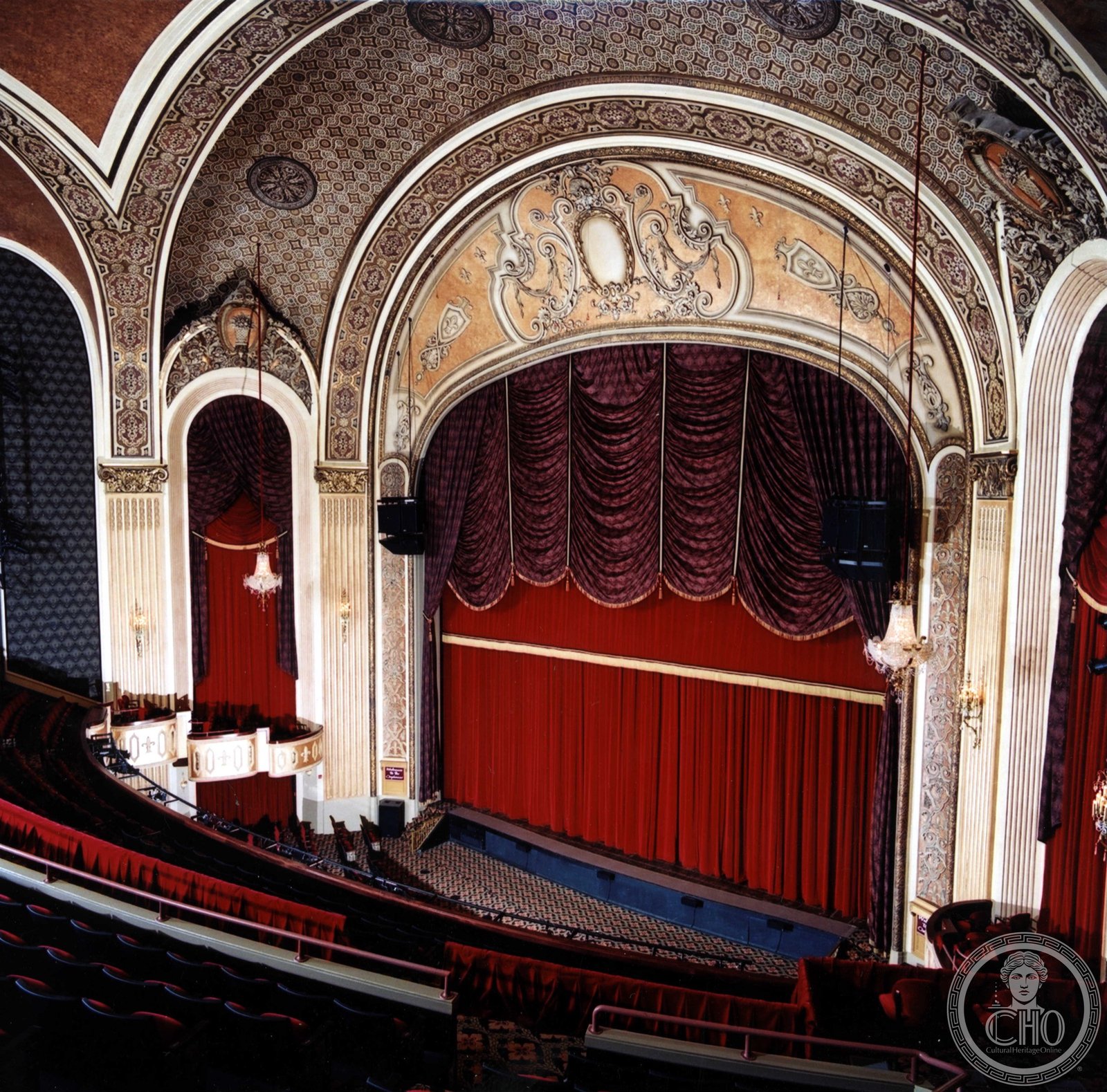
The Orpheum Theatre on Pierce Street is Sioux City’s most ornate surviving picture palace—an elaborate 1927 theater whose lavish interior ornamentation established the civic entertainment anchor of the Missouri River’s largest Iowa commercial center—now fully restored and operating as the Sioux City Orpheum Performing Arts Center.
At a glance
The Orpheum Theatre in downtown Sioux City, Iowa opened in 1927 as a major picture palace designed to serve the commercial and entertainment center of northwestern Iowa and adjacent Nebraska and South Dakota. Sioux City’s position at the confluence of the Missouri, Big Sioux, and Floyd Rivers made it the regional center for an agricultural and commercial hinterland that justified investment in an elaborate downtown theater. The Orpheum’s ornate interior—enriched plasterwork in the grand lobby, an auditorium of operatic ambition, and a facade that held its place on Pierce Street against all subsequent commercial development—has been comprehensively restored; the theater now operates as the Sioux City Orpheum Performing Arts Center and is the principal venue for touring Broadway productions, concerts, and community events in the Siouxland region.
Key facts
- Address: 528 Pierce Street, Sioux City, IA 51101
- GPS: 42.4996° N, 96.4003° W
- Built: 1927
- Style: Eclectic / Spanish Baroque Revival
- Capacity: approximately 2,600 seats
- Status: Active performing arts venue (Sioux City Orpheum Performing Arts Center)
- NRHP: Listed on National Register of Historic Places
History
Sioux City grew rapidly from the 1870s through the 1920s on the basis of meatpacking, grain trading, and the Missouri River commerce that made it the marketing center for agricultural production across three states. By 1927 the city’s commercial core along Fourth Street and Pierce Street supported a downtown entertainment corridor whose ambition was measured by the Orpheum: a theater designed to place the city’s audience in an environment of metropolitan sophistication, using the vocabulary of Baroque ornament and rich plasterwork that connoted cultural aspiration in 1920s America.
The Orpheum opened in 1927 as part of the national Orpheum Theatre circuit—one of the major vaudeville and early film chains that built theaters across the country from its origins in San Francisco. The circuit provided Sioux City with first-run vaudeville acts and later films on a schedule that kept the city current with national entertainment trends. As vaudeville gave way to film through the late 1920s, the Orpheum transitioned to a cinema-primary programming model that sustained its commercial viability through the 1930s and 1940s.
The Orpheum closed in the 1970s and the building was threatened by demolition before a preservation campaign in the 1990s secured funding for a major restoration. The restored theater reopened and has since operated as the principal cultural venue for the Siouxland region, programming Broadway tours, symphony performances, comedy, and other large-format entertainment that no smaller local venue could accommodate.
What you see
The Pierce Street facade occupies a central position in the downtown commercial corridor, its ornamental composition distinguishing the theater from the surrounding commercial streetwall. The entrance bay carries decorative plasterwork in the Baroque eclectic manner typical of 1920s picture palaces that drew on Spanish, Italian, and French ornamental traditions without strict stylistic fidelity—a freely mixed Baroque vocabulary that connoted splendor without requiring historical specificity.
Inside, the lobby carries the full weight of the period’s investment in audience arrival: enriched plasterwork cornices and pilasters, decorative pendant chandeliers, and a sequence of vestibule and lobby spaces that transition the arriving audience from the street into the theater’s alternative reality. The auditorium’s plasterwork is correspondingly elaborate: decorated side walls, a plaster ceiling with coffered and painted panels, and a proscenium arch scaled to the theater’s seat count. The restoration returned the ornamental program to a condition that approximates the original design; the stage and mechanical systems were upgraded to contemporary touring production standards during the same campaign.
Practical information
- The Sioux City Orpheum programs Broadway tours, concerts, comedy, and community events; check siouxcityorpheum.com for the current season calendar.
- Fully accessible; ADA seating in the main orchestra.
- Parking on Pierce Street and in the adjacent Fourth Street parking garage; downtown Sioux City is compact and walkable within the entertainment district.
- The Orpheum is the primary live entertainment venue for the three-state Siouxland region; tickets for major touring shows sell early.
Getting there
The Orpheum Theatre is at 528 Pierce Street in downtown Sioux City, Iowa, at the intersection of three states—Iowa, Nebraska, and South Dakota meet within the city’s metropolitan area. Sioux Gateway Airport (SUX) provides regional connections. By car, Sioux City is 90 miles north of Omaha via I-29, 200 miles northwest of Des Moines via I-80 and US-20, and 300 miles south of Minneapolis via I-90 and I-29. The Missouri River bridges connect the downtown to South Sioux City, Nebraska, and North Sioux City, South Dakota, making the Orpheum an anchor for the broader Siouxland audience.
Nearby
- Sioux City Art Center (2 blocks east): the regional art museum at 225 Nebraska Street holds American art collections and hosts rotating exhibitions in a building that integrates a 1940 Public Works Administration original with a contemporary addition.
- Sergeant Floyd Monument (1 mile south): the 100-foot sandstone obelisk on the Missouri River bluff marks the grave of Sergeant Charles Floyd, the only member of the Lewis and Clark Expedition to die on the journey (1804); a National Historic Landmark.
- Sioux City Public Museum (1 mile north): the museum at 607 4th Street documents the settlement history of the Siouxland region from Native American occupation through the agricultural and industrial development of the Missouri River corridor.
- Missouri River waterfront (0.5 miles west): the riverfront recreational area and walking trail along the river offers views of the confluence of the Missouri with the Big Sioux River.
Sources
- Sioux City Orpheum Performing Arts Center, siouxcityorpheum.com — venue history
- National Register of Historic Places, “Orpheum Theatre Sioux City” nomination
- Iowa Historic Preservation Alliance records
- Cinema Treasures, “Orpheum Theatre, Sioux City” database entry
Find it on the map
See this place and what’s around it →Record researched and written by Luigi De Marchi for Cultural Heritage Online, 2026.
📷 Become a Cultural Heritage Online photographer
Share your photos of places: they stay published under your name as the author. The more they're seen, the more you get noticed — and soon a contest will reward the most appreciated photos.
Log in or sign up free to add a photoIs this page about you?
This page is read by travellers and heritage enthusiasts who find it on Google. Tell us how you are connected to this place and we will take it from there.