
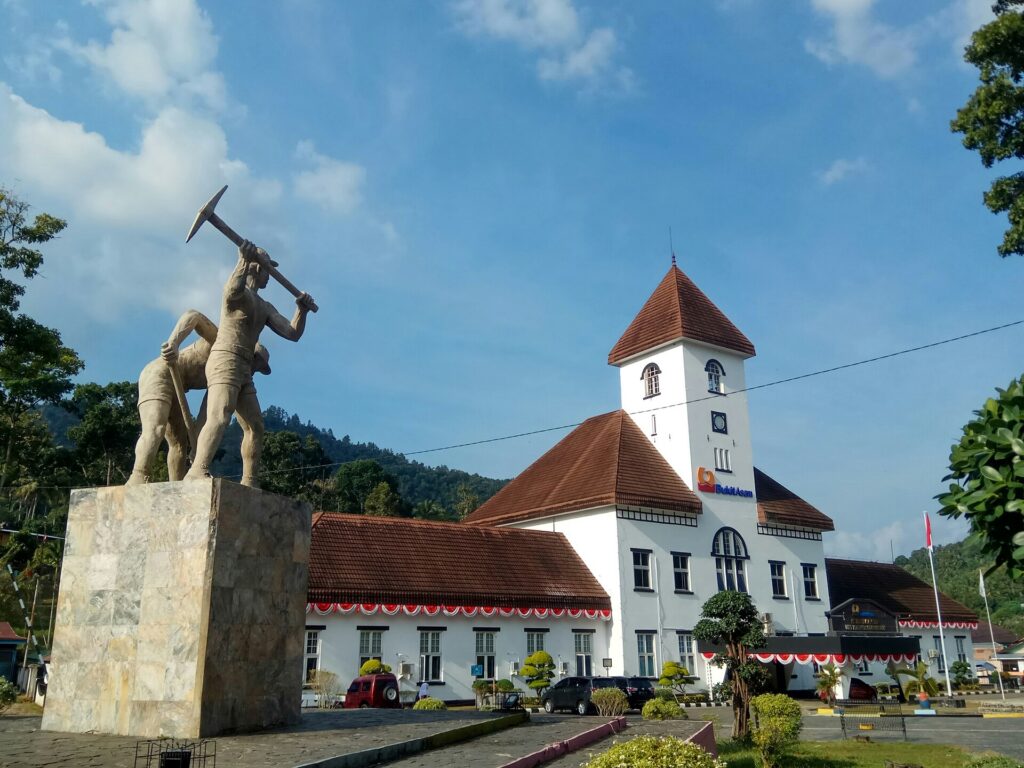
Among the hills of Sumatra, in the late nineteenth century the Dutch built a mining town to extract the coal of Ombilin: mines, a railway running down to the port, buildings and infrastructure raised by the labour of Indonesian workers, convicts and recruited hands. A rare example of the industrial heritage of colonial Asia.
At a glance
The Ombilin Coal Mining Heritage of Sawahlunto, in the highlands of West Sumatra, is a planned company town built by the Dutch colonial authorities from the late 19th century to extract the rich Ombilin coalfield. It comprises the mining site, the company town with its offices, housing and facilities, and the railway and port system built to carry the coal to the coast. Created with a workforce of recruited and convict labour from across the region, it is an outstanding example of industrial heritage in colonial Asia, inscribed by UNESCO in 2019.
Key facts
- UNESCO: World Heritage since 2019 (Ombilin Coal Mining Heritage of Sawahlunto)
- Coal town: a planned company town in the Sumatran highlands
- Dutch colonial: developed from the 1890s to mine the Ombilin coalfield
- Railway and port: a transport system carrying coal to the coast
- Mixed workforce: built with recruited and convict labour
- Industrial heritage: a rare colonial-era example in Asia
History
Surveys in the 19th century revealed rich coal seams in the Ombilin valley, and the Dutch colonial government developed them from the 1890s, founding the town of Sawahlunto to house the operation. Mines, a power plant, offices, churches, schools, housing and a hospital were laid out in the narrow valley, and a railway with steep rack sections was built to carry the coal down to the port of Emmahaven (Teluk Bayur) near Padang.
The mines were worked by labourers drawn from across the Indonesian archipelago, including convicts, and the town grew into a multicultural community. Mining declined in the late 20th century, and Sawahlunto reinvented itself as a heritage town, its industrial and urban legacy recognised by UNESCO in 2019.
What you see
The town preserves its colonial fabric in the valley — the white-walled company offices and mine buildings, the old power station and railway with its locomotives, workers’ housing, churches and the headframes of the mines, several now museums. A miners’ monument recalls the labour that built it.
Walking the compact valley town, with its mix of Dutch industrial and Indonesian elements, evokes the age of colonial coal.
Practical information
- Town: a walkable heritage town with mining museums
- Time needed: half a day
- Note: in the West Sumatran highlands, Minangkabau country
- Setting: a narrow valley inland from Padang
Getting there
Sawahlunto is in the highlands of West Sumatra, Indonesia, about 90 km east of the provincial capital Padang, reached by road. GPS: 0.68° S, 100.78° E.
Nearby
- Padang — the coastal capital of West Sumatra
- Bukittinggi — the highland Minangkabau town
- Lake Singkarak — a large lake in the highlands
Sources
- UNESCO World Heritage Centre — “Ombilin Coal Mining Heritage of Sawahlunto” (ref. 1610)
- Indonesian Ministry of Education and Culture — official body
- Encyclopaedia Britannica — Sumatra
Find it on the map
See this place and what’s around it →📷 Become a Cultural Heritage Online photographer
Share your photos of places: they stay published under your name as the author. The more they're seen, the more you get noticed — and soon a contest will reward the most appreciated photos.
Log in or sign up free to add a photo