
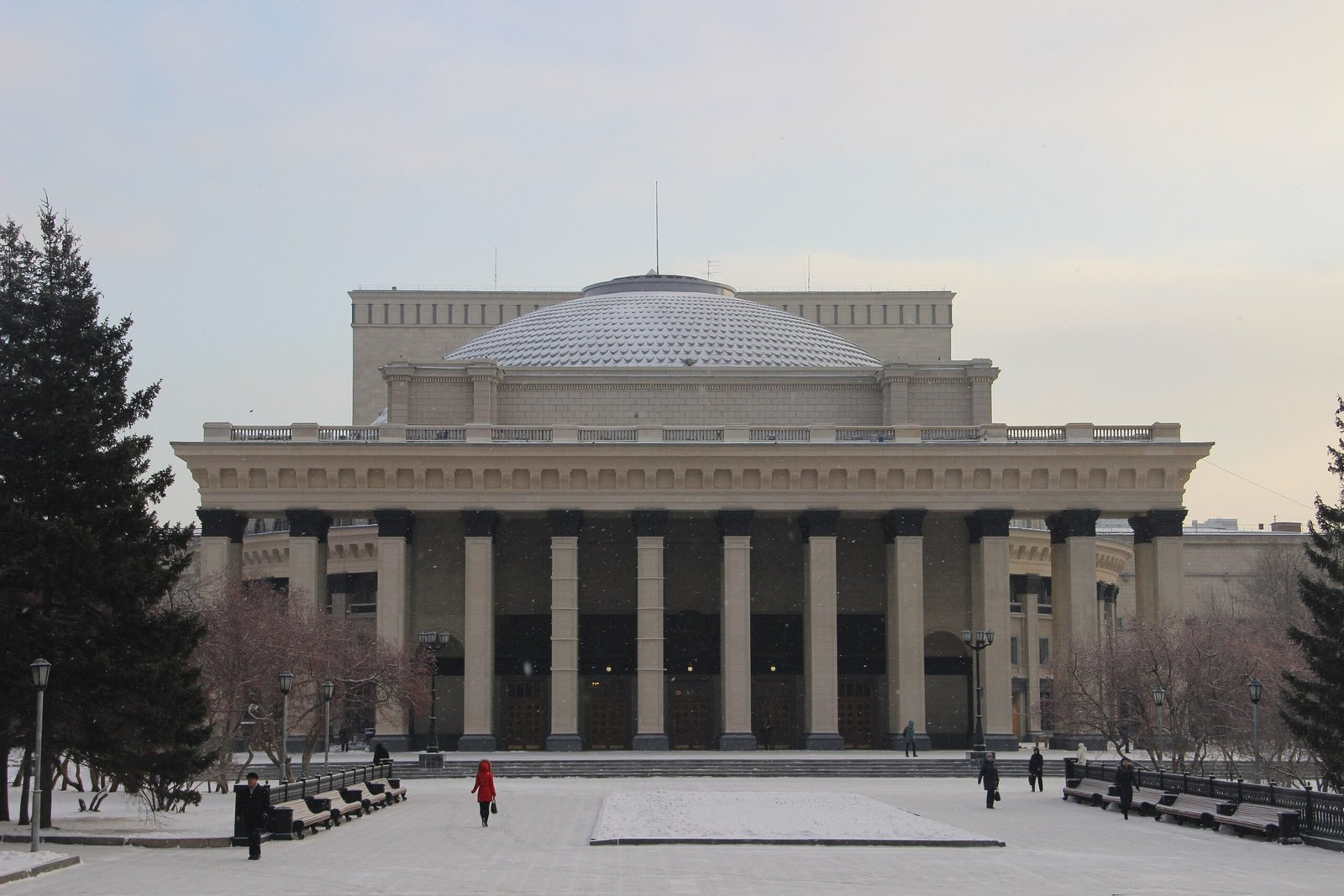
On Lenin Square in Siberia’s largest city stands a theatre built bigger than the Bolshoi, its concrete dome rising over a stage designed for spectacle on an industrial scale.
At a glance
Completed in February 1944, the Novosibirsk State Academic Opera and Ballet Theatre opened to the public on 12 May 1945. Built in a constructivist idiom, it remains the physically largest theatre in Russia. The building sits at the heart of the city, on Lenin Square, and carries official heritage-listed status.
History
Construction finished in the final winter of the Second World War. Months later, with victory secured, the house gave its first performance. It quickly became a civic anchor for a young Siberian city still defining its identity. Decades on, in the fourteenth season of The Amazing Race, the theatre served as a televised checkpoint, briefly turning a Siberian landmark into a global one. A major reconstruction in 2005 modernised its stage machinery and systems, making it, by some measures, the best-equipped theatre in Russia.
What you see
The theatre reads as ten interlocking volumes rather than one block. A lobby and ticket hall occupy the ground floor. Above sit a concert hall on the second and third levels, then a cylindrical auditorium wrapped in circular foyers. Behind it all looms the stage block, 30 metres deep, with a grid rising 29.5 metres. Side wings hold rehearsal rooms, costume workshops, and administrative space; a semi-cylindrical scenery warehouse presses against the stage from the rear. Crowning the whole composition is a dome 60 metres wide and 35 metres high, the building’s defining silhouette across the square. The main hall seats 1,774; smaller halls hold 375 and 150. Total floor area exceeds 40,000 square metres.
Cultural significance
Size alone gives the theatre its reputation, but repertoire has sustained it. Music directors since 2004 have included Teodor Currentzis, Ainars Rubikis, Dmitri Jurowski, and now Mikhail Tatarnikov, each shaping the company’s sound for international audiences. For Novosibirsk, a city built largely in the twentieth century around industry and rail, the theatre offers a rare architectural counterweight: a monument to culture rather than production.
Key facts
- Location: Lenin Square, Novosibirsk, Russia
- Completed: February 1944; first performance 12 May 1945
- Style: Constructivist architecture
- Dome: 60 m wide, 35 m high
- Main auditorium capacity: 1,774
- Heritage status: listed
- Current music director: Mikhail Tatarnikov
Practical information & getting there
The theatre stands directly on Lenin Square, at the symbolic center of Novosibirsk, making it easy to reach by metro or on foot from most points in the city core. Performance schedules, ticketing, and visiting details are best confirmed through the official website before travel.
Sources & resources
Find it on the map
See this place and what’s around it →📷 Become a Cultural Heritage Online photographer
Share your photos of places: they stay published under your name as the author. The more they're seen, the more you get noticed — and soon a contest will reward the most appreciated photos.
Log in or sign up free to add a photoDo you manage this place?
This page is read by travellers and heritage enthusiasts who find it on Google. Keep it accurate — and make it work for you. Free for non-profit heritage institutions.