

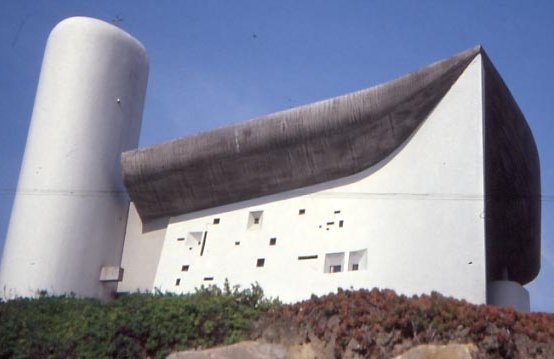
Le Corbusier’s modernist chapel rises from the Ronchamp hillside as a sculptural declaration of post-war spirituality. Built in 1955, this working Roman Catholic sanctuary ranks among the architect’s most accomplished designs.
At a glance
A small Roman Catholic chapel in eastern France, Notre-Dame du Haut exemplifies the radical formal innovation of Franco-Swiss architect Le Corbusier. The building serves both pilgrims and architecture students, drawing roughly 80,000 visitors annually.
History
Completed in 1955, the chapel was built as a pilgrimage site on a ridge above Ronchamp. It replaced an earlier sanctuary destroyed during the Second World War. The Association de l’Œuvre de Notre-Dame du Haut, a private foundation, has maintained the building and its religious mission since its inception.
What you see
The chapel’s sculptural form—with sweeping white concrete walls, a tilted roof, and organic curves—breaks entirely from traditional ecclesiastical language. Le Corbusier conceived the building as a spiritual vessel, integrating the landscape into the design. The interior volumes shift dramatically as natural light penetrates through strategically placed apertures.
Cultural significance
Notre-Dame du Haut stands as a watershed moment in modernist sacred architecture. Its 2016 inscription on the UNESCO World Heritage List—alongside sixteen other Le Corbusier works—acknowledged its decisive influence on twentieth-century design. The chapel demonstrates that modernism need not abandon spiritual resonance.
Key facts
- Country: France
- Location: Ronchamp
- Completed: 1955
- Architect: Le Corbusier
- Coordinates: 47.70°N, 6.62°E
- UNESCO World Heritage List: 2016
Practical information & getting there
The chapel remains a functioning Roman Catholic church. You can attend services or visit during posted hours. Ronchamp lies in the Bourgogne-Franche-Comté region, accessible by car or rail via nearby towns. The Association de l’Œuvre de Notre-Dame du Haut provides current visiting information.
Sources & resources
Find it on the map
See this place and what’s around it →📷 Become a Cultural Heritage Online photographer
Share your photos of places: they stay published under your name as the author. The more they're seen, the more you get noticed — and soon a contest will reward the most appreciated photos.
Log in or sign up free to add a photoIs this page about you?
This page is read by travellers and heritage enthusiasts who find it on Google. Tell us how you are connected to this place and we will take it from there.