
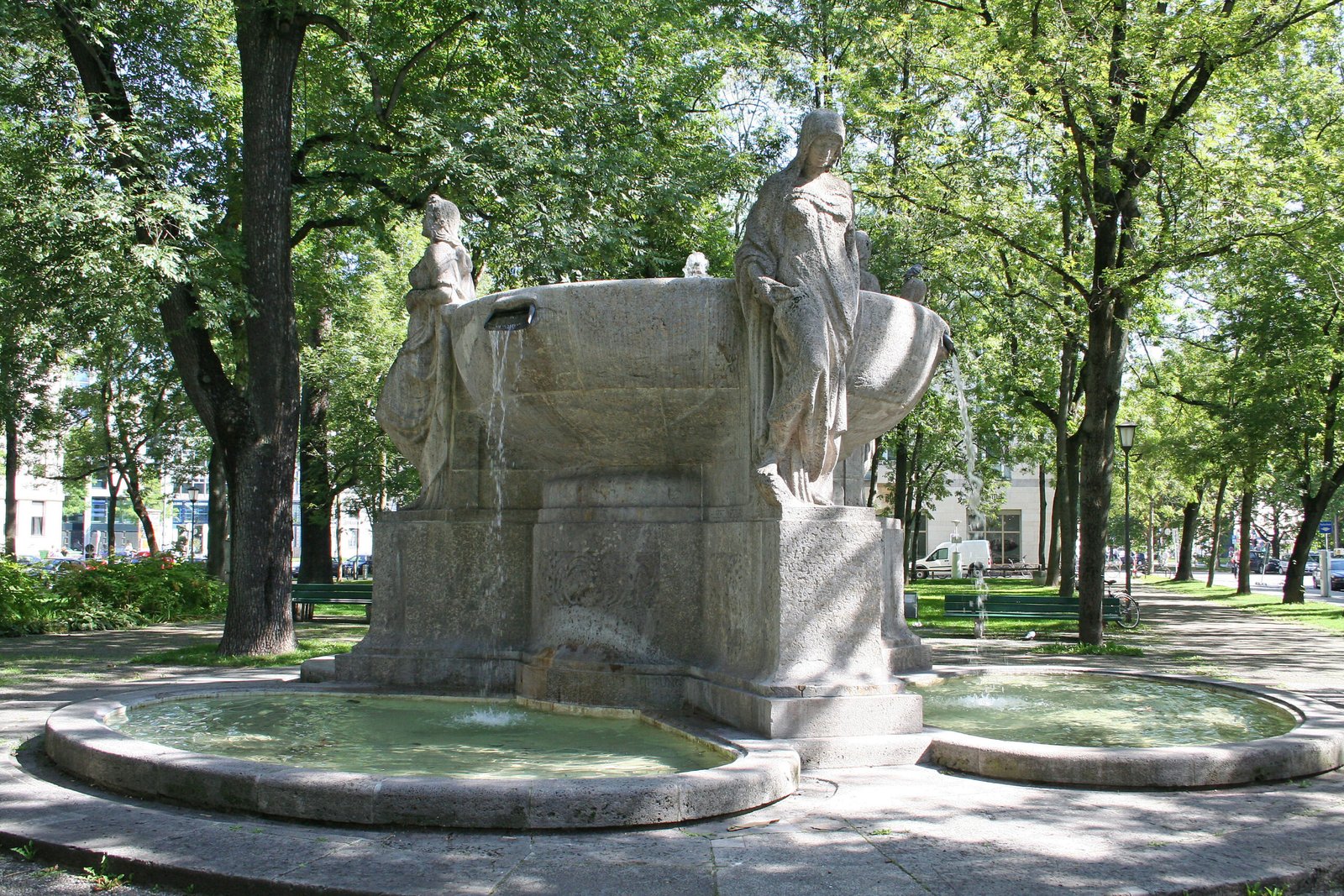
An Art Nouveau fountain depicting the three Germanic goddesses of destiny, their forms rising from Kirchheim limestone in the heart of Munich.
At a glance
The Nornenbrunnen celebrates Norse mythology through the language of early 20th-century design. Water flows from three mouths between the figures of Urd, Verdandi, and Skuld, cascading into shallow basins below. The fountain merges classical subject matter with modernist aesthetics.
History
Designed by Hubert Netzer, the fountain was constructed in 1907 at the Stachus, a major public square in central Munich. In 1970, as part of significant reconstruction work, the fountain was carefully disassembled. It was rebuilt in 1965 at its present location in the Eschenanlage on Maximiliansplatz, where it continues to draw visitors and locals alike.
What you see
The three Norns lean against a substantial water bowl, their bodies carved from cream-colored Kirchheim limestone. Art Nouveau elements soften the forms—flowing lines and organic curves typical of the style emerge in the figures and their arrangement. Water emerges from three sculptural mouths positioned between the goddesses, feeding three ground-level basins that suggest movement and cycle.
Cultural significance
The fountain brings Germanic mythology into Munich’s urban landscape, honoring the Norns who weave the threads of fate in Norse tradition. As an Art Nouveau work, it represents the style’s brief golden age and its ambition to elevate public spaces through imaginative design. The work bridges pagan symbolism and modern aesthetic sensibility.
Key facts
- Country: Germany
- City: Munich (Maxvorstadt district)
- Completed: 1907
- Designer: Hubert Netzer
- Material: Kirchheim limestone
- Coordinates: 48.14277778, 11.57166667
Practical information & getting there
The fountain is located in the Eschenanlage on Maximiliansplatz in central Munich. Public transport connections serve the area well. Visit during daylight hours to see the play of light on the limestone figures and the movement of water through the basins.
Sources & resources
Find it on the map
See this place and what’s around it →📷 Become a Cultural Heritage Online photographer
Share your photos of places: they stay published under your name as the author. The more they're seen, the more you get noticed — and soon a contest will reward the most appreciated photos.
Log in or sign up free to add a photoIs this page about you?
This page is read by travellers and heritage enthusiasts who find it on Google. Tell us how you are connected to this place and we will take it from there.