

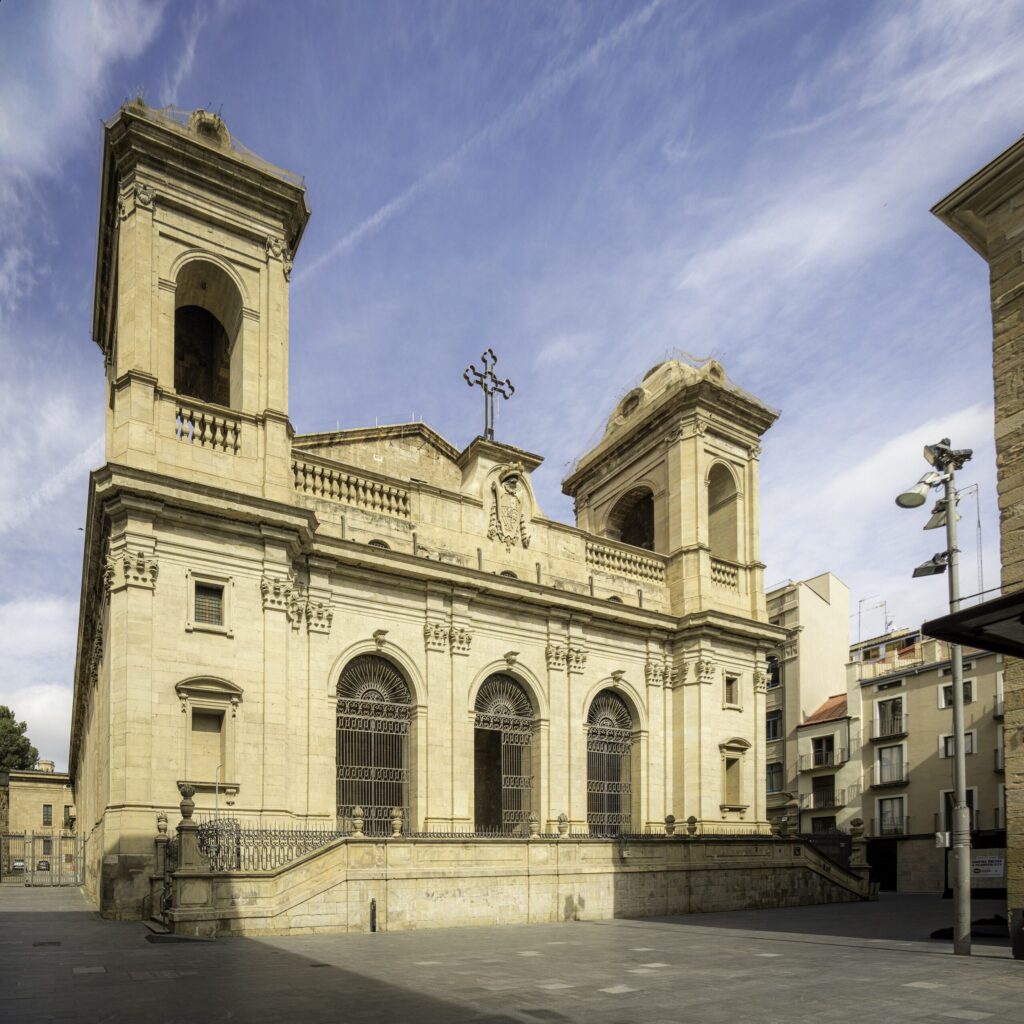
An austere Baroque-Neoclassical cathedral built with royal patronage to replace a fortress-converted predecessor, now the seat of the Diocese of Lleida.
At a glance
The Cathedral of the Assumption stands as Lleida’s principal religious monument, constructed in the late 18th century following the city’s turbulent aftermath of the War of Spanish Succession. Its sober architectural style reflects the transition between Baroque extravagance and Neoclassical restraint, positioned prominently on the city’s main commercial thoroughfare opposite Santa Maria Hospital.
History
Construction began in 1761 and concluded in 1782, financed through donations from King Charles III of Spain, Bishop Joaquín Sánchez, and citizens of Lleida. The cathedral was erected to replace La Seu Vella, the old cathedral that had been repurposed as a fortress and military garrison following the War of Spanish Succession, rendering it unsuitable for worship.
What you see
The New Cathedral exemplifies austere Baroque design with Neoclassical elements. Its restrained ornamentation and geometric proportions distinguish it from the ornamental excess typical of earlier Baroque churches, embodying enlightened tastes of the late 18th century. The building’s prominent location along Lleida’s principal commercial street ensures its visibility as a civic landmark.
Cultural significance
The cathedral represents Lleida’s recovery and renewal following the War of Spanish Succession. Its construction symbolized reconciliation between crown and city, with royal support demonstrating the restoration of civic stability. As the seat of the Diocese of Lleida, it remains the spiritual center of the region’s Catholic faithful.
Key facts
- Location: Lleida, Catalonia, Spain
- Coordinates: 41.6133°N, 0.623°E
- Construction dates: 1761–1782
- Architectural style: Austere Baroque–Neoclassical
- Religious status: Seat of the Diocese of Lleida
Practical information & getting there
The cathedral is centrally located in Lleida on the main commercial street, making it easily accessible by public transport. You can reach it from the city center on foot. Local tourism information provides current visiting hours and details about religious services.
The design is attributed to Pedro Martín Cermeño, with the main works directed by the Italian architect Francisco Sabatini, and the building is regarded as the first Neoclassical construction in Catalonia, still carrying influences of late Baroque and French academicism.
Sources & resources
Find it on the map
See this place and what’s around it →📷 Become a Cultural Heritage Online photographer
Share your photos of places: they stay published under your name as the author. The more they're seen, the more you get noticed — and soon a contest will reward the most appreciated photos.
Log in or sign up free to add a photoIs this page about you?
This page is read by travellers and heritage enthusiasts who find it on Google. Tell us how you are connected to this place and we will take it from there.
This entry stays online and free either way — and a free account lets you add to it yourself.