
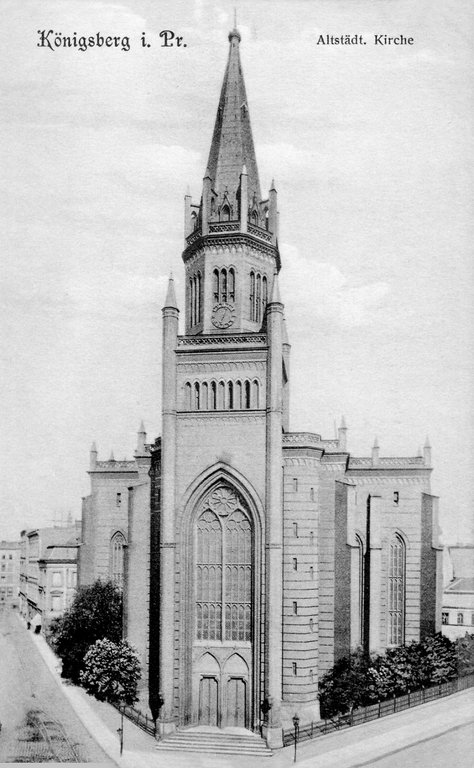
A brick Neo-Gothic replacement for a medieval church that once stood north of Königsberg Castle, designed by Karl Friedrich Schinkel and lost within a century of its dedication.
At a glance
The New Altstadt Church, or Neue Altstädtische Kirche, served the Altstadt quarter of Königsberg from 1845 until its destruction in the Second World War. It replaced an earlier church founded in 1264 that had begun to crack and sink. Schinkel drew up the plans, though budget cuts forced a smaller building than he first proposed. Today nothing of the structure remains standing on its original site.
History
Königsberg’s original Altstadt Church stood south of the castle for over five centuries before subsidence forced its dismantling between 1826 and 1828. Congregants worshipped temporarily at Neurossgarten Church while a new site was chosen, at the crossing of Kreytzenscher Platz and Junkerstraße, north of the castle. Construction started in 1838 to designs by Karl Friedrich Schinkel. The finished church opened in 1845. Its pulpit, choir, and altar were carried over from the old building, or modeled closely on it. The exterior weathered the 1944 bombing of Königsberg relatively intact, but the interior did not survive. Soviet authorities in postwar Kaliningrad chose not to rebuild it, part of a broader effort to erase the city’s German character. Workers dismantled the remaining outer walls in 1959.
What you see
Contemporaries praised the church’s brick Neo-Gothic columns, a rare point of admiration for a design otherwise scaled back from Schinkel’s ambitions. The high altar rose 13 metres. It framed a 1606 wooden carving by an unknown master, depicting the crucifixion alongside John the Apostle, Mary of Nazareth, Mary Magdalene, and the two thieves. A deer-antler chandelier from around 1500, adorned with a Mother and Child, hung nearby. Isaak Riga the Younger designed the confessional. None of this survives in place. Some columns from the church’s portico were salvaged and now form part of the entrance to Kaliningrad’s Baltika Stadium.
Cultural significance
The church occupies an odd position in Königsberg’s memory: a 19th-century Schinkel design built to replace a medieval original, then erased in turn by war and postwar politics. Its lost altar carving, moved for safekeeping to a barn near Arnau in 1943, vanished during the war’s final chaos rather than in the bombing itself. The reuse of its columns at Baltika Stadium is one of the few physical threads connecting present-day Kaliningrad to this particular Königsberg landmark.
Key facts
- Architect: Karl Friedrich Schinkel
- Style: Brick Gothic, Gothic Revival
- Dedicated: 1845
- Predecessor church founded: 1264
- Destroyed: interior lost in the 1944 bombing of Königsberg; remaining walls dismantled 1959
- Surviving fragment: portico columns at Kaliningrad’s Baltika Stadium
Practical information & getting there
No building remains at the church’s original site near the former Königsberg Castle. You can still see relocated columns at Baltika Stadium in central Kaliningrad, a short walk or taxi ride from most city-centre hotels. There is no admission fee or set visiting hours tied to the church itself, since it exists only as a memory and a handful of reused stones.
Sources & resources
Find it on the map
See this place and what’s around it →📷 Become a Cultural Heritage Online photographer
Share your photos of places: they stay published under your name as the author. The more they're seen, the more you get noticed — and soon a contest will reward the most appreciated photos.
Log in or sign up free to add a photoIs this page about you?
This page is read by travellers and heritage enthusiasts who find it on Google. Tell us how you are connected to this place and we will take it from there.