
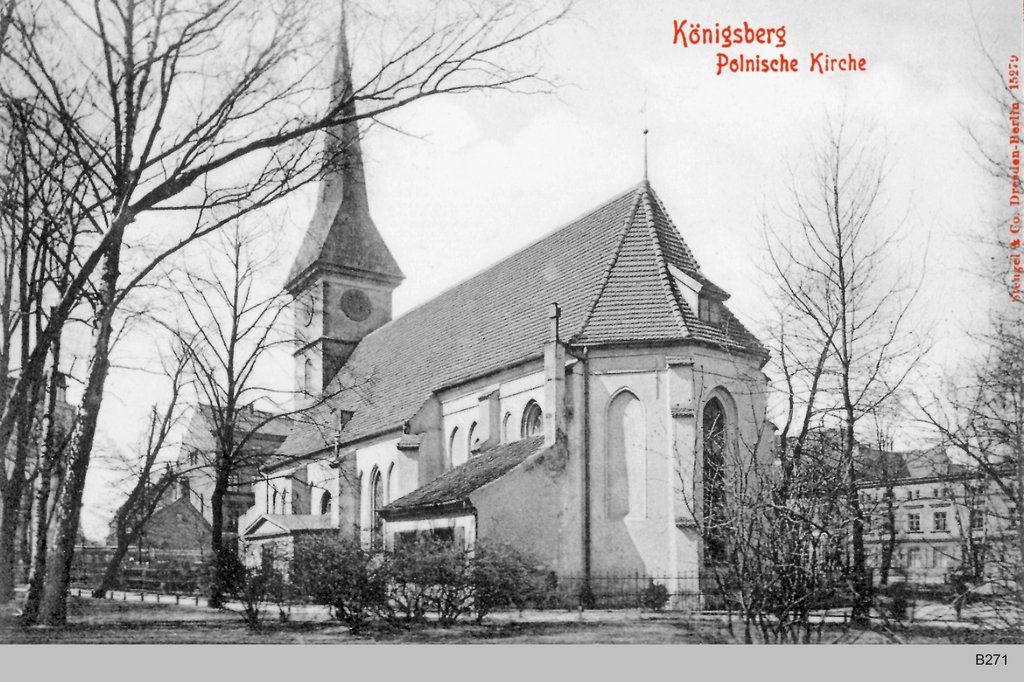
The oldest church of old Königsberg stood for nearly seven centuries before Soviet planners erased its ruins for a boulevard.
At a glance
Steindamm Church began as a wooden Catholic chapel dedicated to Saint Nicholas, first recorded in 1256. Rebuilt in stone after a siege destroyed the first settlement around it, it became the nucleus of the Steindamm district. Gothic in form, it later served Lutheran congregations in German, Polish and Lithuanian before its wartime destruction and postwar demolition.
History
The church’s roots trace to a chapel built at Königsberg’s earliest German settlement. After the Siege of Königsberg destroyed that settlement, the community rebuilt the church in stone in 1263, and the surrounding suburb took the name Steindamm. Lutheran reform reached the church in 1525, when it was granted to non-German Protestant congregations. Polish- and Lithuanian-speaking preachers followed, including Jan Seklucjan, who translated the New Testament into Polish there in the 1540s. Rivalry between Polish and Lithuanian congregants grew so heated that pastors struggled to be heard over the noise. Lithuanians eventually gained their own church in 1603, leaving Steindamm to develop a firmly Polish character; it became known simply as the Polish Church. Occupying Russian forces used the building for Orthodox services during the Seven Years’ War. Composer Otto Nicolai was baptized here in 1810. Napoleonic troops later turned it into a jail and field hospital in 1812. Polish sermons ended in 1874, and the last Polish-language services, held for Masurian soldiers, stopped in 1901. The church survived Allied bombing in 1944 but was destroyed by Soviet artillery during the 1945 Battle of Königsberg. Its ruins were cleared in 1950 to widen Leninskiy Prospekt.
What you see
Nothing remains today. By the early 14th century the church had grown into a single-nave Gothic hall with three vaulted bays and a large wheel window above its southern entrance. Its steeple, added in the 15th century, collapsed in 1559 without harming anyone; a rebuilt spire was finished only in 1710. Inside, three carved keystones marked the choir: the arms of Altstadt, a depiction of Adam and Eve, and an inscription too worn to read by the 20th century. A 1586 triptych by Anton Möller portrayed Judgement Day, its frame attributed to Michael Doebel the Elder around 1690. A slender Salvator Mundi of 1706 stood by the pulpit, itself refashioned in Rococo style in 1760.
Cultural significance
Steindamm Church was a rare shared space. German, Polish and Lithuanian speakers all worshipped within its walls at different points, making it a barometer of Königsberg’s shifting population and politics. Its Polish identity, sustained for centuries by East Prussian-born clergy rather than migrants from Poland itself, reflects the complex layering of language and loyalty in the region. Its destruction, alongside so much of old Königsberg, marks the sharp break between Prussian Kaliningrad and the Soviet city built over it.
Key facts
- Location: Kaliningrad (formerly Königsberg), Russia
- First documented: 1256, as a wooden chapel
- Rebuilt in stone: 1263
- Style: Gothic
- Destroyed: 1945, during the Battle of Königsberg
- Ruins demolished: 1950, to expand Leninskiy Prospekt
Practical information & getting there
The church no longer exists. Its former site lies along today’s Leninskiy Prospekt in central Kaliningrad, now built over with Soviet-era infrastructure. Visitors interested in the site can walk the modern thoroughfare, though no marker or ruin survives above ground. Nearby museums and surviving Königsberg landmarks offer the closest tangible link to this vanished church.
Sources & resources
Find it on the map
See this place and what’s around it →📷 Become a Cultural Heritage Online photographer
Share your photos of places: they stay published under your name as the author. The more they're seen, the more you get noticed — and soon a contest will reward the most appreciated photos.
Log in or sign up free to add a photoIs this page about you?
This page is read by travellers and heritage enthusiasts who find it on Google. Tell us how you are connected to this place and we will take it from there.