

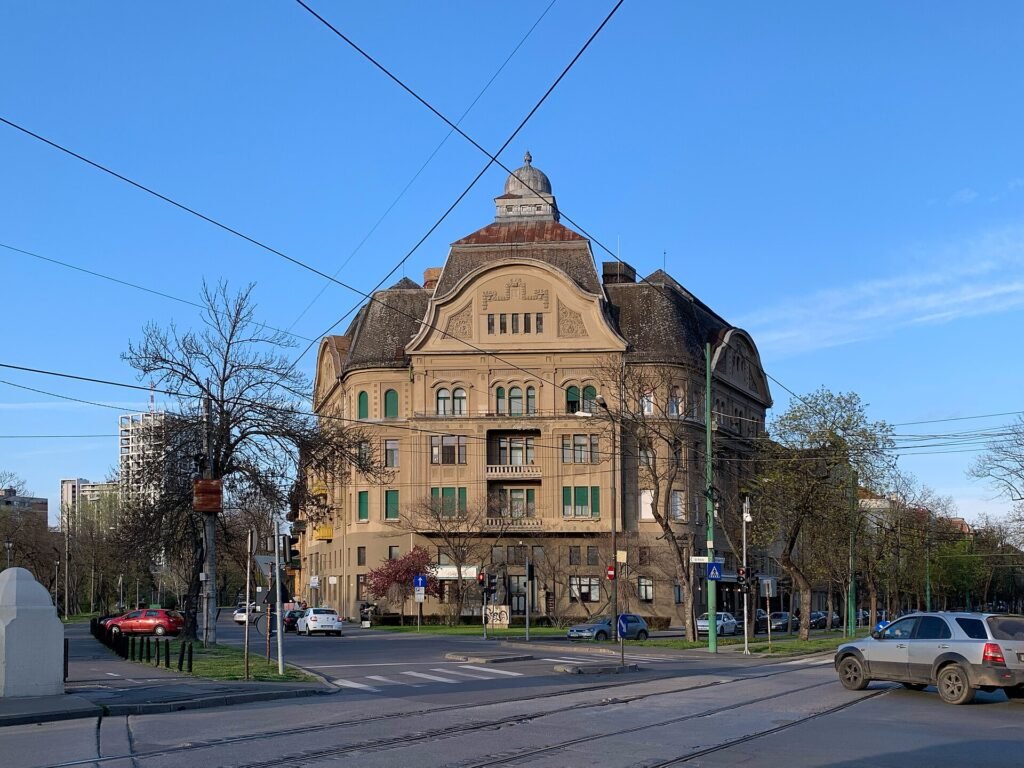
Wavy lines and water-flowers in tile: a public bath built when Timișoara dressed everything in the Secession.
At a glance
The Neptun Baths in Timișoara are a fine example of the city’s Secession architecture, built between 1912 and 1914 by László Székely, the chief architect of Timișoara. A public bathhouse on the river, it is worked in the Viennese Art Nouveau with wavy lines, floral ornament and half-columns. It long served the city’s bathers and is being restored.
Key facts
- Location: Splaiul Tudor Vladimirescu, Timișoara
- Architect: László Székely
- Built: 1912–1914
- Style: Viennese Secession (Art Nouveau)
- Function: public baths
History
Székely shaped much of early-twentieth-century Timișoara as its municipal architect, in the Secession then sweeping the region. The Neptun Baths were among his public commissions, giving the growing industrial city a modern bathhouse.
Finished in 1914, the baths served generations of citizens. After years of closure they are the subject of restoration, recognised as a key piece of the city’s Art Nouveau heritage.
What you see
The building carries the marks of the Viennese Secession: undulating lines, floral and aquatic ornament suited to a place of water, and slender half-columns across the façade. It is a reminder that Timișoara’s Art Nouveau reached beyond palaces to the everyday institutions of the city.
Practical information
- Open: under restoration; exterior viewable from the riverside
- Cost: free to view from outside
- Best for: the Secession façade by the Bega canal
- Time needed: 10–15 minutes
Getting there
The baths stand on the bank of the Bega canal in central Timișoara, a short walk from Piața Victoriei and the city’s other Art Nouveau buildings.
Nearby
- Piața Victoriei — the Secession square nearby
- Lloyd Palace — Baumhorn’s palace at the head of the square
Sources
- Wikipedia / Heritage of Timișoara — Neptun Baths (Băile Neptun)
- Primăria Timișoara — building information
- Wikimedia Commons — image source and licence
Find it on the map
See this place and what’s around it →Record researched and written by Luigi De Marchi for Cultural Heritage Online, 2026.
📷 Become a Cultural Heritage Online photographer
Share your photos of places: they stay published under your name as the author. The more they're seen, the more you get noticed — and soon a contest will reward the most appreciated photos.
Log in or sign up free to add a photoIs this page about you?
This page is read by travellers and heritage enthusiasts who find it on Google. Tell us how you are connected to this place and we will take it from there.