
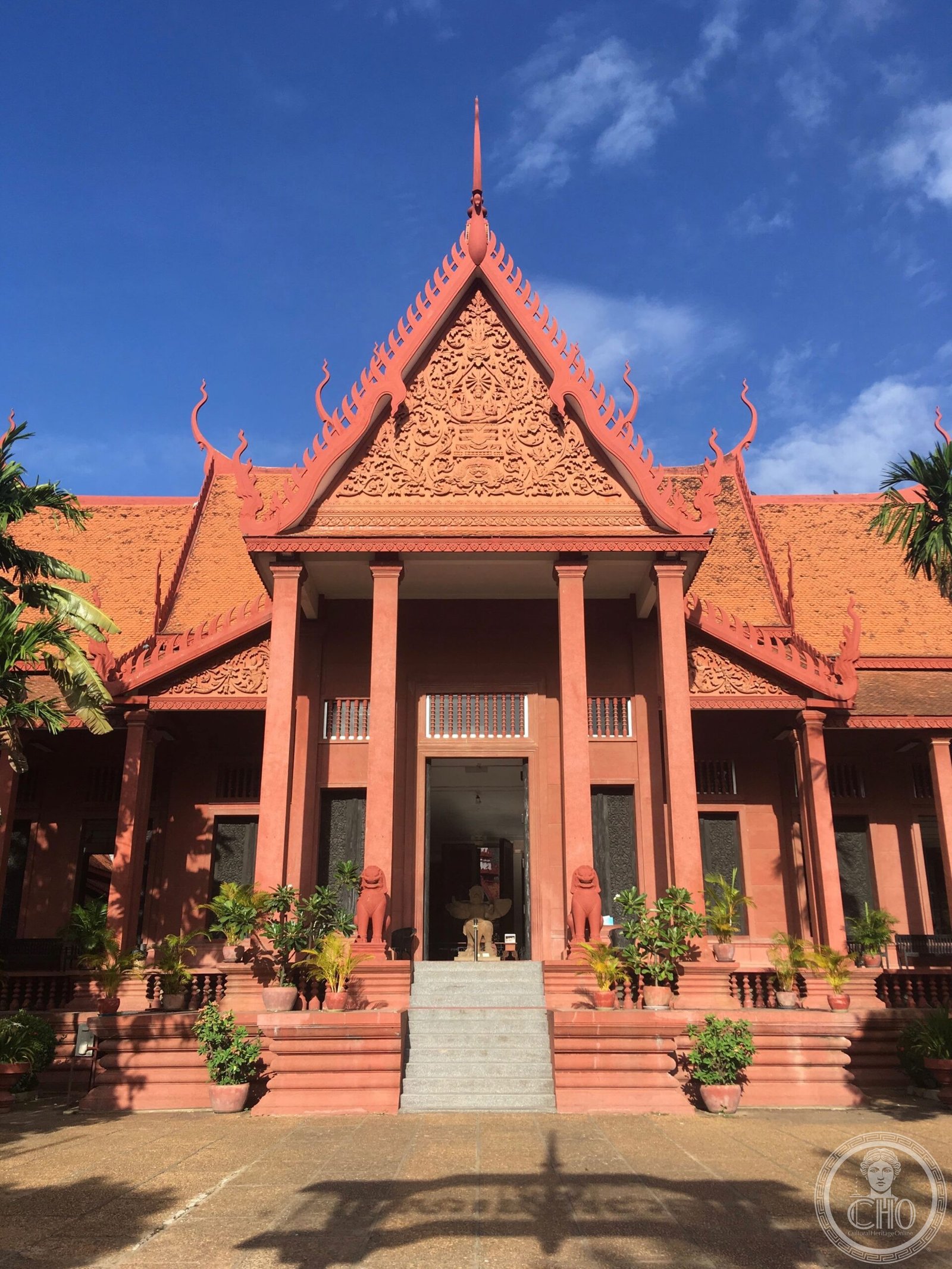
Housed in four red-laterite pavilions grouped around a garden courtyard in the heart of Phnom Penh, the National Museum of Cambodia is the country's most important repository of history and culture. Designed by French architect-archaeologist George Groslier and opened in 1920, the building was the first major modern structure in Southeast Asia to deliberately revive pre-Angkorian Khmer architectural forms rather than imposing a European colonial style. Its tiered terracotta roofs, carved sandstone lintels, and gallery of nagas rising from the gabled eaves are all drawn from ancient temple vocabulary. Inside, the collections hold more than 14,000 objects spanning 2,000 years of Khmer civilisation — bronze divinities, linga pedestals, and the celebrated reclining Vishnu from the Western Mebon temple — making it the world's largest collection of Khmer sculpture outside Angkor itself. Groslier, who founded the School of Cambodian Arts and spent his career documenting traditional craftsmanship, designed the building as both archive and living school. Under the Khmer Rouge between 1975 and 1979 most of the museum's staff were killed; the collections survived, hidden behind locked doors.
At a glance
- Type
- National museum
- Period
- Opened 1920
- Style
- Khmer Revival
- Location
- Phnom Penh, Cambodia
- Coordinates
- 11.5651 N, 104.9292 E
- Architect(s)
- George Groslier
Overview
The National Museum of Cambodia — known locally as Sala Rachana — stands at the corner of Streets 13 and 178 in Phnom Penh, a short walk from the Royal Palace. It was conceived in an era when French colonial administrators debated whether Indochina's heritage should be displayed in Paris or kept in situ. Groslier argued forcefully for the latter, and the museum's foundation was itself an act of cultural restitution. The compound's four interconnected galleries open onto a central courtyard shaded by trees and populated by birds. The collections are arranged chronologically and by medium, with pre-Angkorian bronzes giving way to the great Angkorian masterpieces of the ninth to fifteenth centuries, then to post-Angkorian works in lacquer, wood, and silver.
History
Construction began in 1917 and the museum opened in 1920, functioning simultaneously as a museum, a school of arts and crafts, and a research centre. Groslier directed it until 1945. After independence in 1953 Cambodian curators took over management. The Khmer Rouge period from 1975 to 1979 was catastrophic: most staff were executed, the School of Cambodian Arts was abolished, and the compound was used as a military billet. Objects survived because the galleries were padlocked. Following liberation and the withdrawal of Vietnamese forces in 1989, an international restoration effort beginning in the early 1990s — led by EFEO and UNESCO — stabilised the collections and restored the building's fabric. A major renovation completed in 2008 re-roofed the pavilions and waterproofed the floors.
Architecture and Design
Groslier modelled the museum's massing and ornament on the pavilion halls of Angkor Wat and the Bayon. The plan is a cruciform arrangement of four rectangular galleries meeting at right angles around the courtyard. Walls are in locally quarried red laterite; window surrounds and decorative panels are in moulded concrete finished to resemble dressed sandstone. Roof forms follow the Khmer convention of stacked tiers diminishing in scale, each ridge capped with finials in the shape of naga serpent heads. The courtyard elevation is screened by timber louvred screens carved in traditional patterns — a detail that allows cross-ventilation while filtering direct sunlight. The entrance gateway is flanked by two guardian figures (dvarapalas) cast from originals at Angkor.
Cultural significance
The museum holds the world's largest collection of Khmer sculpture outside of Angkor itself. Highlights include the colossal reclining Vishnu from the Western Mebon temple (eleventh century), a monumental Jayavarman VII head considered the finest surviving royal portrait from the Angkorian period, and an extensive collection of bronze Bodhisattvas from the seventh to ninth centuries. The building itself is culturally significant as the first articulation of Khmer Revival architecture — a vocabulary later adopted for the National Sports Complex, the Chaktomuk Conference Hall, and dozens of public buildings constructed after independence. Groslier's insistence that modern Cambodian architecture should draw on Khmer tradition rather than French models shaped an entire generation of post-colonial design.
Visiting today
The museum is open daily from 8:00 to 17:00, including public holidays. Entry is USD 10 for international visitors; Cambodian citizens enter free. Photography is permitted in the galleries without flash. Audio guides are available in several languages. The courtyard cafe serves coffee and cold drinks. Guided tours can be arranged through the museum office. A small gift shop sells catalogues, postcards, and replicas of key objects. Visitors are advised to arrive early to avoid the midday heat; the courtyard galleries are not air-conditioned. The museum is particularly atmospheric in the early morning when light enters the eastern galleries at low angles.
Getting there
The museum entrance is on Street 13 in central Phnom Penh, immediately north of the Royal Palace compound. Tuk-tuks and ride-hailing apps (Grab, PassApp) are the most convenient options from anywhere in the city. From Phnom Penh International Airport the journey by taxi takes approximately 30 to 40 minutes depending on traffic. The museum is easily walkable from most riverfront hotels on Sisowath Quay. No dedicated parking is available; motorbike parking is managed informally on Street 13. Cycling is practical from the city centre; the riverside bicycle path connects to the museum district.
Sources and resources
Find it on the map
See this place and what’s around it →📷 Become a Cultural Heritage Online photographer
Share your photos of places: they stay published under your name as the author. The more they're seen, the more you get noticed — and soon a contest will reward the most appreciated photos.
Log in or sign up free to add a photoIs this page about you?
This page is read by travellers and heritage enthusiasts who find it on Google. Tell us how you are connected to this place and we will take it from there.