
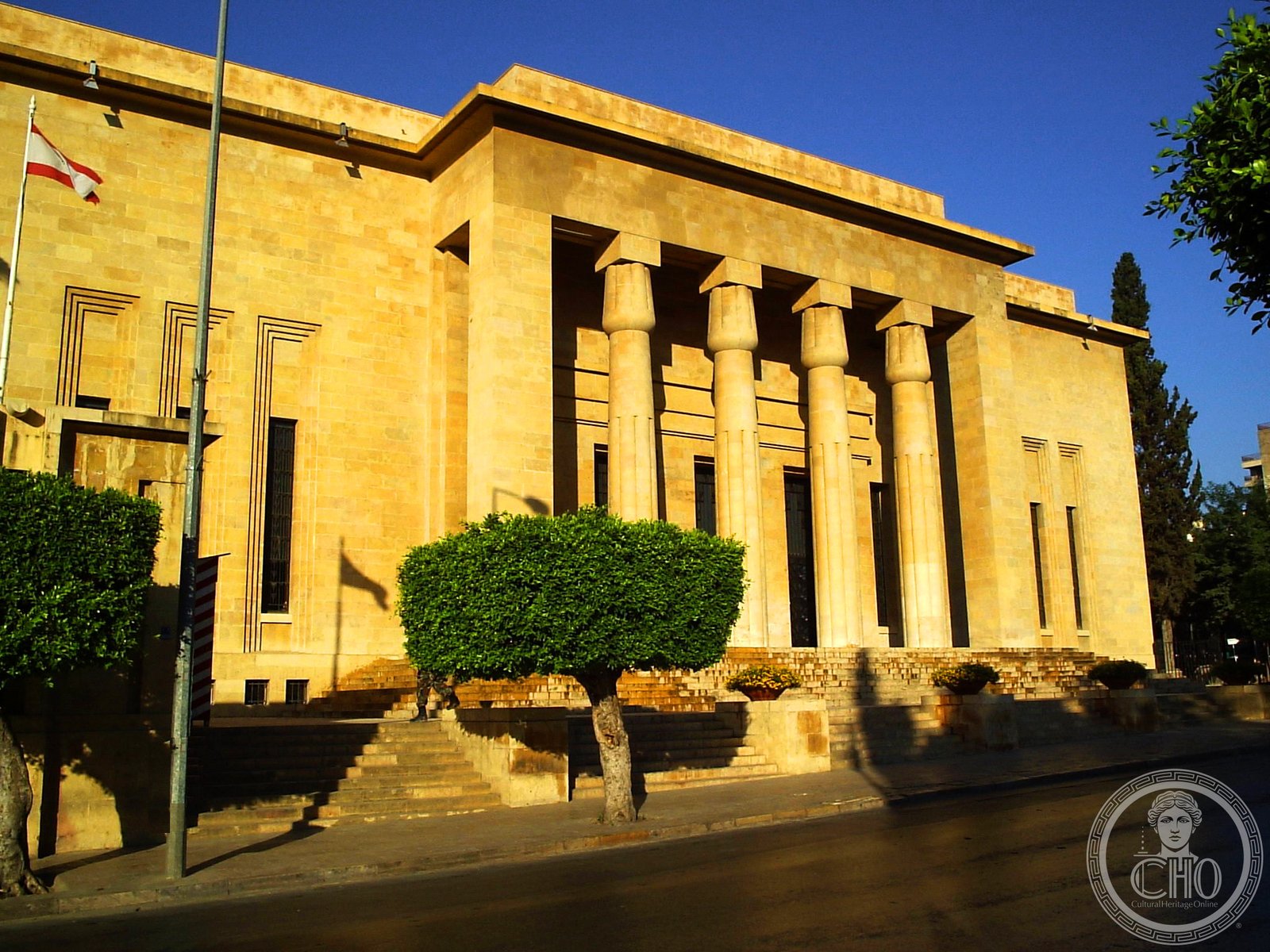
One of the finest Art Deco buildings in the Levant, this monumental museum safeguarded Lebanon's greatest treasures through a devastating civil war, its artifacts sealed in concrete tombs and reopened intact after fifteen years of conflict.
At a glance
- Type
- National Museum
- Period
- 1937 (opened 1942)
- Style
- Art Deco with Egyptian Revival motifs
- Location
- Rue de Damas, Beirut, Lebanon
- Coordinates
- 33.8881, 35.5041
- Architect
- Antoine Nahas and Pierre Leprince-Ringuet
Overview
The National Museum of Beirut is the principal museum of archaeology in Lebanon and one of the most important in the Middle East. Housed in a monumental Art Deco building completed in 1937 and opened to the public in 1942, the museum holds over 100,000 objects spanning Lebanese prehistory through the Ottoman era. The collection encompasses Phoenician, Bronze Age, Hellenistic, Roman, and Byzantine artifacts, making it an irreplaceable record of Lebanon's layered cultural heritage. The building itself, with its commanding facade of Egyptian Revival bas-reliefs and symmetrical limestone wings, is one of the finest examples of Art Deco civic design in the Arab world.
History
Construction began in the 1930s under the French Mandate, designed by architects Antoine Nahas and Pierre Leprince-Ringuet. When Lebanon's civil war erupted in 1975, the museum sat directly on the Green Line dividing Christian East Beirut from Muslim West Beirut. Director Camille Asmar and his team sealed large artifacts in concrete and buried mosaic pavements in sand. After the war ended in 1990, the building was de-mined and the concrete casings opened to reveal the collections intact. The museum reopened progressively through the 1990s and 2000s in a celebrated act of cultural recovery.
Architecture and Design
The building exemplifies monumental Art Deco filtered through Egyptian Revival sensibility. The central pavilion is flanked by symmetrical wings under a flat roof, giving the composition horizontal grandeur suited to an institutional landmark. The facade carries bas-relief panels depicting Phoenician ships and ancient Lebanese historical scenes alongside stylized motifs drawn from Phoenician and Egyptian sources. The use of local limestone grounds the building in its Mediterranean setting while the composition speaks the international architectural language of 1930s institutional Deco. Interior galleries are arranged in a classical plan around a central hall with controlled natural light.
Cultural significance
The museum stands as a symbol of cultural resilience as much as an architectural landmark. Its survival through fifteen years of civil conflict is one of the most celebrated stories of heritage preservation in the twentieth century. The building's position on the former Green Line gives it charged symbolic meaning in post-war Lebanese society. Architecturally it is among the most accomplished examples of Art Deco civic design in the Levant, demonstrating how a Western vocabulary could be inflected with regional imagery to produce a building of genuine local identity.
Visiting today
The museum is open to visitors and actively maintained. Galleries display the permanent collection across ground floor, lower ground, and mezzanine levels, organized thematically from prehistoric Lebanon through the medieval Islamic period. Given Beirut's complex security situation, visitors should check current travel advisories before planning a trip. The museum is managed by the Lebanese Directorate General of Antiquities.
Getting there
Located on Rue de Damas in central Beirut, near the Sodeco area on the former Green Line. Accessible by taxi or ride-share from Downtown Beirut (approximately 10 minutes). Shared service taxis on the Damascus Road route pass nearby. Walkable from the Sodeco and Achrafieh neighborhoods. Street parking is available along Rue de Damas.
Sources and resources
Find it on the map
See this place and what’s around it →Record researched and written by Luigi De Marchi for Cultural Heritage Online, 2026.
📷 Become a Cultural Heritage Online photographer
Share your photos of places: they stay published under your name as the author. The more they're seen, the more you get noticed — and soon a contest will reward the most appreciated photos.
Log in or sign up free to add a photoIs this page about you?
This page is read by travellers and heritage enthusiasts who find it on Google. Tell us how you are connected to this place and we will take it from there.