

A collection born from the paintings of suppressed monasteries waited a century for a building of its own. In 1904 Ghent gave it a classical temple in a park on the site of a demolished fortress.
At a glance
The Museum voor Schone Kunsten stands at the eastern corner of the Citadelpark, south of the old city of Ghent. It was designed by the city architect Charles Van Rysselberghe, built between 1898 and 1904 and doubled in size for the World Exhibition of 1913. The building is a single storey of galleries lit from the roof, laid out in a cross, with a temple front of four Ionic columns and a sgraffito frieze that tells the history of art around its outer walls. It has been a protected monument of Flanders since 1996 and stands within the Citadelpark, protected as a landscape since 1984.
Key facts
- Where: Fernand Scribedreef 1, 9000 Ghent, Belgium, in the Citadelpark; front on Jan Hoetplein, rear on Hofbouwlaan
- Architect: Charles Van Rysselberghe (1850–1920), city architect of Ghent
- Dates: preliminary design 1898, plan approved 1900, shell ready 1902, opened 1904; extension to the original plans for the 1913 World Exhibition; restored 1948–1950 after war damage
- Sculpture and decoration: attic reliefs and corner shields designed by L. Van Biesbroeck; copper statues Ideal and Truth (1902, set up in 1907); sgraffito frieze on the history of art designed by J. Delvin
- Protection: beschermd monument (protected monument), decree of 24 September 1996; part of the protected landscape of the Citadelpark (1984)
- Current use: MSK – Museum of Fine Arts Ghent
- Coordinates: 51.037975, 3.724244 · open in Google Maps
History
The museum is older than its building by a century. It was founded in 1798 to gather the works of art left without an owner when the Austrian and then the French authorities dissolved the Jesuits and many religious houses; the paintings had been stacked in the former Baudelo abbey. The collection opened to the public in 1802 in the church of the abbey of Saint Peter, which was spared from demolition by this new use, and moved in 1810 to the Royal Academy of Fine Arts on Academiestraat, where it stayed until 1904.
A new building was the aim of the Royal Society of Friends of the Museum, founded in 1897 with the antiquarian Fernand Scribe as its first chairman; Scribe himself gave many works to the collection. The commission went to the city architect Charles Van Rysselberghe, designer of many of Ghent’s municipal schools. His preliminary design of 1898 looked to the museums of Liège, Bordeaux and Rome, conceived as classical temples to art, all on a single level and lit from above. The revised plan, approved in 1900, was a symmetrical cross with a semicircular south end and a temple entrance to the north.
The site chosen was a quiet corner of the Citadelpark, the landscape park laid out from 1875 on the ground of the Dutch citadel built between 1819 and 1831. The shell and several galleries were ready in 1902, the painting, mosaic floors and furniture followed in 1903, and the building was formally opened in 1904. For the World Exhibition held in Ghent in 1913 it was extended to Van Rysselberghe’s original plans, with two transverse wings and a wing on Hofbouwlaan, which doubled the exhibition space. The building was badly damaged in the Second World War and restored in 1948–1950 under the city architect J. Trefois, when the artist Oscar Hoge and his daughter repaired the reliefs and sgraffito friezes outside.
What you see
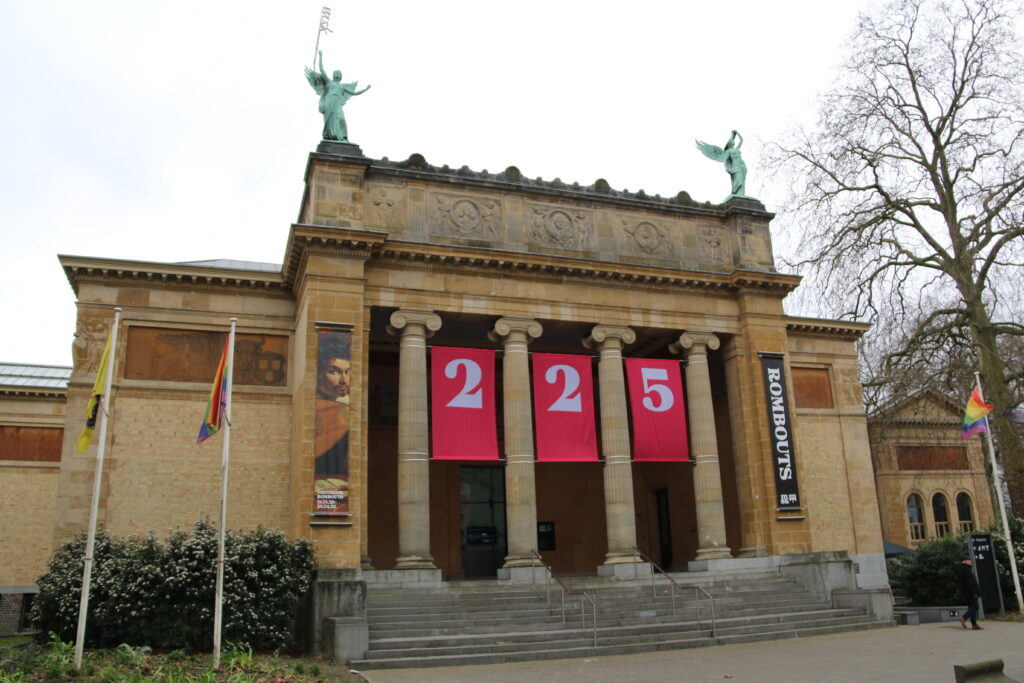
The photograph shows the north front on Jan Hoetplein. A broad flight of blue-stone steps leads up to a portico of four fluted Ionic columns in pale sandstone, set between two plain square piers. Above the columns runs a classical entablature and then a tall attic carved with a frieze of relief panels and medallions. On the two piers at the ends of the attic stand winged figures in copper, gone green with age: the allegories of ideal and of realist art, Ideal and Truth. When the picture was taken, red banners reading 2 2 5 hung between the columns and an exhibition banner on the right-hand pier.
On either side of the portico the walls are of yellow brick and blind: the galleries behind them are lit from the roof. Near the top of these blind walls runs the terracotta-coloured sgraffito frieze, visible in the photograph as a darker band, which the inventory describes as a history of art told like a strip cartoon. At the corners, carved shields held by female figures bear the names and dates of painters such as Rubens and Van Dyck. Under the portico the inner walls carry a coloured sgraffito frieze dated 1902, the floor is a mosaic of leafy tendrils and the ceiling is painted sky blue. Behind it a square hall leads into the large central gallery, with suites of rooms opening off it through doors set in the corners to leave the long walls free for paintings.
Practical information
- The museum is closed on Mondays and open the other six days; check the MSK site for current hours and exhibitions.
- According to Visit Gent, the restoration of panels of the Van Eyck brothers’ Ghent Altarpiece can be watched inside the museum, with the restorers at work from Tuesday to Friday.
- The portico, the frieze and the attic statues can be seen from Jan Hoetplein and the park paths at any time.
- The rear front on Hofbouwlaan has its own portal, with three figures for painting, sculpture and architecture above the door.
Getting there
Gent-Sint-Pieters, the city’s main railway station, is about a kilometre to the west; the walk leads through the Citadelpark and takes around fifteen minutes. From the historic centre around the Belfry and Saint Bavo’s Cathedral, the museum is just under two kilometres south.
Nearby
- S.M.A.K., the city museum of contemporary art, founded in 1999 and housed in a former casino building directly opposite the MSK on Jan Hoetplein.
- The Citadelpark itself, a landscape park of 1875 by H. Van Hulle with ponds, grottoes and waterfalls, protected since 1984.
- Kunstlaan 16-18, an Art Nouveau townhouse of 1901–1902, about 350 metres north.
- Gent-Sint-Pieters Station, about a kilometre west across the park.
Sources
- Inventaris Onroerend Erfgoed, Museum voor Schone Kunsten (Flanders Heritage Agency): foundation of the collection, the design and building history, the 1913 extension, the post-war restoration and the description of the building.
- Inventaris Onroerend Erfgoed, protection record Museum voor Schone Kunsten: protected monument by decree of 24 September 1996; and Citadelpark for the park and its 1984 protection.
- Visit Gent, Museum of Fine Arts in Ghent: Van Rysselberghe’s building in the Citadelpark and the Ghent Altarpiece restoration; and S.M.A.K. for the museum opposite.
- MSK Gent, Plan your visit: address and opening days.
- OpenStreetMap / Nominatim — position, returned as Museum voor Schone Kunsten, 1, Fernand Scribedreef, Gent.
Find it on the map
See this place and what’s around it →📷 Become a Cultural Heritage Online photographer
Share your photos of places: they stay published under your name as the author. The more they're seen, the more you get noticed — and soon a contest will reward the most appreciated photos.
Log in or sign up free to add a photo